
Every monsoon, I inspect cars that could have been saved. Not by a better mechanic, and not by a bigger policy — but by the owner simply not turning the key. In more than twenty-one years of handling motor claims, no single mistake has destroyed more engines, and more claims, than trying to restart a car that has taken in water. This article explains exactly what happens inside a hydrostatically locked engine, the precise clauses insurers use to say “no,” and — if your engine seizure claim has already been rejected — the practical, step-by-step way to fight back.
I will be blunt where competitors are vague, because vagueness is what costs owners lakhs.
What “engine seizure” and “hydrostatic lock” actually mean
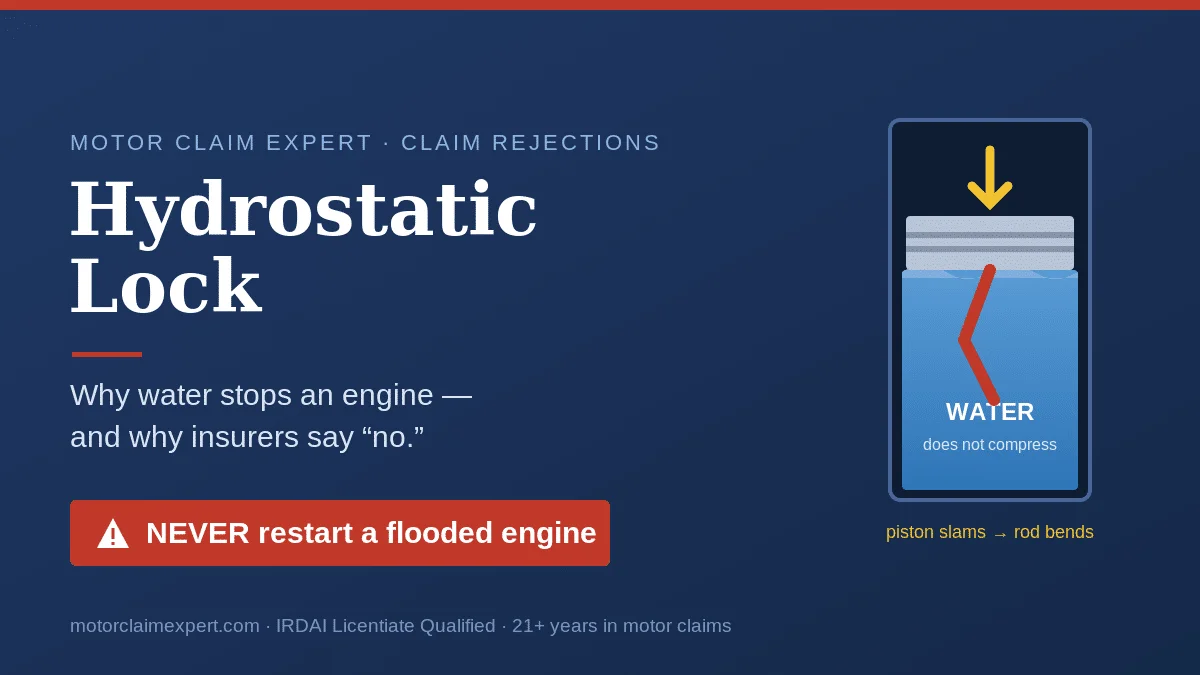
A petrol or diesel engine runs by compressing a mixture of air and fuel inside each cylinder. Air compresses easily. Water does not. When floodwater is drawn into the cylinders through the air intake, the piston rises on its compression stroke and slams into an incompressible column of water. Something has to give — and it is never the water. The connecting rod bends or snaps, the piston cracks, valves distort, and in severe cases the engine block itself fractures. The engine stops dead. This is hydrostatic lock (also called hydrolock), and the resulting damage is what we loosely call engine seizure.
Here is the part that decides your claim: most hydrostatic-lock damage does not happen while the car is sitting in water. It happens the moment the engine is cranked. A submerged engine that is never started often survives with a flush, an oil change and new filters. The same engine, started once, can need a full rebuild. That single distinction — passive water ingress versus damage caused by restarting — is the fault line along which insurers approve or reject.
Why insurers reject engine seizure claims: the three clauses that matter
A standard Indian comprehensive (or standalone own-damage) motor policy does cover flood, inundation and typhoon as insured perils. So owners are understandably confused when the car’s bodywork is paid for but the engine is not. The answer lies in three standard exclusions that appear in virtually every policy wording filed with the IRDAI.
1. Consequential loss
An insurer pays for damage caused directly by an insured peril. It does not pay for damage that is a consequence of a later action. If floodwater enters the engine and the owner then turns the key, the bent rods and cracked pistons are treated as a consequential loss arising from the act of starting — not from the flood itself. This is the single most-cited reason for rejection of hydrostatic-lock claims.
2. Mechanical or electrical breakdown
Policies exclude “mechanical or electrical breakdown, failures or breakages.” Insurers frequently argue that a seized engine is a mechanical failure rather than accidental external damage, especially where the water ingress cannot be clearly tied to a covered flood event.
3. Depreciation and wear & tear
Even where engine damage is admitted, the base policy pays only after deducting depreciation on parts (a percentage that rises with the car’s age). This is why a “covered” engine claim can still leave you with a large bill.
The one mistake that kills the claim (and the engine)
If you take away nothing else, take this: after your car has been in standing water, do not start it, and do not let a helpful bystander or tow operator start it. Not to “check if it works.” Not to move it ten feet. Not to charge the battery. Cranking a wet engine is the difference between a wash-and-flush and a rebuild — and, on the claims side, the difference between a payable flood claim and an excluded consequential loss.
I have seen owners who did everything right — comprehensive policy, valid documents, genuine flood — lose their engine claim because a well-meaning neighbour turned the key while they were arranging a tow. The insurer’s position writes itself: the damage was caused by starting, not by the flood.
The Engine Protection add-on: what it actually covers
The Engine Protection Cover (sold as Engine Protect, Engine Secure, Engine Shield, etc.) is a paid add-on that specifically closes the consequential-loss gap. Where the base policy stops, this add-on steps in. Filed wordings across major Indian insurers typically cover:
- Water ingression — damage from water entering the engine during flooding or waterlogging.
- Hydrostatic lock — engine damage caused when a wet engine is started.
- Lubricant / oil leakage — consequential damage from loss of engine or gearbox oil.
- Internal parts — pistons, connecting rods, crankshaft, cylinder head, and the gearbox / transmission assembly.
- Consumables — engine oil, gearbox oil and similar fluids replaced during the repair.
What it does not do is defeat depreciation entirely, and it comes with real limits worth knowing before you rely on it:
| Feature | Typical position (verify on your own wording) |
|---|---|
| Annual cost | Roughly ₹800–₹2,500 a year, or about 2% of the car’s market value/IDV. |
| Vehicle age limit | Usually not available for cars older than 5 years. Buy it while your car still qualifies. |
| Depreciation | Still applies to parts unless you also hold a Zero-Depreciation cover. |
| Negligence | Damage from repeatedly restarting a flooded engine can still be denied as gross negligence. |
Read that last row twice. The add-on covers hydrostatic lock from an accidental start, but insurers can still contest damage caused by an owner who cranked the engine again and again after it was obviously flooded. The add-on is protection, not a licence to be careless.
What a surveyor actually looks for after a flood claim
When your claim reaches a surveyor, the inspection is not a formality — it is where the claim is truly won or lost. Knowing what we examine lets you protect yourself before we arrive. On a suspected hydrostatic-lock claim, I look for:
- The waterline. Mud, silt and a tide-mark inside the cabin, on the seats, and in the door sills tell me how deep the water rose. A waterline above the air-intake height supports genuine ingress.
- The air filter and intake. A soaked, silt-caked air filter is direct evidence that water reached the intake tract.
- The engine oil. Milky, coffee-coloured oil means water and oil have emulsified. Whether that emulsion has been churned through the engine hints at whether it was run.
- Internal damage on teardown. Bent connecting rods and scoring are classic signatures of a cranked hydrolock, not passive standing water.
- Your documentation. Time-stamped photos of the water level, the tow, and the untouched ignition are, frankly, some of the most persuasive evidence an owner can hand me.
For a fuller picture of how the assessment and settlement work — and what to do if the surveyor’s number looks low — read our guides on how the motor claim process really works and what to do when a surveyor reduces your claim.
What to do the moment your car takes on water
These six steps, in order, protect both your engine and your claim. Save them on your phone before the next downpour.
- Do not start the engine. Turn the ignition fully off. If it is already off, leave it off. This is the whole ballgame.
- Disconnect the battery if you can do so safely — it prevents electrical shorts and stops anyone from cranking the engine.
- Do not push or roll-start the car through water, and do not let a tow operator start it.
- Photograph everything — the water level against the car, the surroundings, the interior waterline, and the untouched ignition — with timestamps on.
- Arrange a flatbed tow to an authorised/network garage. Note the tow details.
- Intimate your insurer immediately — same day. Get a claim/reference number and follow the documented claim process. Do not authorise any repair until the surveyor has inspected the car.
Your engine seizure claim was rejected. Now what?
A rejection letter is a position, not a verdict. If you did not restart the engine, or you hold an Engine Protection add-on, or the insurer’s reasoning is thin, you have a real case. Here is the escalation path, in order.
Step 1 — Get the rejection in writing and read the exact ground
Insist on a written repudiation stating the specific clause relied upon. “Consequential loss” and “mechanical breakdown” are the usual grounds. You cannot rebut a reason you have not been told.
Step 2 — Send a written representation to the insurer’s grievance cell
Reply point-by-point. Attach your flood photos, the tow record, the surveyor’s report (ask for a copy), your policy schedule showing any Engine Protection add-on, and a short factual account confirming the engine was not restarted. Keep it calm and evidence-led. Our template-driven guide on what to do when a claim is rejected walks through this letter in detail.
Step 3 — Escalate to IRDAI’s Bima Bharosa (IGMS)
If the insurer’s grievance cell does not resolve it within 15 days, lodge the complaint on IRDAI’s Bima Bharosa portal. This creates a regulated paper trail the insurer must respond to.
Step 4 — Approach the Insurance Ombudsman
For claims up to ₹50 lakh, the Insurance Ombudsman offers a free, policyholder-friendly forum. File within the prescribed time limit after the insurer’s final reply (or its failure to reply). Ombudsmen have repeatedly taken a practical view where insurers deny genuine flood damage on rigid technical grounds.
Step 5 — Consumer commission, if warranted
As a parallel or final route, the Consumer Protection framework lets you claim not just the repair cost but compensation for deficiency in service. Consumer forums have awarded against insurers where a denial was found arbitrary. This step is best taken with considered advice.
Three real-world scenarios
Scenario A — Comprehensive policy, no add-on, engine not started. Car sat in knee-deep water overnight; owner towed it without cranking. The flood damage to the interior and electricals is payable. The engine, flushed before any start, needed only cleaning, oil and filters — a modest, defensible claim.
Scenario B — Comprehensive policy, no add-on, engine restarted. Same flood, but the owner cranked it to “check.” Result: bent rods, hydrostatic lock, a rebuild — and a rejection citing consequential loss. Without the add-on, this is the hardest case to win, though a single accidental start (versus repeated cranking) is arguable.
Scenario C — Comprehensive policy with Engine Protection add-on. Water ingress and even an accidental hydrostatic lock fall squarely within the add-on. The claim is normally payable, subject to depreciation on parts unless a Zero-Depreciation cover is also in force. This is exactly the situation the add-on was designed for.
The bottom line
Engine seizure claims are not usually lost because of the flood. They are lost because of what happens after the flood — a turned key, a missing add-on, or a thin, undocumented file. Protect the engine by never starting it wet. Protect the claim by photographing everything and intimating immediately. And if you are already holding a rejection letter, remember that it is a starting position, not the last word — the evidence you gathered in the first ten minutes is what turns “no” into “paid.”
Have a rejected engine or flood claim you want a second opinion on? Motor Claim Expert exists to explain exactly these situations in plain language — start with our step-by-step claim process guide.
Frequently asked questions
Does car insurance cover engine seizure in India?
A standard comprehensive or own-damage policy covers flood as a peril, but it usually excludes engine seizure caused by water entering the engine — treating it as a consequential loss or mechanical breakdown. Engine damage is reliably covered only if you hold an Engine Protection add-on.
What is hydrostatic lock and why does it void my claim?
Hydrostatic lock happens when water is drawn into the cylinders. Because water cannot be compressed, the piston slams into it and bends or breaks internal parts. Insurers argue this damage results from the engine being started after flooding — a consequential loss — rather than directly from the flood, which is why base-policy claims are often rejected.
Is water damage to a car engine covered by comprehensive insurance?
Comprehensive insurance covers flood damage to the car in general (interior, electricals, bodywork), but internal engine damage from water ingress typically falls under the mechanical-breakdown and consequential-loss exclusions. The Engine Protection add-on is what specifically covers water ingression and hydrostatic lock.
Should I start my car after it has been through a flood?
No. Never start an engine that has been in standing water, and do not let anyone else start it. Cranking a wet engine is the single action that causes hydrostatic lock — and gives the insurer grounds to reject the claim. Switch the ignition off, disconnect the battery if safe, and arrange a flatbed tow.
What does the engine protection add-on cover?
It covers repair or replacement of the engine and its internal parts (pistons, connecting rods, crankshaft, cylinder head) and the gearbox when damage is caused by water ingression, lubricant/oil leakage, or hydrostatic lock. It also pays for consumables like engine and gearbox oil replaced during the repair.
Can I claim engine seizure without the engine protection add-on?
It is much harder. Without the add-on, you must show the engine damage was direct flood damage and not caused by restarting — for example, an engine that was never cranked after submersion. A single accidental start is arguable; repeated cranking is usually treated as gross negligence and denied.
My engine seizure claim was rejected — can I still fight it?
Yes. Get the written repudiation, send a point-by-point representation to the insurer’s grievance cell with your flood photos and tow record, then escalate to IRDAI’s Bima Bharosa portal and, if needed, the Insurance Ombudsman (for claims up to ₹50 lakh). Denials are frequently overturned where the owner did not restart the engine and can prove it.
How much does the engine protection add-on cost, and is it worth it?
Typically ₹800–₹2,500 a year, or roughly 2% of the car’s value. Against an engine rebuild that can run from ₹40,000 to well over ₹1.5 lakh, it is strongly worth it if you live in a flood-prone or waterlogging-prone city — but note it is usually unavailable once the car is more than five years old, so buy it early.
To avoid this exclusion in the first place, consider an Engine Protection add-on, which covers water-ingress and hydrostatic-lock engine damage.
Sources & official references
- Policy wording: engine damage from water ingress (hydrostatic lock) is treated as a consequential loss and is excluded from the standard own-damage section — it needs a separate Engine Protection add-on — under your IRDAI-approved motor policy wording.
- Legal principle: an exclusion must relate to the proximate cause of the loss, and the insurer carries the burden of establishing it.
- Escalation: the IRDAI Bima Bharosa (IGMS) grievance portal, the Insurance Ombudsman, and a consumer court under the Consumer Protection Act, 2019.


