
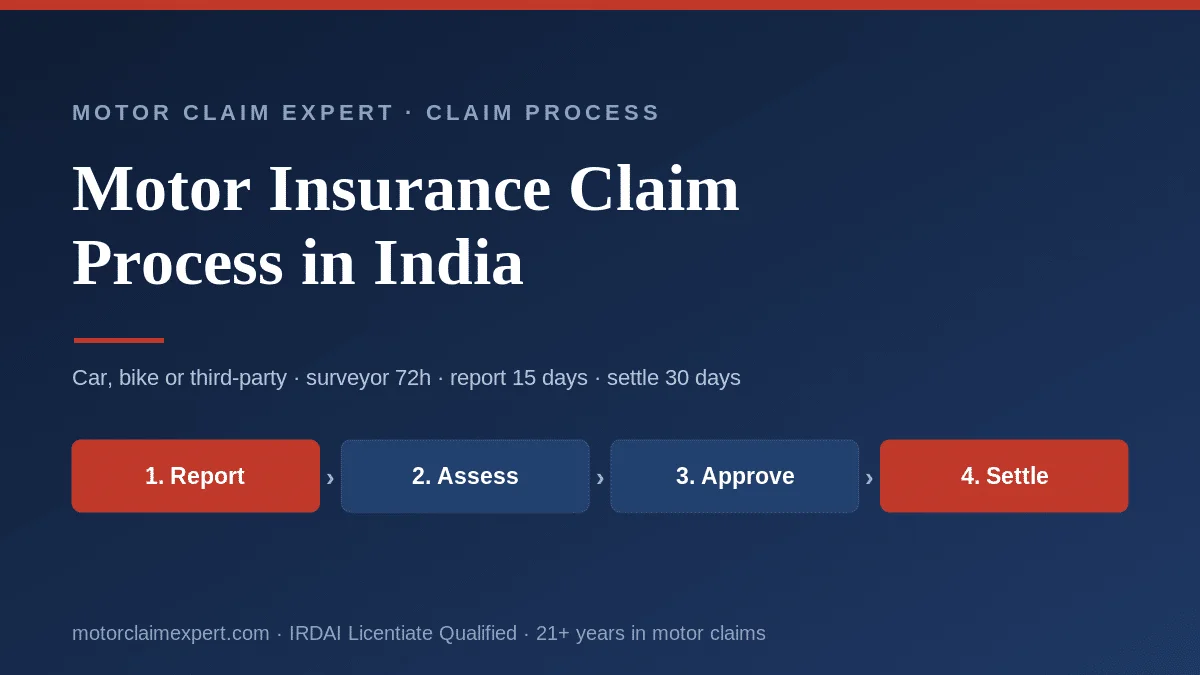
Filing a motor insurance claim in India is not complicated — but it is unforgiving of mistakes, and a claim can lose value or fail at any one of a handful of predictable points. This is the complete map: how a car or bike claim actually moves from the moment of loss to the money in hand, the regulatory clock that governs each stage, and the traps that quietly sink otherwise-valid claims. Treat this as your starting point; each stage links to a dedicated deep-dive guide when you need the detail.
The four stages of every motor claim
Whether it’s a scratched bumper, a stolen bike or a third-party accident, every motor claim follows the same skeleton. Understanding the whole arc before you start means you never miss the deadline that matters or hand the insurer a reason to cut the claim.
| Stage | What happens | The clock |
|---|---|---|
| 1. Report | Intimate the loss, get a claim number, file an FIR if needed | Immediately — the same day |
| 2. Assess | Surveyor inspects and values the damage | Surveyor appointed within 72 hours |
| 3. Approve | Estimate agreed; cashless or reimbursement chosen; repair done | Report due within 15 days |
| 4. Settle | Insurer pays after re-inspection | Within 30 days of the report |
For the own-damage path in full operational detail — every stage, deduction and mistake — follow our own-damage claim walkthrough. This page stays the overview; the walkthrough is the deep dive.
Which claim are you making? Car, bike, and third-party
“Motor claim” covers several very different situations, and the first thing to get right is which one you’re in — the process, documents and outcome differ.
Car own-damage (accident, fire, flood)
Damage to your car under comprehensive cover. Intimate, let the surveyor see the fresh damage before any repair, choose cashless or reimbursement, and settle after re-inspection. The full sequence is in the own-damage walkthrough; how the surveyor decides repair versus replacement often matters more to your payout than the headline estimate.
Theft
A theft claim needs an FIR, the keys, and a “no-trace” report from the police before the insurer settles on the IDV. The specifics are in our car theft claim guide.
Third-party (you caused injury or damage to others)
Third-party claims are handled by the Motor Accident Claims Tribunal, not the usual own-damage process — a separate track with its own rules for accident compensation.
Two-wheeler
A bike claim works like a car’s but the economics are tighter — a compulsory deductible, steep plastic depreciation, and a No-Claim Bonus that a small claim can wipe out. See the two-wheeler own-damage claim guide before you file for minor damage.
Cashless vs reimbursement — decide before repairs begin
Insider note: for a straightforward claim, cashless at a network garage almost always wins — you pay only your deductible, depreciation and non-payables, and the insurer settles the rest directly. Reimbursement gives workshop freedom but you fund the repair first. Make the choice before work starts. The full trade-off is in cashless vs reimbursement, and if cashless is refused at the counter, our guide on a cashless claim denied at the garage shows why and what to do.
The claim clock: your IRDAI timelines
Under the IRDAI (Protection of Policyholders’ Interests) Regulations, 2024, the timelines are not courtesies — they are rights. The surveyor is appointed within 72 hours of intimation, the survey report is due within 15 days (with a ₹500-per-day penalty to you if the surveyor drags), and the insurer must settle or reject within 30 days of the report. If it stalls past that without good reason, interest is payable and you can escalate.
Do these and most claims run clean: intimate the same day and note the claim number; photograph the fresh damage before anything is touched; keep your claim documents ready and fill the claim form correctly; never start repairs before the survey or written approval; and stay available for the re-inspection before you collect the vehicle.
Where claims silently fail: the rejection traps
Most rejected claims aren’t fraudulent — they trip on avoidable, well-known traps. Knowing them in advance is the single best insurance against a “claim rejected” letter.
| Trap | How to avoid it |
|---|---|
| Delayed intimation | Report immediately; a genuine claim shouldn’t fail on delay, but you avoid the fight entirely |
| Repairing before survey | Wait for approval — the commonest reason a claim is cut |
| No valid driving licence | Drive only with a valid licence for that vehicle class |
| Undeclared modification / CNG kit | Declare and endorse any fitment or modification |
| Misrepresentation at proposal | Disclose material facts honestly when you buy |
Each trap has its own dedicated guide: late intimation, an undeclared CNG/LPG kit, and misrepresentation or non-disclosure. And when a rejection isn’t valid, remember the governing rule: your policy is the contract, and an insurer can’t invent new conditions at claim time.
If the loss is severe: when repair costs approach the vehicle’s value, you may be looking at a write-off rather than a repair — read total loss and the 75% rule, and if the car is financed, total loss with a car loan explains who gets paid first and how to avoid still owing money on a wreck.
If your claim is delayed, cut or rejected
A worked example, end to end
The complete motor-claims library
Use this page as your hub. Whatever stage you’re at, the dedicated guide goes deeper:
Get the process right and a motor claim becomes a sequence, not a gamble: report at once, let the surveyor see the fresh loss, get written approval before any repair, hold the insurer to the 30-day clock, and escalate on the record if it stalls. Bookmark this page — it’s the map; the guides above are the terrain.
Frequently Asked Questions — Motor Insurance Claim Process
How do I file a motor insurance claim in India?
Intimate the loss to your insurer immediately and note the claim number, let the surveyor assess the damage before any repair, get the estimate approved, choose cashless or reimbursement, and settle after re-inspection. The insurer must decide within 30 days of the survey report.
How long does a motor insurance claim take?
Under IRDAI’s 2024 rules the surveyor is appointed within 72 hours of intimation, the survey report is due within 15 days, and the insurer must settle or reject the claim within 30 days of that report.
What documents are needed for a car insurance claim?
Typically the policy copy, RC, driving licence, a filled claim form, an FIR for theft or third-party cases, photographs of the damage and the repair estimate. See our documents checklist for the full list.
Is the claim process different for a two-wheeler?
The four stages are the same, but two-wheeler economics are tighter — a compulsory deductible, heavy depreciation on plastic parts, and a No-Claim Bonus you can lose on a small claim, so it is often better to self-fund minor damage.
Why do motor insurance claims get rejected?
Common traps are delayed intimation, repairing before the survey, driving without a valid licence, undeclared modifications or a CNG or LPG kit, and misrepresentation at the proposal stage. Most are avoidable.
What can I do if my claim is delayed or rejected?
Reply in writing quoting your policy clause, then escalate through the insurer’s grievance cell to IRDAI’s Bima Bharosa, the Insurance Ombudsman, or a consumer court.
Cashless or reimbursement — which is better?
Cashless at a network garage is simplest and needs the least cash upfront, as the insurer pays the garage directly. Reimbursement gives workshop freedom but you pay the full bill first and claim it back.
Sources & official references
- IRDAI (Protection of Policyholders’ Interests) Regulations, 2024 — claim turnaround times, surveyor appointment and settlement.
- Insurance Act, 1938 — Section 64UM (survey and loss assessment).
- IRDAI-approved Indian Motor policy wording — own-damage cover, deductibles, depreciation and exclusions.


