
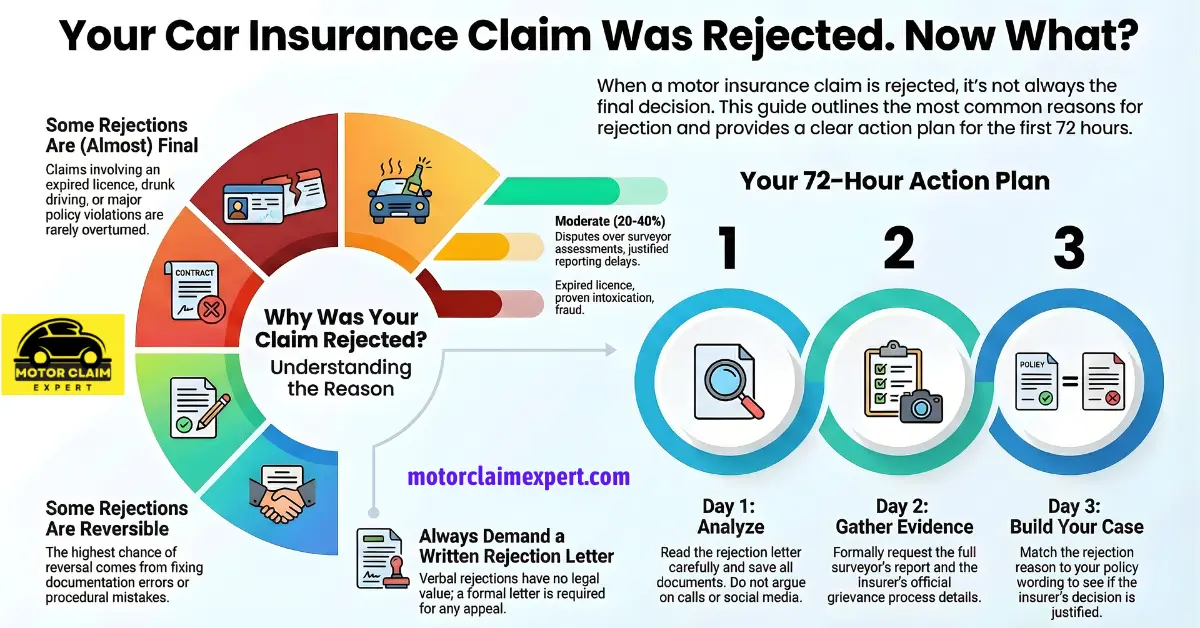
A rejected motor insurance claim is rarely the end of the road. Most rejections fall into a handful of recognised reasons, and many of them — especially the technical ones — can be challenged and overturned. The key is to stop reading the rejection as a verdict and start reading it as a claim the insurer now has to justify: it must cite the exact policy clause it is relying on and the evidence behind it. This page maps every common reason a motor claim is rejected to what it actually means and whether it usually stands, then walks through the escalation ladder — from replying to the repudiation letter all the way to the consumer court.
The common reasons a motor claim is rejected
| Reason given | What it means | Usually challengeable? |
|---|---|---|
| Late intimation | You reported the claim after a delay | Often — delay alone rarely defeats a genuine claim |
| Misrepresentation / non-disclosure | A material fact was wrong or omitted at proposal | Depends — only a material fact counts |
| Drunk driving / no valid licence | Driving under the influence or unlicensed | Own-damage: hard if proven; third party protected |
| Undeclared CNG/LPG kit | A fitted kit was not declared to the insurer | Often part-payable if the kit didn’t cause the loss |
| Non-cooperation / missing statement | The insurer says it couldn’t verify the claim | Often — the failure must be material |
| Consequential loss (engine/flood) | Damage treated as a consequence, not the accident | Depends on the cause and your add-ons |
First, get the repudiation in writing
Before anything else, obtain the rejection in writing, stating the exact policy clause relied on and the evidence behind it. You cannot challenge a ground you have not seen stated, and a rejection that will not commit to a specific clause is already on weak footing. Under the IRDAI’s policyholder-protection framework, the insurer owes you clear reasons — and the burden of proving a breach that justifies repudiation sits largely with the insurer, not with you.
How insurers decide to reject — and what to check first
In practice, a repudiation is built on two things: a policy condition or exclusion, and the evidence a surveyor or investigator gathered. When a claim lands on the “reject” side, it is usually because the file shows a breach of a condition (a late intimation, an undeclared modification, an exclusion such as driving under the influence) — but the strength of that decision depends entirely on whether the breach was fundamental and connected to the loss. That is the first thing to check. Ask two questions of any rejection: does the cited clause actually apply to my facts, and did the alleged breach have any real bearing on how the loss occurred? A technical breach with no connection to the damage — an expired-but-renewable licence, a kit that played no part in an accident, a delay where the event was still verifiable — is exactly the kind of ground consumer forums decline to let defeat a genuine claim. Where the breach is real and central, the rejection is far more likely to stand. Reading your own rejection through that lens tells you quickly whether to fight it, negotiate a part-settlement, or accept it.
The escalation ladder
- Reply to the repudiation letter — a reasoned response citing the clause, your facts and your evidence. Our template guide shows how.
- The insurer’s grievance cell, then the IRDAI Bima Bharosa (IGMS) portal if it is unhelpful.
- The Insurance Ombudsman — free, for individual policyholders, for disputes up to the prescribed limit.
- A consumer court — where a wrongful rejection is treated as a deficiency in service, with interest, compensation and costs.
- Don’t overlook the middle path: where a breach exists but did not cause the loss, a non-standard (part) settlement — often around 75% — may be the right outcome rather than all-or-nothing.
When a rejection is likely to stand — and when it isn’t
The single best predictor is the fundamental-versus-technical distinction. A rejection tends to stand where the breach was fundamental and connected to the loss — driving drunk into the accident, a genuinely material misrepresentation, a never-licensed driver. It tends to fall where the breach was technical or unconnected — a short delay in intimation on an otherwise verifiable claim, an undeclared accessory that had nothing to do with the damage, a missing document the insurer could work around. If your rejection is of the second kind, it is well worth pursuing.
Frequently Asked Questions — Rejected Motor Insurance Claims
What are the most common reasons a car insurance claim is rejected?
Late intimation, misrepresentation or non-disclosure of a material fact, driving under the influence or without a valid licence, an undeclared CNG/LPG kit, non-cooperation, and consequential-loss exclusions such as engine damage from water ingress. Each has its own detailed guide.
Can a rejected motor insurance claim be reopened?
Often, yes. Get the rejection in writing, check whether the cited clause actually applies and whether the alleged breach was connected to the loss, then reply and escalate. Technical rejections unconnected to the loss are frequently overturned.
What is the first thing to do after a claim is rejected?
Obtain the repudiation in writing, stating the exact policy clause and the evidence. You cannot challenge a ground you have not seen, and a vague rejection is itself a weakness.
Where can I complain about a wrongly rejected claim?
Reply to the repudiation, then approach the insurer’s grievance cell, the IRDAI Bima Bharosa portal, the Insurance Ombudsman, and finally a consumer court, which treats a wrongful rejection as a deficiency in service.
When is a rejection likely to be upheld?
When the breach was fundamental and connected to the loss — for example driving drunk into the accident, a material misrepresentation, or a driver who never held a licence. Technical breaches unconnected to the damage are far weaker grounds.
Can I get part of my claim if there was a minor breach?
Sometimes. Where a breach exists but did not cause or worsen the loss, courts have allowed a non-standard settlement — commonly around 75% of the admissible amount — rather than a full rejection.
Who has to prove the rejection is justified?
Largely the insurer. It must show that the cited condition or exclusion applies and, for many grounds, that the breach was material — not merely that a rule was technically broken.
Sources & official references
- Regulation: the insurer’s duty to give clear reasons and settle genuine claims sits within the IRDAI (Protection of Policyholders’ Interests) framework.
- Supreme Court judgment: Om Prakash v. Reliance General Insurance Co. Ltd. (Supreme Court, 2017) — a genuine claim should not be rejected on hyper-technical grounds.
- Law: a wrongful rejection is a deficiency in service under the Consumer Protection Act, 2019; unresolved grievances may go to the Insurance Ombudsman (Insurance Ombudsman Rules, 2017, amended 2021).


