
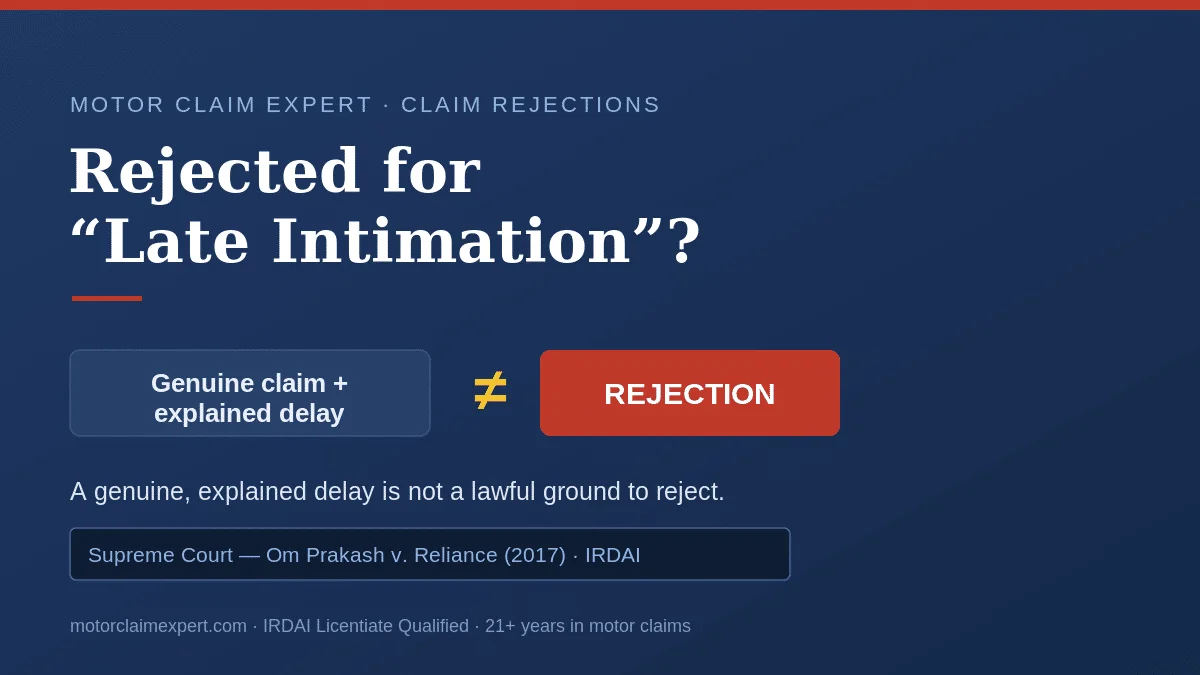
“Your claim is rejected because you informed us late.” Few repudiation lines feel as unfair as this one — the damage was real, the policy was valid, and yet a few days’ delay in picking up the phone has apparently cost you everything. Here is what most owners are never told: delay in intimation, on its own, is rarely a lawful reason to reject a genuine claim. Both the insurance regulator and the Supreme Court of India have said so in plain terms. In more than twenty-one years of handling motor claims, I have seen many of these rejections overturned — not by pleading, but by quoting the right authority back to the insurer. This article shows you how.
Why insurers reject claims for “late intimation”
Every motor policy carries a condition — often Condition 1 — requiring you to give the insurer notice of any accident, loss or theft “immediately” or “as soon as reasonably possible.” When intimation comes days or weeks later, insurers lean on this clause to repudiate, arguing you breached a condition of the contract.
On paper it looks watertight. In practice, insurers have often used it as a technical shortcut — a way to close a genuine, otherwise-payable file without engaging with its merits. That mechanical use of the clause is exactly what the regulator and the courts have pushed back against.
What the law actually says
Two authorities matter here, and they point the same way.
IRDAI: don’t reject genuine claims mechanically
The insurance regulator, the IRDAI, has directed insurers that genuine claims should not be repudiated in a mechanical fashion merely because intimation was delayed. Its guidance on delay in claim intimation makes the point that contractual time-limits should not defeat a genuine claim where the delay is explained by the circumstances, and that repudiating claims on purely technical grounds erodes policyholders’ confidence in insurance. The regulator’s expectation is that a rejection must rest on sound logic and valid grounds — not on the calendar alone.
The Supreme Court: delay, if explained, is not a shelter
The position was settled by the Supreme Court of India in Om Prakash v. Reliance General Insurance Co. Ltd. (2017). There, a truck was stolen, an FIR was lodged the very next day, but the formal claim to the insurer came months later — and the insurer repudiated it for breach of the “immediate notice” condition, even though its own investigator had confirmed the theft was genuine.
The Court held that a genuine claim, already verified as correct, cannot be rejected solely on the ground of delayed intimation if the reason for the delay is satisfactorily explained. It warned that rejecting genuine claims on purely technical grounds, in a mechanical manner, causes policyholders to lose confidence in the insurance industry and fuels needless litigation. That judgment is the anchor you cite when a delayed-intimation rejection lands on your desk.
Where a delay can still hurt you
This is where honest guidance matters, because the protection is not unconditional. A delay can still damage your claim when:
- The delay is unexplained. The law protects a delay that is satisfactorily explained — hospitalisation, being stranded, genuine ignorance of the requirement. “I forgot” is not an explanation.
- The delay prevented verification. If waiting made it impossible to establish how the damage or theft occurred — the vehicle moved, repaired, or evidence lost — the insurer has a real, not merely technical, objection.
- A theft was not reported to the police promptly. In theft claims, the FIR is the backbone of the case. In Om Prakash, the FIR was filed the next day, which is precisely what made the later insurance intimation forgivable. A late FIR is far harder to defend than late insurance intimation.
- The delay increased the loss. If prompt notice would have limited the damage and your delay made it worse, the insurer may resist that additional portion.
So the honest position is not “delay never matters.” It is: delay alone, for a genuine and still-verifiable claim, is not a lawful ground for outright rejection.
Theft vs accident: intimation works differently
The two situations are not the same, and treating them alike is a common mistake.
| Theft claim | Accident / own-damage claim | |
|---|---|---|
| First priority | File the FIR at once — police first, insurer next | Secure the scene, photograph damage, then intimate |
| What proves the loss | The FIR and police investigation | The surveyor’s inspection of the damaged vehicle |
| Effect of late insurer intimation | Forgivable if the FIR was prompt and theft is verified | Forgivable if the damage is still inspectable and explained |
For how the FIR fits into the wider claim, see our guide on the FIR in a motor insurance claim.
How to explain a delay credibly
The single most important thing you can do is convert “I was late” into “here is exactly why, and here is proof.” Credible, documented explanations I have seen accepted include:
- Medical: you or the driver were hospitalised after the accident — attach discharge summaries.
- Stranded or remote: the incident happened far from home or network — a police diary entry or travel record helps.
- Genuine ignorance: a first-time owner unaware of the intimation window — less strong, but combined with a prompt FIR and honest conduct, still workable.
- Waiting on the police: you prioritised the FIR and formalities before the insurer — reasonable, and exactly the sequence Om Prakash endorsed.
Two real-world scenarios
Scenario A — Theft, insurer told late. A car is stolen overnight; the owner files the FIR the next morning but, chasing the police for two weeks, formally intimates the insurer only afterwards. The insurer cites the “immediate notice” clause. Because the FIR was prompt and the theft is verified, this is the Om Prakash situation almost exactly — the delay is explained and the loss is genuine, so the rejection should not survive a proper representation.
Scenario B — Accident, owner hospitalised. A driver is injured in a highway crash and spends ten days in hospital before intimating the insurer. The damaged vehicle is intact and inspectable. With discharge papers explaining the delay and a surveyor able to assess the damage, the loss is both genuine and verifiable — a delayed-intimation rejection here is a technical objection, not a real one.
Where it goes the other way: a minor dent reported six weeks later, after the car has already been driven and partly repaired, with no explanation offered. The insurer now genuinely cannot verify how or when the damage occurred — and here the delay is a real problem, not a technicality.
How to overturn a late-intimation rejection
- Get the repudiation in writing stating the exact condition relied on (usually the “immediate notice” clause), and obtain the surveyor’s report.
- Send a written representation to the insurer’s grievance cell. State plainly that the claim is genuine and verifiable, explain the delay with documents, and cite Om Prakash v. Reliance General Insurance (Supreme Court, 2017) and the IRDAI’s direction against mechanical, technical rejections.
- Escalate to IRDAI’s Bima Bharosa portal if the grievance cell does not resolve it, creating a regulated record.
- Approach the Insurance Ombudsman for claims up to ₹50 lakh — a free, policyholder-friendly forum that regularly applies the Om Prakash principle.
- Consumer commission as a parallel or final route, where deficiency-in-service and compensation can also be claimed.
The overall sequence mirrors any disputed claim — our guide on what to do when a claim is rejected walks through the representation letter, and the wider journey is in the motor claim process guide.
Myth vs reality
| Myth | Reality |
|---|---|
| “I informed them late, so the claim is automatically void.” | A genuine, verifiable claim cannot be rejected solely for delayed intimation if the delay is satisfactorily explained. |
| “Late intimation and a late FIR are the same thing.” | They are not. A prompt FIR can rescue a late insurer intimation; a late FIR in a theft case is far harder to defend. |
| “There is nothing I can do once it’s rejected.” | A repudiation is a starting position. The IRDAI direction and Om Prakash have overturned many delayed-intimation rejections. |
The bottom line
A “late intimation” rejection is one of the most beatable repudiations in motor insurance — provided your claim is genuine, the loss can still be verified, and you can explain the delay. The law does not reward carelessness, so intimate as early as you reasonably can and file the FIR at once in a theft. But if you are already holding a rejection that rests on nothing more than a few late days, do not accept it at face value. Explain the delay, attach your proof, and quote the regulator and the Supreme Court back to the insurer. Very often, that is enough.
Fighting a rejection? Read this alongside our guides to acting on a rejected claim and whether a claim can be rejected without a driver’s statement.
Frequently asked questions
The intimation date you write on the claim form is checked against when the loss occurred — another reason to report early.
A late or missing police record hurts as much as late intimation — see FIR vs panchnama for which your claim needs.
Delay is one ground; intoxication and licence are others. See can your claim be rejected for drunk driving or no valid licence and what the law actually requires.
Can a car insurance claim be rejected for late intimation in India?
Not on that ground alone, if the claim is genuine and still verifiable and the delay is satisfactorily explained. The IRDAI has directed insurers not to reject genuine claims mechanically for delayed intimation, and the Supreme Court held the same in Om Prakash v. Reliance General Insurance (2017).
What did the Supreme Court say about delayed intimation?
In Om Prakash v. Reliance General Insurance Co. Ltd. (2017), the Court held that a genuine claim already verified as correct cannot be rejected solely because intimation was delayed, if the delay is satisfactorily explained. It warned that rejecting genuine claims on purely technical grounds erodes policyholder confidence.
How late is too late to inform the insurer?
There is no magic number. What matters is whether the delay is explained and whether the loss can still be verified. A short, well-explained delay on a genuine, inspectable claim is usually defensible; a long, unexplained delay that prevents verification is not. Always intimate as early as you reasonably can.
Does a late FIR also void a theft claim?
A late FIR is far harder to defend than late insurer intimation. In theft claims the FIR is the backbone of the case — in Om Prakash the FIR was filed the next day, which is what made the later insurance intimation forgivable. Report a theft to the police at once.
How do I explain a delay in intimation to the insurer?
Convert ‘I was late’ into a documented reason: hospitalisation (discharge summaries), being stranded or in a remote area (police diary entry, travel record), or prioritising the FIR and formalities first. A credible, evidenced explanation is what the law protects.
What should I do if my claim was rejected only for late intimation?
Get the written repudiation and surveyor’s report, then send a representation to the grievance cell stating the claim is genuine and verifiable, explaining the delay with proof, and citing Om Prakash (2017) and the IRDAI direction against technical rejections. Escalate to Bima Bharosa and the Insurance Ombudsman if needed.
Does IRDAI protect policyholders from technical claim rejections?
Yes. IRDAI guidance requires that claim rejections rest on sound logic and valid grounds, and that contractual time-limits should not defeat a genuine claim where the delay is explained. Rejecting genuine claims purely on technical grounds runs against the regulator’s stated expectations.
Can the insurance ombudsman help with a late-intimation rejection?
Yes. The Insurance Ombudsman handles motor claim disputes up to Rs 50 lakh, free of cost, and regularly applies the Om Prakash principle that a genuine, explained-delay claim should not be rejected on technical grounds. It is a strong, low-cost route to challenge such a repudiation.
Sources & official references
- Supreme Court judgment: Om Prakash v. Reliance General Insurance Co. Ltd. (Supreme Court, 2017) — a delay in intimating a claim, on its own, is not a valid ground to reject a genuine claim where the insured acted bona fide (a stolen truck reported to the police promptly).
- IRDAI regulation: IRDAI (Protection of Policyholders’ Interests, Operations and Allied Matters of Insurers) Regulations, 2024 and the Master Circular on Protection of Policyholders’ Interests, 2024 — insurers should not reject genuine claims on hyper-technical grounds.
- Escalation: the IRDAI Bima Bharosa (IGMS) grievance portal; a wrongful rejection is a deficiency in service actionable under the Consumer Protection Act, 2019.


