
A total loss is the quietest way an insurer can underpay you. There is no rejection letter to fight, no repudiation clause to argue — just a settlement figure that feels low and a discharge voucher waiting for your signature. In more than twenty-one years of handling motor claims, I have watched more money slip away at this stage than at almost any other, because owners do not understand how the number is built. This article explains exactly how a total loss and a constructive total loss are decided in India, how your payout is calculated down to the last deduction, and where — precisely — you can push back.
Total loss vs constructive total loss: they are not the same thing
People use “total loss” loosely. Insurers do not. Two distinct situations sit under the term, and the difference decides how your claim is handled.
An actual total loss is a vehicle that no longer meaningfully exists as a vehicle — burnt to the shell, crushed, swept away, or stolen and never recovered. Repair is not on the table because there is nothing to repair.
A constructive total loss (CTL) is the far more common and far more disputed case. The car can be repaired — but it is not worth repairing. When the cost of putting it back on the road climbs too high relative to what the car is insured for, the insurer stops treating it as a repair claim and “writes it off” instead. The car is physically repairable; economically, it is finished.
The 75% rule: how a constructive total loss is actually decided
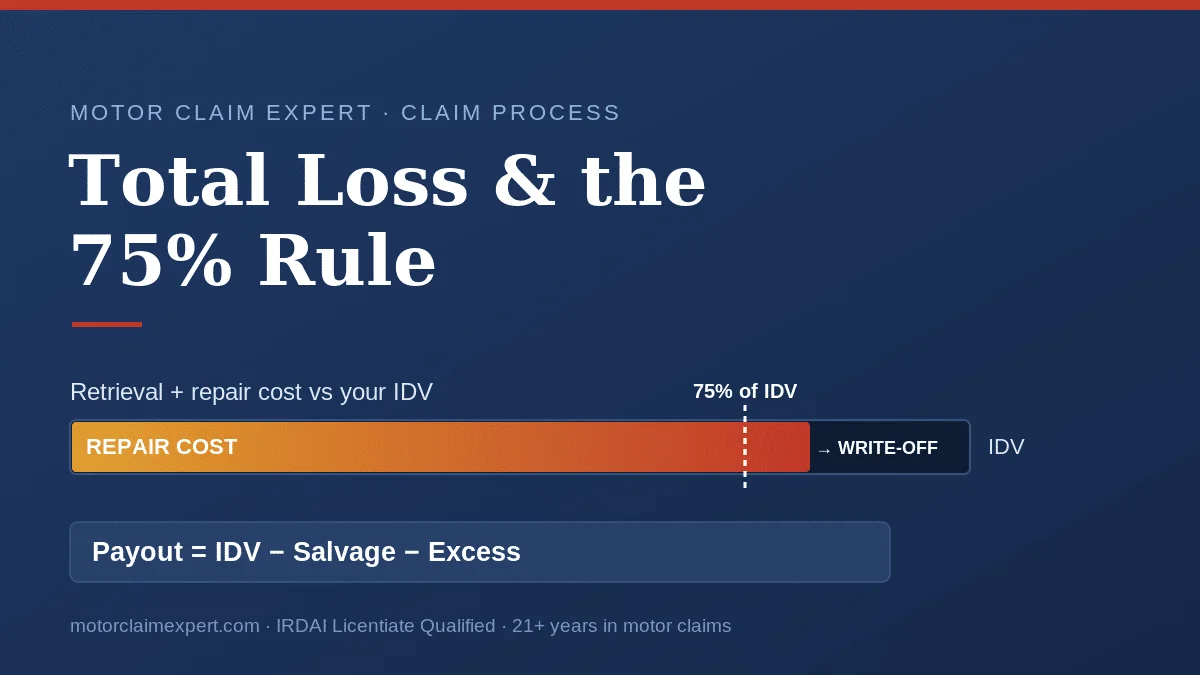
Here is the line that governs it. Under the standard Indian motor policy wording, a vehicle is treated as a constructive total loss when the aggregate cost of retrieval and repair — subject to the terms of the policy — exceeds 75% of the Insured’s Declared Value (IDV).
Read that carefully, because two words carry weight:
- “Retrieval and repair.” It is not just the repair estimate. The cost of recovering and towing the wreck is added in. A car sitting at the bottom of a flooded underpass can cross the threshold faster than its dented panels alone would suggest.
- “75% of IDV.” The benchmark is not the car’s showroom price or even its market value — it is the IDV printed on your policy schedule. If your IDV is set low, the 75% ceiling is low, and your car tips into “write-off” on a smaller repair bill.
This is why the same accident can be a repair for one owner and a total loss for another. It is arithmetic against the IDV — not a judgement about how bad the car looks.
What you actually get paid
Once a claim is settled as a total loss or CTL, the policy is clear about the ceiling: the company’s liability shall not exceed the IDV of the vehicle (including fitted accessories) as shown in the schedule, less the value of the wreck. In plain terms:
Three things decide whether that number is fair:
- The IDV — the single biggest lever, and one you set months earlier at renewal (more on this below).
- The salvage / wreck value — what the damaged car is deemed to be worth as scrap or for parts. This is deducted only if you keep the wreck. It is also where a great deal of money is quietly lost.
- The compulsory excess (and any voluntary deductible you chose) — a fixed amount the policy always deducts.
Note what is not in that formula: part-by-part depreciation. In a repair claim, depreciation is deducted on each replaced part. In a total loss, you are paid on the IDV basis instead — the depreciation is already baked into the IDV itself. If a surveyor appears to be stacking both, that is worth questioning.
IDV is the whole game — and you set it before the accident
Because every total-loss payout is anchored to the IDV, the most important decision you make about a write-off happens long before the crash: the IDV you agree to at each renewal.
IDV is the manufacturer’s listed selling price of your car, reduced by a fixed depreciation percentage for age, plus the value of any fitted accessories (also depreciated). The standard depreciation grid insurers use to arrive at IDV is:
| Age of vehicle | Depreciation for IDV |
|---|---|
| Not exceeding 6 months | 5% |
| 6 months to 1 year | 15% |
| 1 to 2 years | 20% |
| 2 to 3 years | 30% |
| 3 to 4 years | 40% |
| 4 to 5 years | 50% |
| Over 5 years | Mutually agreed between insurer and owner |
Insurers usually allow you to adjust the IDV within a band (commonly around 10–15%) at renewal. Owners chasing the lowest premium quietly accept the lowest IDV offered — and then feel cheated when a write-off pays out that same low figure. The IDV is not a formality on the renewal screen; it is the exact cheque you will receive if the car is totalled. Set it honestly to what the car is worth to you, not to shave a few hundred rupees off the premium.
For older cars beyond five years, IDV is “mutually agreed” — which means it is negotiable, and worth negotiating, at renewal rather than after the accident.
The salvage trap: keep the wreck or surrender it?
After a write-off you face a choice that materially changes your cheque, and it is rarely explained well.
Option 1 — Surrender the wreck to the insurer. The insurer takes ownership of the salvage and pays you the full IDV (less your compulsory excess). You walk away with the maximum settlement but no car.
Option 2 — Retain the wreck yourself. You keep the damaged vehicle, and the insurer deducts the agreed salvage value from your payout. This only makes sense if the wreck is genuinely worth more to you than the deduction — for parts, or a rebuild you understand the legal implications of.
Here is where owners lose money: the salvage value is negotiable, and a higher salvage figure means a lower cheque for you. An inflated salvage assessment can quietly cut a settlement by a meaningful margin. If you are surrendering the wreck, salvage value should not reduce your payout at all — so scrutinise any settlement that both takes your car and deducts salvage.
What a surveyor actually does in a total-loss assessment
Knowing how the assessment is built lets you follow the money. On a suspected total loss, the surveyor:
- Prepares a repair estimate — a full parts-and-labour cost to restore the vehicle, including hidden structural damage found on inspection.
- Adds retrieval/towing cost to that estimate.
- Compares the total against 75% of your IDV to decide repair vs CTL.
- Assesses the salvage value of the wreck if you intend to retain it.
- Confirms the IDV and deductions from your policy schedule to arrive at the net figure.
Every one of those steps is a document you are entitled to see. If the surveyor’s reduced figure looks wrong, the remedy is the same as in any assessment dispute — ask for the report and challenge the specific line. Our guide on what to do when a surveyor reduces your claim walks through that, and the overall sequence is in our motor claim process guide.
The loose ends after a write-off: NCB, RTO and your loan
A total-loss settlement is not the end of the paperwork. Three things need handling:
Your No Claim Bonus. NCB is earned by you, not tied to the car. Even though you have made a claim, the earned NCB from previous claim-free years can be carried forward to the policy on your next car via an NCB retention letter — a genuinely valuable entitlement owners forget in the chaos. See our guide to how NCB works.
RTO and registration. When the insurer takes the salvage, ownership and registration have to be dealt with correctly — typically transfer of the wreck to the insurer/salvage buyer and the paperwork that goes with it. Keep this clean; a registration that is not properly closed can create problems later.
A car on loan (hypothecation). If the vehicle is financed, the settlement is usually paid with the financier’s interest noted, and the loan account has to be squared. This is exactly why the IDV should never be under-set on a financed car — a low IDV can leave you still owing the bank after the insurer has paid.
If your total-loss settlement looks low: what to do
A settlement offer is not a final verdict, and you do not have to sign the discharge voucher on the spot.
- Get the survey report and the calculation in writing — the repair estimate, the IDV used, the salvage value, and every deduction. You cannot challenge a number you have not seen.
- Check the IDV against your schedule — it must match the IDV you paid premium on, not a lower figure.
- Question the salvage value — especially if the insurer is also taking the wreck. This is the most disputable number in the file.
- Do not sign the discharge voucher “in full and final settlement” if you disagree — or sign it explicitly “under protest,” preserving your right to pursue the balance. Our guide on the discharge voucher trap explains why this matters.
- Escalate if needed — the insurer’s grievance cell, then IRDAI’s Bima Bharosa portal, and the Insurance Ombudsman for claims up to ₹50 lakh. Under IRDAI’s policyholder-protection rules, a claim should be settled within about 30 days of receiving the required documents.
The bottom line
A total loss is decided by arithmetic, not sympathy: retrieval-plus-repair against 75% of your IDV, then IDV minus salvage minus excess. The owners who are treated fairly are the ones who set their IDV honestly at renewal, who read the surveyor’s calculation instead of trusting the headline figure, who challenge the salvage value, and who never sign a discharge voucher they disagree with. The car may be finished — your claim doesn’t have to be.
Facing a write-off or a total-loss figure that feels low? Start with our step-by-step claim process guide, and if a flood is involved, read why engine and flood claims are treated differently.
Frequently asked questions
A total-loss settlement needs a specific set of transfer documents — see the claim documents checklist for the full list.
A stolen car is settled like a total loss but has its own procedure — see the full car theft insurance claim process, from FIR to IDV settlement.
Total-loss and theft transfer ownership to the insurer — which is why a recovered stolen car is theirs, not yours, after the payout.
If a flooded car is written off, its salvage can quietly re-enter the used market. If you are buying second-hand, learn how to spot a flood-damaged used car and the insurance and claim risks it carries.
One reason a total-loss cheque looks smaller than expected is the salvage deduction. See why your total-loss payout is IDV minus the wreck’s salvage value, and the surrender-vs-retain choice.
A write-off also affects your discount. See whether you keep your No-Claim Bonus after a total loss and how to carry it to a new car.
What is the 75% rule in car insurance total loss?
A car is treated as a constructive total loss when the combined cost of retrieving and repairing it exceeds 75% of its Insured Declared Value (IDV). Below that threshold the insurer usually repairs the car; above it, the insurer writes it off and settles on the IDV basis instead.
What is the difference between total loss and constructive total loss?
An actual total loss means the vehicle no longer exists as a vehicle — burnt, crushed, washed away, or stolen and not recovered. A constructive total loss means the car can be repaired but it is not economical to do so, because repair plus retrieval costs cross about 75% of the IDV.
How is a total loss settlement calculated in India?
The settlement is the IDV shown on your policy schedule, minus the salvage (wreck) value if you keep the car, minus the compulsory excess and any unpaid premium. Part-by-part depreciation is not applied separately, because depreciation is already built into the IDV.
Will I get the full IDV if my car is a total loss?
You receive the full IDV (less your compulsory excess) only if you surrender the wreck to the insurer. If you keep the wreck, the agreed salvage value is deducted from the IDV. The IDV is the ceiling of the insurer’s liability.
Should I keep the salvage or let the insurer take it?
Surrendering the wreck usually gets you the full IDV less excess and is the cleaner, higher payout. Retaining the wreck only makes sense if it is genuinely worth more to you than the salvage deduction, and you understand the registration and roadworthiness implications. If the insurer both takes the car and deducts salvage, question it.
Does depreciation apply to a total loss claim?
Not part-by-part, as it would in a repair claim. A total loss is settled on the IDV, which already reflects age-based depreciation. If a surveyor appears to deduct part depreciation on top of the IDV, ask for the calculation in writing.
Can I keep my No Claim Bonus after a total loss?
Yes. NCB belongs to you, not the car. Even after a total-loss claim, the NCB earned in previous claim-free years can be carried forward to your next car’s policy using an NCB retention letter. Ask your insurer for it before the policy closes.
What can I do if my total loss settlement is too low?
Get the survey report and full calculation in writing, check the IDV matches your schedule, and question the salvage value. Do not sign the discharge voucher as ‘full and final’ if you disagree — sign ‘under protest’ or not at all. Escalate to the insurer’s grievance cell, IRDAI’s Bima Bharosa portal, and the Insurance Ombudsman for claims up to Rs 50 lakh.


