
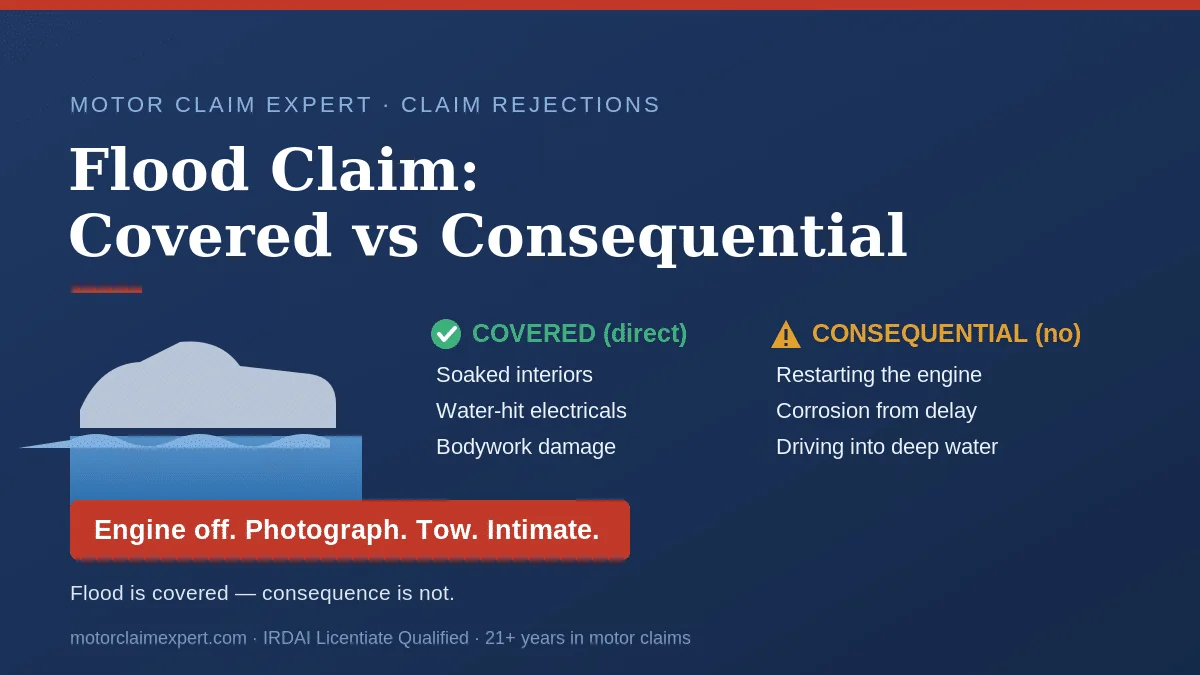
After a flood, the part of your claim you lose is rarely the flood damage itself — it is the damage you accidentally turned into a “consequential loss.” Comprehensive insurance covers flooding. Yet every monsoon I see genuinely flooded cars underpaid or rejected, because the owner did something after the water that moved the damage across an invisible line the insurer watches closely. In more than twenty-one years of handling motor claims, I have learned that winning a flood claim is mostly about understanding that one line: accidental (direct) damage is paid; consequential damage is not. This guide shows you exactly where the line sits and how to stay on the right side of it.
First, the good news: flood is a covered peril
A comprehensive or standalone own-damage motor policy covers your vehicle against flood, inundation and typhoon. (A third-party-only policy does not — it never covers damage to your own car.) Where the cover applies, direct flood damage across the vehicle is payable, depending on how high the water rose and how long the car was submerged:
- Interiors and upholstery soaked by floodwater.
- Electricals and electronics — wiring, control units, sensors, infotainment — damaged by water contact.
- Brakes, transmission and mechanical parts directly damaged by the flood.
- Bodywork and exterior damage from the water and debris.
So the flood itself is not the problem. The problem is everything that is not counted as direct flood damage.
The line that decides everything: accidental vs consequential
Insurers split flood damage into two buckets, and only one is paid.
| Accidental / direct damage (paid) | Consequential damage (excluded) |
|---|---|
| Caused directly by the flood itself | Caused by an action or inaction after the flood |
| Soaked interiors, water-damaged electricals, bodywork | Engine wrecked by restarting a wet car (hydrostatic lock) |
| Damage the surveyor can tie to the water event | Rust and corrosion that set in from delay in acting |
Two words in the policy do the work here: a standard motor policy excludes consequential loss and mechanical or electrical breakdown, and it deducts depreciation and wear. Almost every underpaid flood claim traces back to one of those three exclusions.
The actions that convert a covered claim into an excluded one
These are the flood claim-killers — each one moves damage from the “paid” column to the “excluded” column:
- Restarting the engine. The single most expensive mistake. Cranking a wet engine causes hydrostatic lock, which insurers treat as consequential, not flood, damage. This is important enough to have its own guide — see engine seizure and hydrostatic lock.
- Deliberately driving into deep water. Getting caught in a rising flood is bad luck; knowingly driving through an obviously waterlogged stretch can be treated as contributory negligence and used to resist the claim.
- Delay and roadside repairs. Waiting to intimate, or letting a local mechanic “dry it out,” muddies the evidence and lets corrosion set in — both weaken the claim.
- Letting corrosion develop. Rust that forms because the car sat wet and untreated is argued as a consequence of inaction, not of the flood.
Is driving through a flooded road covered?
This is the question owners ask most, and the honest answer is: it depends on intent and evidence. If you were caught out by water that rose around you, the resulting damage is a flood loss and should be covered. If you deliberately drove into a clearly impassable, waterlogged stretch — especially if you then kept the engine running — the insurer can argue you contributed to the loss and contest it.
Corrosion and damage that shows up later
Flood damage is not always immediate. Electrical faults, seized components and rust often surface days or weeks later. Here the timing trap bites: damage that appears later is easy for an insurer to attribute to delay or wear rather than to the flood. The defence is documentation — if you established the flood event and the water level at the time, you can tie later-emerging faults back to it. If you did nothing and simply returned to the car weeks later, that link is far harder to prove.
What a surveyor looks for on a flood claim
Knowing the inspection lets you protect the evidence before it happens. On a flood claim, the surveyor reads:
- The waterline — mud, silt and a tide-mark inside the cabin, seats and door sills, which fix how deep the water rose.
- Silt in the air intake and filter — evidence water reached the engine.
- Fresh vs old corrosion — whether rust is consistent with a recent single event or with long neglect.
- Signs the engine was cranked — the tell-tale of a consequential hydrostatic-lock loss.
- Your documentation — time-stamped photos of the water level and the untouched ignition are the most persuasive evidence you can offer.
What to do the moment your car floods
- Do not restart the engine. If it stalled in water, leave it off. This one step protects most of your claim.
- Switch off the ignition and, if safe, disconnect the battery to prevent electrical shorts.
- Photograph everything, time-stamped — the water level against the car, the interior waterline, the surroundings, and the ignition left untouched.
- Arrange a flatbed tow to a network garage; do not let anyone attempt roadside repairs.
- Intimate the insurer the same day and get a claim reference. Delay itself can be treated as a policy violation.
For the engine-specific version of these steps, the hydrostatic-lock guide goes deeper; for the overall journey, see the motor claim process.
Add-ons that keep a flood claim whole
| Add-on | Why it matters in a flood |
|---|---|
| Engine Protection | Covers water ingress and hydrostatic lock — the exact consequential gap the base policy leaves. |
| Zero Depreciation | Removes the depreciation cut on replaced parts — significant when a flood replaces many parts at once. |
| Consumables cover | Pays for oils and fluids replaced during the flood repair, which add up. |
If the water was deep enough that repairs approach the car’s value, the claim may be settled as a write-off — how that number is built is in our guide to total loss and the 75% rule. Electric cars have their own flood nuances — see whether the EV battery is covered.
If your flood claim is rejected
A flood repudiation usually rests on one of the exclusions above — consequential loss, mechanical breakdown, negligence or delay. If your claim is genuine and the damage is direct flood damage, do not accept it at face value:
- Get the exact ground in writing and the surveyor’s report.
- Reply with a representation that ties your damage to the flood event and rebuts the specific ground — our repudiation-reply template is built for exactly this.
- Escalate to IRDAI’s Bima Bharosa and, for claims up to ₹50 lakh, the Insurance Ombudsman.
Myth vs reality
| Myth | Reality |
|---|---|
| “Comprehensive cover means the whole flood claim is paid.” | Direct flood damage is paid; consequential damage (restart, corrosion from delay) usually is not. |
| “I should dry it out and start it to check.” | Starting a wet engine is the fastest way to convert a covered claim into a rejected one. |
| “Damage that appears next week can’t be claimed.” | It can, if you documented the flood event and level — that ties later faults back to the covered peril. |
The bottom line
Flood is covered; consequence is not. The owners who are paid fairly are the ones who treat the first ten minutes as the most important part of the claim: engine off, battery disconnected, everything photographed, a flatbed tow, and same-day intimation. Do that, and almost all of your flood damage stays “direct” and payable. Restart the car, drive into deep water, or leave it wet for a fortnight, and you hand the insurer the one word it needs — consequential. Stay on the right side of the line, and if a genuine claim is still refused, take it up the ladder.
Flooded car? Read this with our guides to engine seizure and hydrostatic lock and what to do when a claim is rejected.
Frequently asked questions
The engine gap is the costliest part of a monsoon claim — see whether an Engine Protection add-on is worth it for your car.
Buying a used car during or just after the monsoon? Here is how to check a used car for hidden flood damage before you pay — and why the paperwork alone will not protect you.
Does car insurance cover flood damage in India?
Yes, but only a comprehensive or standalone own-damage policy — flood, inundation and typhoon are covered perils. A third-party-only policy never covers damage to your own car. Direct flood damage to interiors, electricals and bodywork is payable; consequential damage is not.
What is the difference between accidental and consequential damage in a flood claim?
Accidental (direct) damage is caused by the flood itself and is paid. Consequential damage is caused by an action or inaction after the flood — such as restarting a wet engine or letting corrosion set in from delay — and is excluded under the consequential-loss and mechanical-breakdown clauses.
Is driving through a flooded road covered by insurance?
It depends on intent and evidence. Being caught in rising water is a covered flood loss. Deliberately driving into an obviously waterlogged stretch — especially if you then keep the engine running — can be treated as contributory negligence and used to contest the claim.
Why was my flood claim rejected even though I have comprehensive insurance?
Usually because the damage was classed as consequential rather than direct — most often from restarting the engine, driving through deep water, delay in intimation, or corrosion from inaction. Comprehensive cover pays direct flood damage, not damage you caused after the flood.
Does insurance cover rust and corrosion after a flood?
Corrosion that is part of the direct flood damage and repaired promptly can be covered (a Zero-Depreciation add-on helps). But rust that develops because the car sat wet and untreated is argued as a consequence of inaction and is typically excluded.
What should I do immediately after my car is flooded?
Do not restart the engine. Switch off the ignition, disconnect the battery if safe, take time-stamped photos of the water level and untouched ignition, arrange a flatbed tow to a network garage, and intimate the insurer the same day. Do not allow roadside repairs.
Which add-ons protect a flood claim?
Engine Protection (covers water ingress and hydrostatic lock — the main consequential gap), Zero Depreciation (removes the depreciation cut when many parts are replaced), and Consumables cover (pays for oils and fluids replaced during the repair).
What can I do if my flood claim is rejected?
Get the exact ground and the surveyor’s report in writing, then reply with a representation that ties your damage to the flood event and rebuts the specific ground. If unresolved, escalate to IRDAI’s Bima Bharosa and the Insurance Ombudsman for claims up to Rs 50 lakh.
Sources & official references
- Policy wording: flood, storm and inundation damage is covered under the own-damage section of a comprehensive policy, while engine damage from water ingress (hydrostatic lock) is an excluded consequential loss needing an Engine Protection add-on — per your IRDAI-approved motor policy wording.
- Legal principle: the exclusion applied must relate to the proximate cause of the loss, and the insurer bears the burden of proving it.
- Escalation: the IRDAI Bima Bharosa (IGMS) portal, the Insurance Ombudsman, and the consumer courts under the Consumer Protection Act, 2019.


