
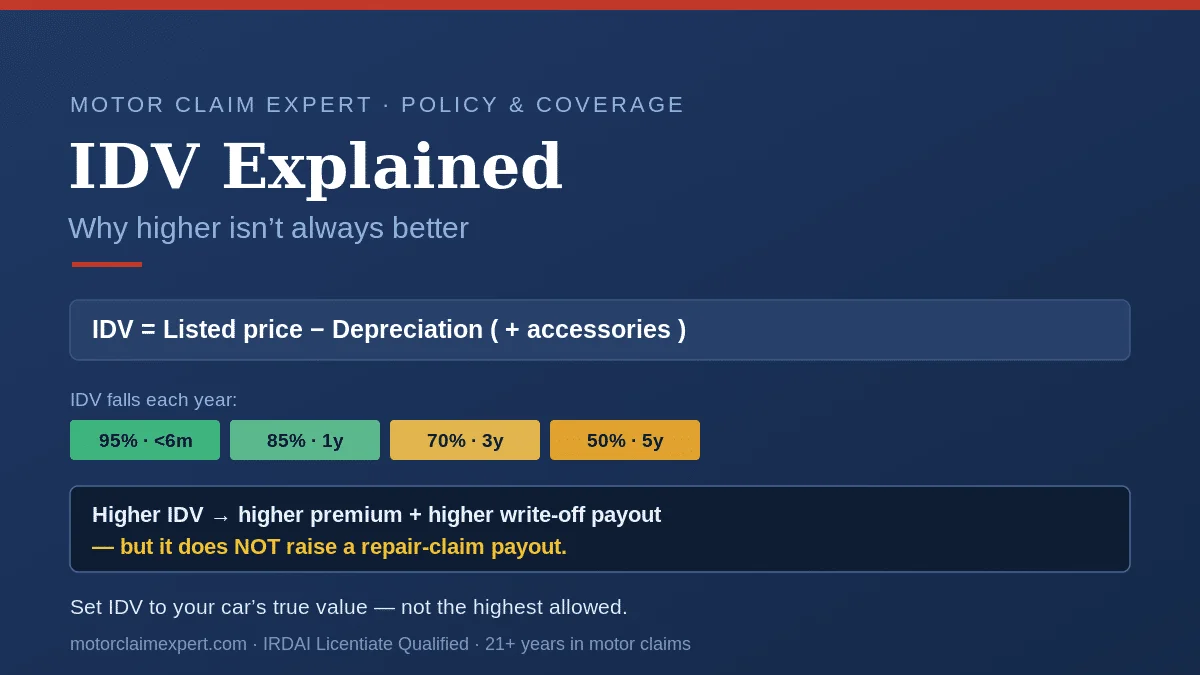
IDV is the number most owners click past on the renewal screen — and it quietly decides two things that matter enormously: what you pay in premium, and what you get if the car is ever written off or stolen. The advice you will hear most often is “set it higher for a bigger payout.” In more than twenty-one years of handling motor claims, I can tell you that is mostly wrong, and occasionally expensive. This guide explains what IDV really is, how it is calculated, and — the part no calculator tells you — why a higher IDV is not automatically better.
What IDV actually is (three roles, not one)
IDV stands for Insured Declared Value. It is the value the insurer fixes for your car at the start of the policy, and it does three distinct jobs that owners routinely blur together:
| IDV is… | What that means |
|---|---|
| The payout ceiling on a write-off or theft | If the car is a total loss or stolen, the IDV (less the wreck value and excess) is the most you receive. |
| The basis of your own-damage premium | The OD premium is a percentage of the IDV — so a higher IDV always means a higher premium. |
| NOT the basis of a repair claim | A normal repair claim is settled on the actual repair cost (minus depreciation and excess), not on the IDV. |
That third line is the one that overturns the “higher is better” myth — hold onto it.
How IDV is calculated
The formula is straightforward:
It is based on the manufacturer’s listed selling price of your exact make and model, reduced by a fixed depreciation percentage for age. It does not include registration charges, road tax or the insurance cost. The standard age-based depreciation grid used to set IDV is:
| Age of vehicle | Depreciation | IDV ≈ % of listed price |
|---|---|---|
| Not exceeding 6 months | 5% | ~95% |
| 6 months to 1 year | 15% | ~85% |
| 1 to 2 years | 20% | ~80% |
| 2 to 3 years | 30% | ~70% |
| 3 to 4 years | 40% | ~60% |
| 4 to 5 years | 50% | ~50% |
| Over 5 years | Mutually agreed | Negotiable |
Insurers usually let you adjust the IDV within a band of about ±15% at renewal. That band is where the real decision sits.
Why a higher IDV is not automatically better
Here is the logic the calculators skip, laid out plainly:
- A higher IDV always raises your premium. That part is guaranteed — the own-damage premium is a percentage of the IDV.
- A higher IDV only raises your payout on a total loss or theft. For the far more common repair claim, the settlement is the actual repair cost, not the IDV. You can double your IDV and a dented door still pays the same.
- Over-declaring does not buy a bigger claim. A surveyor assesses the car’s actual value; an IDV inflated well beyond what the car is really worth does not translate into a larger settlement, and can create friction at assessment.
- Under-declaring to save premium is the opposite trap. A low IDV means a small cheque if the car is written off — and on a financed car, an IDV set below the outstanding loan can leave you still owing the bank after the insurer has paid.
A worked example: what your IDV choice really changes
Illustrative numbers make it concrete. Take a three-year-old car with a listed price around ₹10 lakh. The grid puts its IDV near ₹7 lakh, and the ±15% band lets you set it roughly between ₹6 lakh and ₹8 lakh. Here is what that choice actually moves:
| If you claim for… | Low IDV (₹6L) | High IDV (₹8L) |
|---|---|---|
| A dented door (repair) | Same payout — the actual repair cost | Same payout — the actual repair cost |
| A total loss / theft | Up to ₹6L | Up to ₹8L |
| Your premium | Lower | Higher (OD is a % of IDV) |
Notice the pattern: the higher IDV changes nothing for the everyday repair claim you are most likely to make — it only helps in the rarer write-off or theft, and you pay a higher premium every year for that difference. That is the whole case for right-sizing rather than maxing out.
When a higher IDV genuinely helps
Within the sensible band, lean towards the higher end when:
- The car is new or premium, where a write-off would be a large loss.
- The car is financed and you want the total-loss payout to clear the loan.
- You are in a theft-prone area, where a stolen-vehicle payout is a real risk you want fully covered.
How a write-off figure is actually built — IDV less the wreck value — is in our guide to total loss and the 75% rule.
When a lower IDV can make sense
Lean lower when the car is older and you would not seriously repair a major loss anyway — a modest IDV keeps the premium down and still covers the smaller repair claims you are more likely to make. Just never set it so low that a total-loss cheque would feel like a fresh injury.
IDV, depreciation and Return to Invoice
Because the depreciation grid pulls the IDV down every year, a three- or four-year-old car is insured — and paid out — at a fraction of what you originally spent. If that gap worries you, the Return to Invoice (RTI) add-on pays the original invoice value on a total loss or theft instead of the depreciated IDV. It is one of the few add-ons that directly changes the write-off maths, and it is especially worth considering on new and electric cars — see our guide to EV car insurance, where the numbers are largest.
How to set your IDV right
- Anchor to real value. Check what your exact make, model, variant and year actually sells for today.
- Use the band deliberately. Nudge up for a new, premium or financed car; nudge down for an old one you would not rebuild.
- Never under-declare a financed car below the outstanding loan.
- Consider RTI on new/EV cars if the depreciation gap bothers you.
- Re-check every renewal — the IDV should fall each year, and the right figure changes with it.
Myth vs reality
| Myth | Reality |
|---|---|
| “A higher IDV means a bigger claim.” | Only on a total loss or theft. Repair claims pay the actual cost, whatever your IDV. |
| “A low IDV is a smart way to cut premium.” | It also cuts your write-off payout — and can leave a financed car owing the bank. |
| “IDV is my car’s resale price.” | It is a depreciation-schedule value for insurance — related to market value, but not a resale quote. |
The bottom line
IDV is not a lottery ticket you size up for a bigger prize; it is a value you size right. It caps what you are paid if the car is written off or stolen, it sets your own-damage premium, and it does nothing for an ordinary repair claim. Set it to what your car is genuinely worth today, lean gently up for a new, premium or financed vehicle, add Return to Invoice if the depreciation gap troubles you, and revisit it every renewal. Do that, and you will neither over-pay for cover you cannot use nor find yourself short on the one day it matters most.
Working out your cover? Read this with our guides to total loss and the 75% rule and how surveyors assess damage.
Frequently asked questions
Your IDV is exactly what a theft claim pays out — see how the car theft claim process settles at IDV.
Because a theft claim pays your full IDV, a car recovered after settlement belongs to the insurer — you were already made whole once.
A stolen bike is also settled at IDV — see the two-wheeler theft claim guide for the bike-specific process and traps.
A car with a hidden flood or total-loss past can be harder to insure at a fair IDV. See the full picture of flood-damaged used car risks before buying second-hand.
In a total loss you rarely get the full IDV in hand — the wreck’s value is part of the sum. See how salvage value is deducted from a total-loss payout.
IDV applies to own-damage and comprehensive cover. If you are choosing a policy type first, start with third-party vs own damage vs comprehensive.
What is IDV in car insurance?
IDV (Insured Declared Value) is the value the insurer fixes for your car at the start of the policy. It is the maximum you are paid if the car is a total loss or stolen, and it is the basis of your own-damage premium. It is not the basis of an ordinary repair claim.
How is IDV calculated in India?
IDV = the manufacturer’s listed selling price minus depreciation, plus accessories minus their depreciation. It excludes registration, road tax and insurance cost. Depreciation follows an age grid — about 5% under 6 months, 15% up to a year, then 20/30/40/50%, and mutually agreed beyond 5 years.
Is a higher IDV better in car insurance?
Not automatically. A higher IDV always raises your premium but only raises your payout on a total loss or theft — repair claims are settled on actual cost, not IDV. Over-declaring doesn’t buy a bigger repair claim; the best IDV is your car’s true current value.
Does a higher IDV increase my repair claim payout?
No. A repair claim is settled on the actual repair cost, minus depreciation and excess — regardless of your IDV. IDV only sets the ceiling for a total-loss or theft settlement.
Can I change my car’s IDV?
Yes, within a band of about plus or minus 15% at renewal. Nudge it up for a new, premium or financed car; nudge it down for an older car you would not rebuild after a major loss. Set it close to the car’s real value.
What happens if I set my IDV too low?
You cut your premium, but you also cut your total-loss or theft payout. On a financed car, an IDV set below the outstanding loan can leave you still owing the bank after the insurer has paid.
Is IDV the same as my car’s resale value?
No. IDV is a depreciation-schedule value used for insurance. It is related to market value but is not a resale quote — it is set by the age-based depreciation grid on the manufacturer’s listed price.
How can I get the invoice value instead of the depreciated IDV?
Add the Return to Invoice (RTI) add-on. On a total loss or theft it pays the original invoice value rather than the depreciated IDV — useful on new and electric cars where depreciation opens a large gap.


