
“Electric cars are cheaper to insure” is half true — and the other half can cost you a great deal. The headline is real for one part of the premium and wrong for the part that matters most when you actually claim. In more than twenty-one years of handling motor claims, I have watched EV owners buy on the cheaper number and then discover, at claim time, that the way an electric car is insured is genuinely different from a petrol one. This guide lays out the real premium picture, the five add-ons that actually matter on an EV, and the charging and fire exclusions that quietly sink claims — so you buy the right cover, not the cheapest.
The premium reality: cheaper and dearer at the same time
An EV premium has two halves that move in opposite directions:
| Component | How it compares to a petrol car |
|---|---|
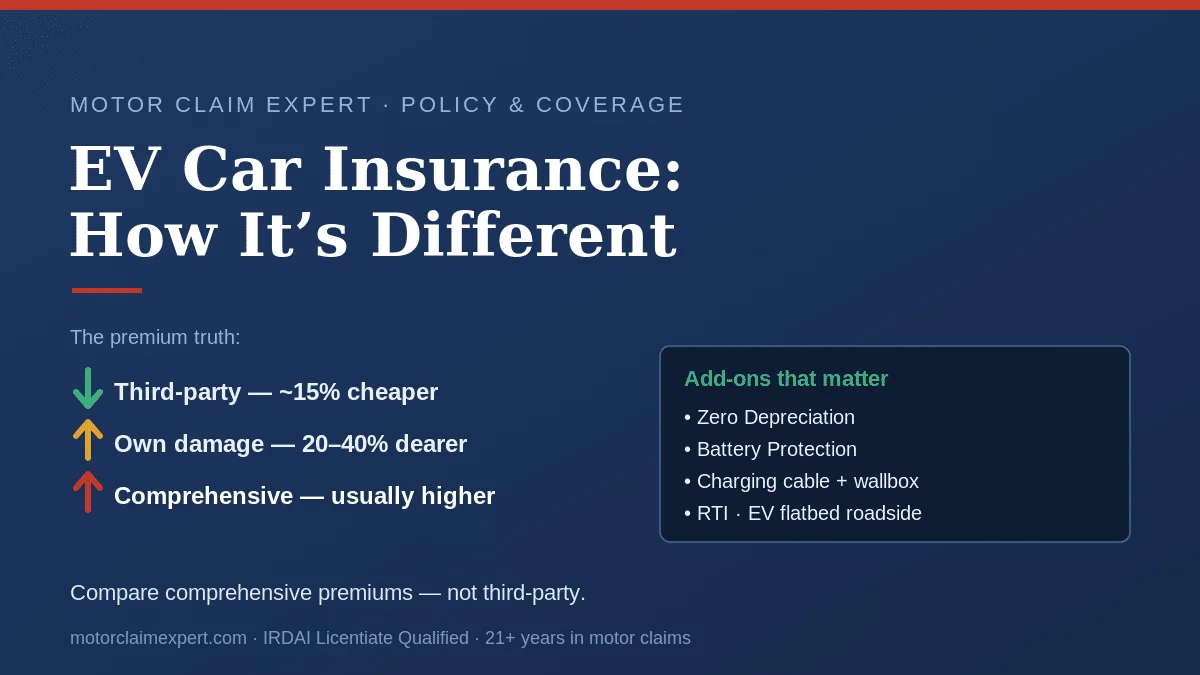
| Third-party (TP) | Cheaper — EVs get an IRDAI discount of about 15% on the third-party premium. |
| Own damage (OD) | Dearer — typically 20–40% higher, because the car’s value (and repair cost) is higher. |
| Comprehensive (both) | Often higher overall — the dearer own-damage side usually outweighs the cheaper third-party discount. |
So the “cheaper to insure” claim is true only for the third-party slice. On a full comprehensive policy — the one you actually want — an electric car frequently costs more to insure than a comparable petrol car, not less.
Why the own-damage side costs more
Three structural facts push an EV’s own-damage premium up:
- The battery is 40–60% of the car’s value. That inflates the Insured Declared Value (IDV), and the own-damage premium is a percentage of the IDV.
- EV repairs cost more. Genuine EV parts have longer lead times, fewer garages have certified EV technicians, and battery diagnostics need specialised equipment — repair bills commonly run well above the petrol equivalent.
- Parts are pricier and depreciate hard. Sensor-laden bumpers, full-LED lighting and soft-touch interiors are expensive to replace, and depreciation bites unless you hold Zero Depreciation.
A worked comparison: petrol vs EV premium
Illustrative numbers make the split clear. Take a petrol car and its electric equivalent (your actual figures will vary with IDV, city and insurer):
| Premium part | Petrol | Electric |
|---|---|---|
| Third-party | Baseline | ~15% lower |
| Own damage | Baseline | 20–40% higher (higher IDV + repair cost) |
| Comprehensive (net) | Baseline | Usually higher — the OD rise outweighs the TP saving |
The lesson is not “EVs are dear” — it is that the comprehensive premium, with the add-ons you actually need, is the only number worth comparing. A quote that looks cheaper is almost always leaning on the third-party discount.
The five add-ons that actually matter on an EV
Petrol-car advice does not transfer. For an electric car, five add-ons earn their place — and the first two are close to essential:
| Add-on | Why it matters on an EV | Typical cost/yr |
|---|---|---|
| Zero Depreciation | Removes the depreciation cut — on pricey EV parts, this is the difference between a full payout and a large out-of-pocket bill. | Varies with IDV |
| Battery Protection | Covers water ingress and electrical/charging surge to the pack — gaps the base policy leaves. See our EV battery cover guide. | ₹2,500–₹4,000 |
| Charging cable + wallbox | Your home charger and cable are expensive and are not covered under the car policy by default. | ₹800–₹1,200 |
| Return to Invoice (RTI) | On a total loss or theft, pays the invoice value rather than the depreciated IDV — useful given how EVs depreciate. | Varies with IDV |
| Roadside assistance (EV flatbed) | An EV must be flatbed-towed, never tow-dragged — the wrong tow can damage the drivetrain. | ₹300–₹800 |
The charging and fire exclusions owners miss
These are the EV-specific traps that turn a covered event into a rejected one:
- Non-OEM chargers and batteries. Using an unauthorised or non-approved charger — or a third-party battery — is a named exclusion at many insurers. Charge by the manufacturer’s specification.
- Thermal runaway after a flood. If your EV has stood in water, do not switch it on and do not plug it in. Water can create internal shorting in the pack that leads to a delayed thermal runaway — fires have started days after a flood when an owner tried to power up. Tow it on a flatbed and let a certified workshop check it.
- Degradation is a warranty matter, not insurance. Gradual range loss is the carmaker’s responsibility under warranty — insurance covers accidental, external damage. We explain the line in the EV battery guide.
The consequential-loss principle that governs flooded petrol engines applies to EVs too — see flood claims: consequential vs accidental and why restarting a flooded vehicle voids cover.
Set your EV’s IDV right
Because the battery makes an EV’s IDV high, it is tempting to under-declare it to shave the premium. Resist that. The IDV is the ceiling of what you are paid if the car is written off, and on an expensive EV an under-set IDV can leave you badly short — especially on a financed car. How the write-off figure is built is in our guide to total loss and the 75% rule.
How an EV claim is different
When you do claim, expect a few differences from a petrol car:
- Flatbed recovery, not a hook-and-tow.
- A certified EV workshop — not every network garage can safely work on a high-voltage pack.
- Longer lead times for genuine EV parts and battery components.
- Battery diagnostics that only specialised equipment can perform, which shapes the surveyor’s assessment. How that assessment works is in our guide on how surveyors assess car damage.
How to buy or renew EV cover well
- Compare comprehensive premiums, not third-party, with identical add-ons.
- Add Zero Depreciation and Battery Protection at minimum; add charging-cable, RTI and EV roadside as they fit your situation.
- Set the IDV honestly to the car’s real value.
- Check the charger and battery exclusions in the wording before you rely on the cover.
- Prefer an insurer with a clean EV-claim record and access to certified EV workshops near you.
Myth vs reality
| Myth | Reality |
|---|---|
| “EVs are cheaper to insure.” | Only the third-party part. Comprehensive cover is often dearer because own-damage is 20–40% higher. |
| “My comprehensive policy covers the home charger.” | Not by default — the charger and wallbox need a dedicated add-on. |
| “After a flood I’ll just charge it to check.” | Never plug in or switch on a flooded EV — it can trigger a delayed battery fire and void the claim. |
The bottom line
An electric car is not just a petrol car with a battery, and it is not insured like one. The third-party premium is cheaper; the comprehensive premium usually is not. The add-ons that matter are different — Zero Depreciation and Battery Protection first, then charging-cable, RTI and EV-ready roadside. And the fastest ways to lose an EV claim are uniquely electric: an unauthorised charger, or powering up a flooded pack. Buy on the comprehensive number, cover the battery and the charger, set the IDV honestly, and charge by the book — and your electric car will be exactly as well protected as it is expensive.
Going deeper on EV cover? Read this with our guides to whether the EV battery is covered and IDV and total loss.
Frequently asked questions
Are electric cars cheaper to insure in India?
Only partly. The third-party premium is about 15% cheaper thanks to an IRDAI discount for EVs, but the own-damage premium is 20-40% higher. On a full comprehensive policy the EV is often more expensive overall, not less.
Why is EV own-damage insurance more expensive?
Because the battery is 40-60% of the car’s value, which raises the IDV that the own-damage premium is based on, and because EV repairs cost more — genuine parts have longer lead times, few garages have certified EV technicians, and battery diagnostics need specialised equipment.
What add-ons do I need for an electric car?
At minimum Zero Depreciation and Battery Protection. Then consider charging cable and wallbox cover, Return to Invoice, and roadside assistance with EV flatbed towing. Petrol-car add-on advice does not transfer to EVs.
Is the home charger or wallbox covered by car insurance?
Not by default. Your home charger and cable are not covered under the standard car policy — you need a dedicated charging-cable and wallbox add-on, typically around Rs 800-1,200 a year.
Does EV insurance cover battery degradation?
No. Gradual range loss and degradation are warranty matters, covered by the manufacturer. Insurance covers accidental, external damage — accident, fire, theft and flood — not wear. Water ingress and charging surge need a Battery Protection add-on.
Can my EV claim be rejected for using a non-OEM charger?
Yes. Using an unauthorised or non-approved charger, or a third-party battery, is a named exclusion at many insurers and can lead to rejection. Charge and service by the manufacturer’s specification.
What should I do if my EV is flooded?
Do not switch it on and do not plug it in. Water can cause internal shorting that triggers a delayed thermal runaway — fires have started days after a flood. Flatbed-tow the car to a certified workshop, photograph everything, and intimate the insurer the same day.
How much does electric car insurance cost in India?
A comprehensive EV policy commonly runs from about Rs 10,000 to Rs 50,000 a year (an electric SUV often around Rs 25,000-30,000), depending on the IDV, location, claim history and add-ons. Compare comprehensive premiums with the same add-ons, not just third-party.


