
An older car is cheaper to run in every way except one that owners rarely think about until they claim: the insurance maths quietly changes as the car ages. The payout you’d get shrinks, the point at which the insurer writes the car off arrives sooner, and some covers you paid for stop being worth it. None of this means an older car is a problem to insure — it means you should insure it differently. This guide explains how claims and cover work for an older vehicle in India, and how to keep paying for protection that still makes sense.
Why an older car’s claim is different
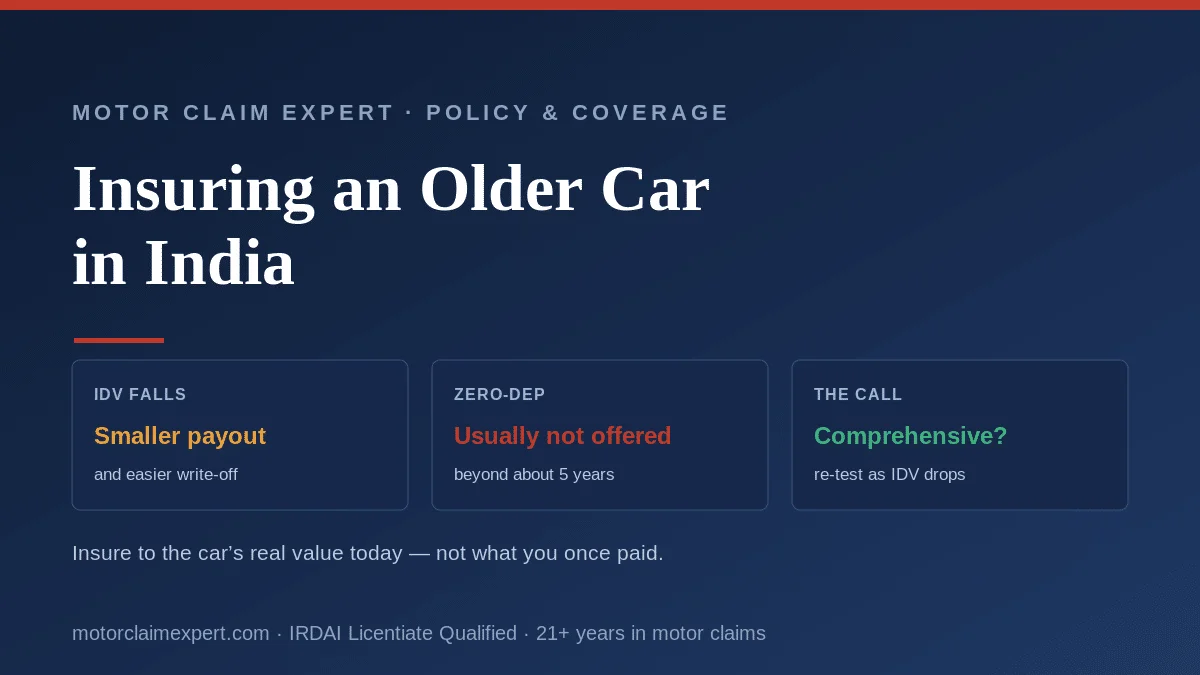
Everything about an own-damage claim is anchored to the IDV — the insured declared value, which is the car’s current market value after depreciation. As the car gets older, the IDV drops year on year. Two consequences follow directly. First, if the car is stolen or written off, the settlement is that lower IDV, not what you once paid. Second — and this surprises people — a moderate repair bill now represents a larger share of a smaller IDV, so the car reaches the insurer’s write-off point far more easily than a newer one would.
Expert note — how IDV is fixed once a car is old: for the first years, the IDV is set from a standard depreciation grid tied to the car’s age. Once a car passes roughly five years, that grid runs out, and the IDV is set by mutual agreement between you and the insurer, based on the vehicle’s condition, model and local market. This matters at renewal: an IDV set too low quietly shrinks any future total-loss payout, while an unrealistically high one just raises your premium for value you’d never actually recover. On an older car, the IDV conversation at renewal is the most important thing you do.
Should you keep comprehensive, or drop to third-party?
This is the real decision for an older-car owner. Third-party cover is compulsory and cannot be dropped. The question is only whether the own-damage part still earns its premium.
| Situation | Sensible cover |
|---|---|
| Car still has a meaningful IDV; you couldn’t easily absorb a repair | Keep comprehensive (TP + own damage) |
| IDV is low; own-damage premium is a large fraction of it | Weigh dropping own damage; keep at least third-party |
| Car is very old / near end of life | Third-party (compulsory) is the practical minimum |
A useful rule of thumb: when the own-damage premium starts to look large next to the IDV it protects, comprehensive is giving you less and less. But don’t drop own-damage cover casually — a single at-fault accident you’d have to fund yourself can cost far more than a few years of premium. Decide on the numbers, not on the car’s age alone.
The deductions bite harder on an old car
Expect more to be knocked off a repair claim. On an older car, depreciation on replaced parts is at its steepest — rubber, plastic and many parts are cut heavily by age, so you bear more of every repair bill. And the add-on that would have cancelled that — zero-depreciation — is usually not offered beyond roughly five years, so it’s rarely an option when you’d most feel the depreciation. Factor this in: an own-damage claim on an old car returns a smaller share of the bill than the same claim on a new one. The full mechanics are in our guide to claim deductions.
Write-off and end-of-life realities
Because the IDV is low, an older car tips into a constructive total loss after damage that a newer car would simply have repaired — the repair estimate crosses the write-off threshold quickly. Separately, keep the car’s paperwork current: a private car’s registration is valid for a set period and must be renewed to stay legal, and a vehicle that is unfit or beyond its usable life brings scrappage into the picture. An expired registration or an unroadworthy vehicle also weakens any claim, so an older car’s documents matter as much as its cover.
Insuring an older car well — a checklist
A worked example
An older car deserves cover matched to what it’s actually worth today — a realistic IDV, a comprehensive-vs-third-party decision you revisit every year, and no add-ons that stopped making sense. Do that and you neither overpay for a car you’d never fully recover nor leave yourself exposed on one you still rely on. Start with how IDV works and the three types of cover, and you’ll insure your older car with your eyes open.
Frequently Asked Questions — Insuring an Older Car
Is it worth keeping comprehensive insurance on an old car?
It depends on the IDV. While the car still has a meaningful value and you could not easily absorb a repair, comprehensive is worth it. When the own-damage premium becomes large relative to a low IDV, weigh dropping to third-party, which stays compulsory.
How is IDV decided for a car older than 5 years?
For the first years the IDV follows a standard age-based depreciation grid. Beyond about five years it is set by mutual agreement between you and the insurer, based on the car’s condition, model and local market value.
Can I get zero-depreciation cover on an old car?
Usually not. Zero-depreciation is generally offered only up to around five years, so on an older car you typically bear the depreciation on replaced parts at claim time.
Why is my older car declared a total loss so easily?
Because its IDV is low, a moderate repair estimate can exceed the write-off threshold (commonly around 75% of IDV), so the insurer settles it as a total loss instead of repairing it.
Do I still need insurance for a very old car?
Yes. Third-party insurance is compulsory at any age. Own-damage cover is optional and worth holding while the car has real value you would want protected.
What should I check at renewal for an older car?
Set a realistic IDV, re-test the comprehensive-versus-third-party decision, drop add-ons that no longer fit, protect your No-Claim Bonus, and keep the registration and fitness current.
Does an expired registration affect my claim?
Yes. An unregistered or unfit vehicle is not legally roadworthy, which can weaken or defeat a claim. On an older car, keeping the documents current matters as much as the cover.
Sources & references
- Standard motor depreciation schedule (age-based IDV); for vehicles beyond ~5 years IDV is set by mutual agreement between insurer and owner.
- Motor Vehicles Act, 1988 — compulsory third-party insurance (s.146); registration/fitness validity for private vehicles.
- Zero-depreciation add-on eligibility (typically limited to newer vehicles); constructive-total-loss assessment (~75% of IDV).


