
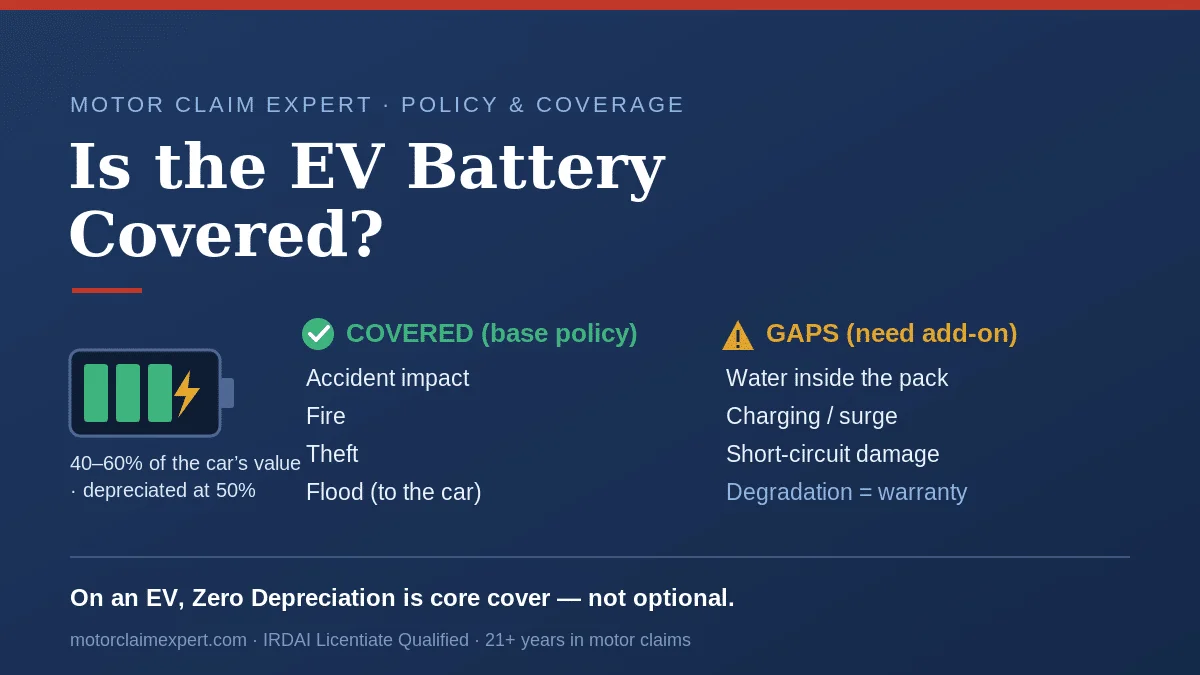
The battery is the single most expensive thing you own on wheels. On most electric cars it accounts for 40–60% of the vehicle’s value, which means the question every EV owner eventually asks — “if something happens to my battery, is it covered?” — is really a question about the biggest financial risk of owning the car. In more than twenty-one years of handling motor claims, I have learned that the honest answer is: partly, and the gaps are exactly where owners get hurt. This article explains, in plain language, what your insurance actually covers on an EV battery, what your warranty covers instead, and where the two quietly leave you exposed.
First, untangle two different safety nets: warranty vs insurance
Almost every confused EV battery claim I see starts with one mistake — the owner assumes warranty and insurance are the same shield. They are not. They protect against opposite kinds of failure.
| Manufacturer’s warranty | Motor insurance | |
|---|---|---|
| Protects against | Manufacturing defects and capacity loss (degradation) | External, accidental damage — collision, fire, theft, flood |
| Typical term | Commonly 8 years / 1,60,000 km, guaranteeing the pack stays above a set state of health (often ~70%) | One year at a time, renewed |
| Who pays | The carmaker | Your insurer |
Read your battery warranty terms against your own vehicle’s handbook — the exact years, kilometres and health threshold vary by manufacturer. The principle, though, is constant: a battery that slowly loses range is a warranty matter; a battery damaged in an accident, fire or flood is an insurance matter.
What a standard comprehensive policy does cover on the battery
Here is the reassuring part. Because the battery is a fitted part of the insured vehicle, a standard comprehensive (or standalone own-damage) policy generally covers the battery against the same insured perils as the rest of the car:
- Accidental impact — collision damage to the pack.
- Fire — including battery fire arising from an accident or external cause.
- Theft — of the vehicle or the battery.
- Natural calamities — flood, inundation and similar events that damage the car.
So if your EV is hit, burnt in an accident, stolen or caught in a genuine flood, the battery is, in principle, part of what the policy responds to. The trouble begins with the risks that are specific to how an electric car actually fails.
The gaps a standard policy quietly leaves
An EV does not fail like a petrol car, and the standard wording was not written around a large lithium-ion pack. Three battery-specific risks are commonly excluded unless you add cover:
- Water entering the battery pack — not the obvious flood that submerges the whole car, but water ingress into the sealed pack, which many wordings treat as outside the base cover.
- Charging and electrical surge — damage from a voltage spike or fault during charging.
- Short-circuit consequential damage — electrical damage that spreads from an internal short.
These are precisely the modern EV failure modes owners worry about, and they are the ones a base policy is most likely to argue over. This is not a reason to distrust EV insurance — it is a reason to buy the right add-on, which I come to below.
The depreciation bomb: why a “covered” battery claim can still cost you lakhs
This is the single most important thing an EV owner needs to understand before a claim, and almost no one explains it clearly.
When a part is replaced under an own-damage repair claim, the insurer does not pay the full price of the new part — it deducts depreciation first. Under the standard depreciation grid, batteries are depreciated at 50%. On a petrol car that rule is trivial: a 12-volt battery costs a few thousand rupees, so a 50% cut is a few thousand rupees. On an EV, the “battery” is the traction pack — and it is a different universe of money.
| Situation | Who absorbs the depreciation |
|---|---|
| Comprehensive policy, no Zero Depreciation | You do. On a pack that can cost ₹1–5 lakh (and ₹8–12 lakh on premium models), a 50% battery depreciation cut can leave a very large bill in your lap. |
| Comprehensive policy + Zero Depreciation | The insurer does. Zero-dep removes the depreciation deduction on replaced parts, so the pack is settled far closer to full value. |
The add-ons that actually matter for an EV
You do not need every add-on a dealer offers. For an electric car, three earn their place:
| Add-on | What it fixes | Why it matters on an EV |
|---|---|---|
| Zero Depreciation | Removes the depreciation cut on replaced parts | Protects you from the 50% battery-depreciation hit — the biggest single exposure |
| Battery Protection Cover | Extends cover to water ingress into the pack, charging/electrical surge and consequential short-circuit damage | Closes the exact gaps the base policy leaves; roughly ₹1,500–₹4,000 a year (more on premium cars) |
| Charging equipment / cable cover | Covers the home charger and cable | Charging hardware is expensive and sits outside the car’s own-damage cover |
Names differ between insurers — “Battery Secure,” “Battery Protect,” “EV Shield” — but the function is what matters. Read the wording for the three risks above before you assume they are included.
Your battery inflates your IDV — set it right
Because the battery is such a large share of the car’s value, an EV’s Insured Declared Value (IDV) is high, and your own-damage premium follows it. That is not a reason to under-declare the IDV to save premium — the IDV is also the ceiling of what you are paid if the car is written off. On a financed EV especially, an under-set IDV can leave you still owing the bank after a total loss. We explain this trade-off in detail in our guide to total loss and the 75% rule.
Warranty exclusions that surprise EV owners
Even the warranty — your protection against degradation and defects — can be voided by everyday habits. The most common reasons I see warranties denied are:
- Using non-approved or third-party fast chargers that fall outside the manufacturer’s specification.
- Unauthorised modifications to the battery, wiring or software.
- Skipping scheduled service at authorised workshops.
Here is the sting: if one of these voids your warranty and the battery then degrades or fails from a non-accidental cause, insurance will not fill the gap — because that is a warranty-type failure, not accidental external damage. Protect the warranty by charging and servicing by the book.
Myth vs reality
| Myth | Reality |
|---|---|
| “Comprehensive insurance fully covers my EV battery.” | It covers accidental, fire, theft and flood damage — but water ingress into the pack and charging surge often need a Battery Protection add-on. |
| “If my battery loses range, I’ll claim on insurance.” | Range/degradation is a warranty matter, not insurance. Insurance covers damage, not wear. |
| “Zero Depreciation is optional on an EV.” | The battery is depreciated at 50% and is the priciest part — without zero-dep, a battery claim can cost you lakhs. |
If your EV battery claim is rejected
Battery claims are most often refused on the grounds of “not accidental,” consequential damage, owner negligence, late intimation, or use of a non-OEM charger. If you believe the damage is genuinely from a covered peril and your documentation is sound, a rejection is a starting position, not the end:
- Get the rejection in writing with the exact clause relied upon, and ask for the surveyor’s report.
- Reply with a written representation to the insurer’s grievance cell, attaching photos, the intimation record and any evidence that the cause was accidental.
- Escalate to IRDAI’s Bima Bharosa portal if the grievance cell does not resolve it.
- Approach the Insurance Ombudsman for claims up to ₹50 lakh. Consumer commissions, too, have overturned insurers who wrongly rejected genuine EV battery claims.
The general approach mirrors any disputed motor claim — our guides on what to do when a claim is rejected and the overall motor claim process apply directly. And because water and electrical damage sit at the same “consequential loss” boundary that trips up flood claims, our piece on why flooded-engine claims are treated differently is worth reading alongside this one.
The bottom line
Is the EV battery covered by insurance? Yes for accidental, fire, theft and flood damage — but the modern EV risks of water ingress into the pack and charging surge usually need a Battery Protection add-on, and the crushing 50% depreciation on the most expensive part you own makes Zero Depreciation close to essential. Keep your warranty alive by charging and servicing to specification, know which failures belong to the carmaker and which to the insurer, and buy the two add-ons that actually matter. Do that, and the biggest financial risk of owning an electric car becomes a manageable one.
Buying or renewing cover for an electric car? Read it alongside our guides to IDV and total loss and the motor claim process.
Frequently asked questions
Is the EV battery covered under comprehensive car insurance in India?
Yes, for accidental impact, fire, theft and flood — because the battery is a fitted part of the insured vehicle. But EV-specific risks like water entering the sealed battery pack, charging or electrical surge, and consequential short-circuit damage are often excluded unless you buy a Battery Protection add-on.
Does insurance cover EV battery water damage or flooding?
Flood damage to the car is a covered peril, but water ingress into the sealed battery pack is commonly excluded under a standard policy. A Battery Protection add-on is what specifically extends cover to water entering the pack and charging-related electrical damage.
Does car insurance cover EV battery degradation or range loss?
No. Gradual capacity loss and range degradation are warranty matters, not insurance. Insurance covers sudden, external, accidental damage — not wear. If the pack falls below its guaranteed state of health within the warranty term under normal use, that is the manufacturer’s responsibility.
Why do I need Zero Depreciation on an electric car?
Because batteries are depreciated at 50% under the standard grid, and on an EV the battery is the most expensive part (Rs 1-5 lakh, up to Rs 8-12 lakh on premium models). Without Zero Depreciation, a battery claim can leave you paying lakhs out of pocket. On an EV, treat it as core cover, not optional.
What is the Battery Protection add-on and what does it cover?
It extends your policy to EV-specific risks the base cover leaves out: water ingress into the battery pack, charging and electrical surge, and consequential short-circuit damage. It typically costs around Rs 1,500-4,000 a year, more on premium cars. Insurers sell it under names like Battery Secure or Battery Protect.
How much does EV battery replacement cost in India?
A traction battery pack typically costs Rs 1-5 lakh for mainstream cars and Rs 8-12 lakh for premium models — often 40-60% of the car’s value. That scale is exactly why depreciation and the right add-ons matter so much on an EV.
Can I claim the same EV battery damage on both warranty and insurance?
No. You cannot claim the same damage twice. Manufacturing defects and degradation are covered by the warranty; accidental, fire, theft and flood damage by insurance. If the warranty covers a defect, the insurer will not also pay, and vice versa — both check which cause applies.
What can I do if my EV battery claim is rejected?
Get the rejection and the exact clause in writing, ask for the surveyor’s report, and reply with a written representation to the insurer’s grievance cell with evidence that the cause was accidental. If unresolved, escalate to IRDAI’s Bima Bharosa portal, then the Insurance Ombudsman for claims up to Rs 50 lakh. Consumer commissions have overturned wrongful EV battery rejections.


