
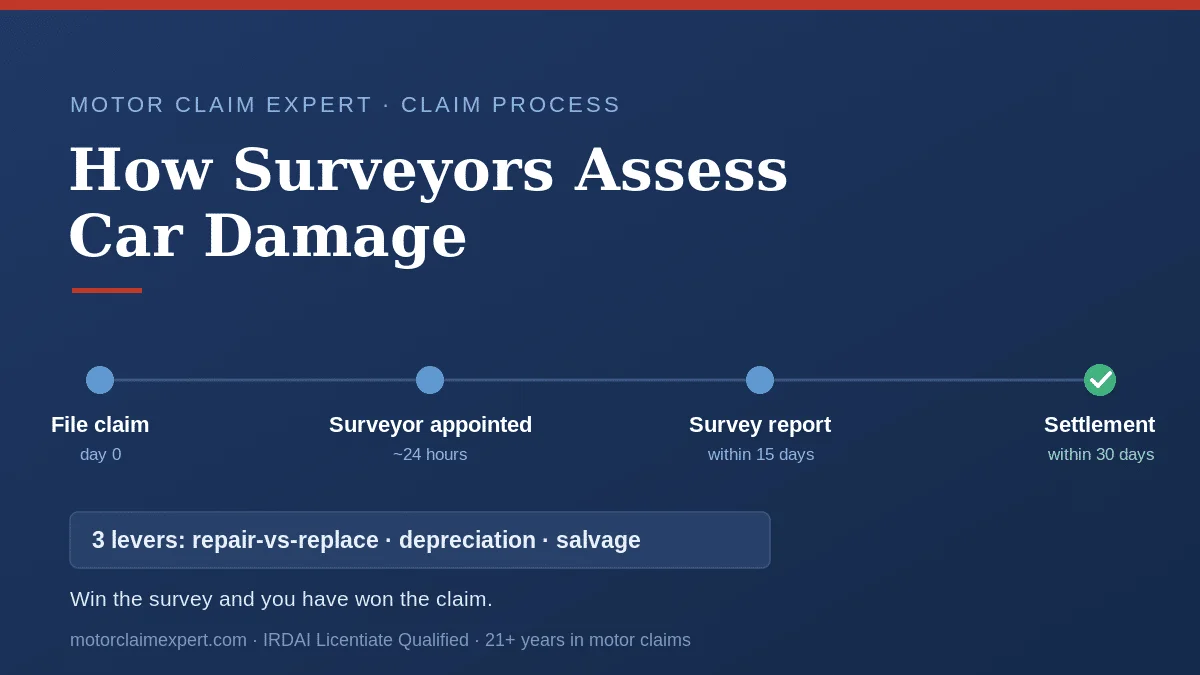
The survey is where your claim is really decided — and most owners have no idea what actually happens in it. You file the claim, someone inspects the car, and a number comes back. That number is built by a surveyor, and understanding how they build it is the difference between accepting whatever you are offered and knowing when to push back. In more than twenty-one years of handling motor claims — much of it on the assessment side — I have watched the same few decisions inside a survey decide the size of thousands of settlements. This guide takes you inside the process, step by step, so you know exactly what happens after you file and how to protect yourself.
Who is the surveyor, and why do they matter?
A motor surveyor (formally, a Surveyor and Loss Assessor) is an independent, IRDAI-licensed professional who inspects the damage, works out its cause and extent, and quantifies what the claim is worth. They are governed by the IRDAI (Insurance Surveyors and Loss Assessors) Regulations, 2015. Crucially, the surveyor is meant to be neutral — not the insurer’s employee — and their report is the pivot document on which the settlement turns.
One threshold matters up front: for a motor loss above ₹50,000, a licensed surveyor must be appointed. Below that, insurers increasingly assess smaller claims themselves through app-based photos and AI tools, without a physical survey.
The timeline: what should happen, and by when
The process runs on regulated timelines. Knowing them tells you when something has gone wrong.
| Stage | Expected timeline |
|---|---|
| Surveyor appointed | Promptly after you intimate — typically within about 24 hours |
| Inspection | At the spot or the garage where the vehicle is |
| Survey report | Within 15 days of allocation (a ₹500/day penalty is payable to the claimant for delay) |
| Settlement | Within 30 days of the insurer receiving the report and all required documents |
If a survey drags on well past these windows without explanation, that itself is a service issue you can raise with the insurer’s grievance cell.
What the surveyor actually does
Behind the single number in the report is a sequence of judgements. This is the part no competitor explains, and it is exactly where your settlement is made or lost:
- Verifies the cause matches the incident. The first question is whether the damage is consistent with how you said it happened. Damage that does not fit the story invites doubt — and questions.
- Assesses the extent. Every damaged part is examined and hidden damage is looked for — a bumper knock can conceal a bent crossmember.
- Decides repair vs replace, part by part. Whether each part is repaired or replaced changes the cost significantly.
- Applies depreciation. On a normal claim, replaced parts are paid after deducting depreciation by material and age — the deduction owners feel most.
- Assesses salvage and betterment. The value of replaced old parts (salvage) and any “betterment” where a new part improves the car can be adjusted.
- Checks for pre-existing damage. Old, unrelated damage is separated out so it is not paid under this claim.
- Quantifies and writes the report. The assessed figure, the deductions and the reasoning are set down — the document the insurer settles on.
A worked example: how a survey number is built
Numbers make the levers concrete. Take a three-year-old car with front-end damage and a garage estimate of about ₹80,000. Watch how the surveyor arrives at a lower assessed figure — and, crucially, why:
| Item | Surveyor’s call |
|---|---|
| Plastic bumper | Replaced — but plastic parts carry 50% depreciation, so half the part cost is your share. |
| Metal fender | Replaced — metal parts depreciate by age (around 20% on a 3-year car). |
| Bonnet | Repaired, not replaced — labour and paint only, a big saving over a new panel. |
| Headlamp glass | Glass carries nil depreciation — paid in full. |
| Paint | Material component depreciated (commonly 50%); labour paid. |
| Less: salvage + excess | Value of the old replaced parts and your compulsory excess are deducted. |
The ₹80,000 estimate might settle around ₹55,000–₹60,000 — and every rupee of the gap is explainable: a repair-not-replace call, depreciation by material and age, salvage, and the excess. A Zero-Depreciation add-on removes the depreciation cuts; without it, they are yours. Once you can read the report this way, you can see instantly whether a low figure is fair or worth challenging.
Spot survey, final survey and re-inspection
You may encounter more than one survey, and it helps to know why:
- Spot survey — a quick inspection where the vehicle is (roadside or towing point) to record the damage before it is moved or repaired.
- Final survey — the detailed assessment at the garage, often as the car is opened up and hidden damage emerges.
- Re-inspection — a check after repairs, common in cashless claims, to confirm the work matches what was approved.
The on-account payment most owners never ask for
Here is a genuinely useful entitlement that goes unclaimed: where liability is clearly established, a surveyor can recommend an on-account (interim) payment of up to 75% of the estimated amount, so you are not left stranded while the full settlement is processed. If your claim is clear-cut and money is tight, it is worth asking the insurer about an on-account payment.
How to protect yourself during the survey
- Do not start repairs before the survey. Beginning work — or letting the garage strip the car — before the surveyor has inspected it is the fastest way to lose parts of your claim.
- Be present if you can. Point out every bit of damage, including anything that is not obvious, so nothing is missed.
- Hand over documents cleanly — policy, RC, driving licence, FIR where relevant — so there is no excuse for delay. The overall list is in our motor claim process guide.
- Get the garage estimate and, later, a copy of the survey report. You are entitled to understand how the number was built.
- Photograph the damage yourself, with timestamps, before any work begins.
For the specific things a surveyor looks for on flood and engine claims, see our guides on flood claims and engine seizure.
If you disagree with the assessment
The surveyor’s figure is not the last word. If it looks low, work out which lever moved it and challenge that specifically:
- Ask for the survey report and the calculation — the repair estimate, depreciation, salvage and any deductions.
- Challenge the specific line — a part that should have been replaced not repaired, an excessive depreciation cut, an inflated salvage figure. Our guide on what to do when a surveyor reduces your claim walks through this.
- Escalate with a written representation (use our repudiation-reply template), then IRDAI’s Bima Bharosa and the Insurance Ombudsman.
Where repairs approach the car’s value, the assessment tips into a write-off — how that is calculated is in our total loss and 75% rule guide.
Myth vs reality
| Myth | Reality |
|---|---|
| “The surveyor works for the insurer, so the number is fixed.” | The surveyor is an independent licensed professional, and the report is recommendatory — you can dispute it. |
| “I should get the car repaired fast, then claim.” | Repairing before the survey destroys the evidence and can forfeit that part of the claim. |
| “A low figure means the claim is denied.” | Usually it just means one lever — repair-vs-replace, depreciation or salvage — moved. Find it and challenge it. |
The bottom line
The survey is not a formality; it is the moment your claim takes its real shape. A licensed surveyor inspects the damage, decides what is repaired or replaced, applies depreciation and salvage, and writes the report the insurer pays on — on regulated timelines you can hold them to. Protect yourself by never repairing before the survey, being present, handing over clean documents, and getting the report. And if the number is low, remember it was built from a few specific decisions — find the one that moved it, and challenge that. Understand the survey, and you are never again at the mercy of a number you did not see coming.
Want to go deeper? Read this with our guides to disputing a low survey and the full motor claim process.
Frequently asked questions
The survey has its own deadline: the report is due within 15 days of appointment. See how this fits the full motor claim settlement timeline from intimation to payment.
If the surveyor approved less than your garage quoted, see why the approved amount is lower than the garage estimate — which deductions are legitimate and how to challenge the rest.
What does a motor insurance surveyor do?
A surveyor is an independent, IRDAI-licensed professional who inspects the damaged vehicle, verifies the cause and extent of the loss, decides which parts are repaired or replaced, applies depreciation and salvage, and writes the report the insurer settles on. Their assessment is the pivot of the claim.
Is a surveyor mandatory for a car insurance claim?
For a motor loss above Rs 50,000, a licensed surveyor must be appointed. Below that, insurers increasingly assess the claim themselves using app-based photos and AI tools without a physical survey.
How long does a surveyor take to submit the report?
Under the IRDAI Surveyors and Loss Assessors Regulations, the surveyor must submit the report within 15 days of being allocated the claim. A penalty of Rs 500 per day is payable to the claimant for delay beyond that.
Can I start repairs before the surveyor inspects my car?
No. Starting repairs — or letting the garage strip the car — before the surveyor has inspected it destroys the evidence and can forfeit that part of your claim. Wait for the survey, and photograph the damage yourself first.
What does the surveyor check when assessing damage?
Whether the damage matches how you said it happened, the full extent including hidden damage, whether each part is repaired or replaced, depreciation on replaced parts, salvage and betterment, and any pre-existing unrelated damage that should not be paid under this claim.
Can I get an interim payment before the claim is settled?
Yes, in many cases. Where liability is clearly established, the surveyor can recommend an on-account (interim) payment of up to 75% of the estimated amount. If your claim is clear-cut, ask the insurer about an on-account payment.
What can I do if I disagree with the surveyor’s assessment?
Ask for the survey report and calculation, then challenge the specific line — a part that should have been replaced not repaired, an excessive depreciation cut, or an inflated salvage figure. Escalate with a written representation, then IRDAI’s Bima Bharosa and the Insurance Ombudsman.
How long does the insurer take to settle after the survey?
Once the insurer has the survey report and all required documents, it should settle the claim within 30 days. Unexplained delay beyond that is a service issue you can raise with the grievance cell and, if needed, the Ombudsman.
Sources & official references
- Law: Section 64UM of the Insurance Act, 1938 — assessment of loss by a licensed surveyor and loss assessor for claims above the prescribed threshold.
- Supreme Court judgment: New India Assurance Co. Ltd. v. Pradeep Kumar, (2009) 7 SCC 787 — a surveyor’s report is an important document but is not final or binding, and may be departed from where it is shown to be arbitrary or perverse.
- IRDAI regulation: surveyor allocation and report timelines are set by the IRDAI (Protection of Policyholders’ Interests…) Regulations, 2024 and the Master Circular on General Insurance Business, dated 11 June 2024.


