
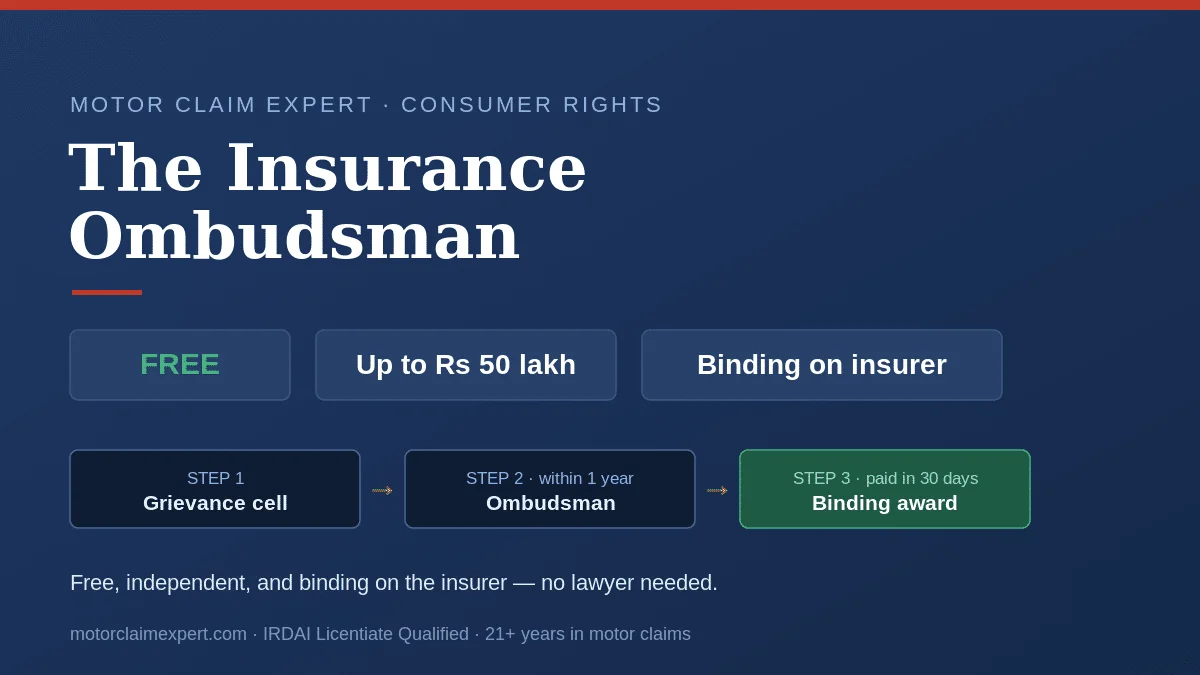
There is a free, out-of-court forum that can order your insurer to pay — and most policyholders never use it. When a motor claim is wrongly rejected, underpaid or endlessly delayed, owners assume the only options are to give up or hire a lawyer. Neither is true. The Insurance Ombudsman settles disputes between policyholders and insurers at no cost, and its award is binding on the insurer. In more than twenty-one years of handling motor claims, I have seen the Ombudsman overturn repudiations that looked hopeless — not because the forum is soft on insurers, but because a well-prepared complaint is hard to refuse. This is how to file one, and how to actually win.
What the Insurance Ombudsman is — and what it is not
The Insurance Ombudsman is a government-established grievance-redressal body for individual policyholders, created to resolve disputes with insurers quickly, impartially and without cost. It operates under the Insurance Ombudsman Rules, 2017 (amended in 2021), and there are at present 17 Ombudsman offices across India.
- It is free. There is no fee to file a complaint.
- It is binding on the insurer. If the Ombudsman passes an award in your favour, the insurer must comply within 30 days.
- It is for individuals. It handles personal policyholder complaints, not commercial disputes of large companies.
- It is not a court — for you. The award binds the insurer, but if you are dissatisfied you remain free to pursue a consumer commission or civil court. You lose nothing by trying the Ombudsman first.
When you can approach the Ombudsman
The Ombudsman hears a wide range of motor-insurance grievances, including:
- Repudiation (rejection) of a claim, in full or in part.
- Delay in settlement beyond the timelines the insurer is bound to.
- Disputes over the amount paid — a low total-loss figure, an under-assessed repair, salvage or depreciation deductions.
- Premium, policy terms or misselling disputes, and other deficiencies in service by the insurer, agent, broker or intermediary.
The 2021 amendment widened the scope from narrow “disputes” to deficiencies in service generally — a meaningful expansion for policyholders. The one hard ceiling is value: the compensation sought must not exceed ₹50 lakh (a limit raised from the earlier ₹30 lakh).
The one prerequisite: exhaust the insurer’s grievance cell first
This is the step most rejected complainants get wrong. You cannot go straight to the Ombudsman. You must first raise a written grievance with the insurer’s own grievance-redressal cell, and give it time to respond.
- Write to the insurer’s grievance cell setting out the complaint and the relief you want.
- Wait for the response — the insurer should deal with it within 30 days.
- You may then approach the Ombudsman if the insurer rejects the grievance, if you are dissatisfied with its reply, or if it does not reply within one month.
Lodging the grievance through IRDAI’s Bima Bharosa (IGMS) portal is a clean way to create this record, because it timestamps the complaint and forces a tracked response.
Which office do you file with?
You file with the Ombudsman office that has territorial jurisdiction — that is, the office covering either the location of the insurer’s branch you dealt with, or your own place of residence. The complaint may be made by you, or by your legal heir, nominee or assignee. With 17 offices nationwide, there is one covering your area; the list is published on the Council for Insurance Ombudsmen and IRDAI policyholder websites.
How to file: the step-by-step
- Put the complaint in writing. Include your name and address, the insurer’s name and branch, a clear description of the grievance with supporting documents, a copy of the grievance you made to the insurer (and its reply, if any), and the specific relief you are seeking.
- Attach your evidence. The policy schedule, the claim intimation, the surveyor’s report, the repudiation letter, photographs, the FIR (in theft), and any correspondence.
- Include the self-declaration. You confirm the same dispute is not already pending before, or decided by, a consumer forum, court or arbitrator — the Ombudsman will not take up a matter that is already in litigation.
- Submit it online through the complaint portal, or by email, post, or in person to the office with jurisdiction.
For the underlying paperwork every claim generates, see our motor claim process guide and, for building the representation itself, what to do when a claim is rejected.
What happens after you file
The process is designed to be quick and non-adversarial. The Ombudsman may first attempt a mediation between you and the insurer. If that does not resolve it, the Ombudsman passes a reasoned award, ordinarily within about three months of receiving all the required documents. If the award is in your favour, the insurer must comply within 30 days and confirm compliance to the Ombudsman.
| Stage | What happens |
|---|---|
| 1. Grievance cell | Written complaint to the insurer; 30 days to respond |
| 2. Ombudsman complaint | Filed within 1 year; free; up to ₹50 lakh |
| 3. Mediation / award | Reasoned award, ordinarily within ~3 months of full documents |
| 4. Compliance | Insurer complies within 30 days of the award |
How to actually win: a claims professional’s edge
Filing is easy; winning is about preparation. The complaints that succeed share the same qualities, and they are entirely within your control:
- Lead with the evidence, not the emotion. A tight chronology — policy, incident, intimation, survey, repudiation — with documents attached, beats pages of grievance.
- Name the exact ground and rebut it. Quote the clause the insurer relied on and show precisely why it does not apply to your facts.
- Cite the authority that fits. Where a claim was rejected only for delayed intimation, the Supreme Court’s reasoning in Om Prakash v. Reliance General Insurance is directly on point; where a surveyor’s figure is too low, our guide on disputing the surveyor shows how to frame it.
- Ask for something specific. State the exact amount and relief you seek, including interest and the deficiency-in-service angle where it applies.
- Keep it verifiable. Everything you assert should be provable from the documents in the file.
A worked example: how it typically unfolds
Consider a common pattern. A car is written off after an accident, and the insurer settles at a figure the owner believes is well below the IDV, deducting an inflated salvage value. The owner does three things in order. First, they raise a written grievance with the insurer’s grievance cell through Bima Bharosa, attaching the policy schedule, the surveyor’s report and their own calculation; the insurer replies but holds its figure. Second, within the one-year window, they file with the Ombudsman office covering their city — a tight complaint that states the exact shortfall, rebuts the salvage number, and asks for the balance plus interest, with a self-declaration that the matter is not before any court. Third, the Ombudsman examines the file, and because the settlement calculation cannot be justified against the policy schedule, passes an award directing the insurer to pay the difference, which the insurer complies with inside 30 days. No lawyer, no fee — just a documented, well-argued complaint. The facts vary case to case, but the structure that wins does not.
What the Ombudsman cannot do
Honesty matters here. The Ombudsman is powerful but bounded:
- It cannot entertain a complaint above ₹50 lakh, or one already pending or decided in a court, consumer forum or arbitration.
- It generally deals with individual policyholder grievances, not large commercial disputes.
- Its award binds the insurer, but if you find it inadequate you may still pursue the consumer commission or civil court — the Ombudsman route does not extinguish those rights.
For disputes that outgrow the Ombudsman, the consumer-protection framework is the next step, and it can award compensation for deficiency in service beyond the claim amount.
Myth vs reality
| Myth | Reality |
|---|---|
| “I need a lawyer to approach the Ombudsman.” | No. It is designed for individuals to file themselves, free of cost, in plain language. |
| “I can go straight to the Ombudsman after a rejection.” | You must first raise a written grievance with the insurer and wait up to 30 days. |
| “The award is just a suggestion.” | An award in your favour is binding on the insurer, which must comply within 30 days. |
The bottom line
The Insurance Ombudsman is the most underused tool in the policyholder’s hands: free, independent, binding on the insurer, and reachable in plain language without a lawyer. It will not rescue a claim that has no merit — but for a genuine claim wrongly rejected, underpaid or delayed, it is very often the fastest way to a fair result. Raise your grievance with the insurer first, keep every document, watch the one-year clock, and put a tight, evidence-led complaint in front of the office with jurisdiction. Done well, that is frequently all it takes.
Holding a rejection or a low settlement? Start with what to do when a claim is rejected, and if the number is the problem, read how total-loss payouts are calculated.
Frequently asked questions
If the Ombudsman route does not resolve it — or your claim exceeds the Ombudsman’s limit — the next rung is the consumer court under the Consumer Protection Act, 2019, which can award the claim plus interest, compensation and costs.
Is the Insurance Ombudsman free to approach?
Yes. There is no fee to file a complaint with the Insurance Ombudsman. It is designed for individual policyholders to file themselves, in plain language, without a lawyer.
What is the maximum claim amount the Insurance Ombudsman can handle?
The compensation sought must not exceed Rs 50 lakh (a limit raised from the earlier Rs 30 lakh). Disputes above that ceiling must go to a consumer commission or civil court instead.
Can I go directly to the Ombudsman after my claim is rejected?
No. You must first raise a written grievance with the insurer’s grievance-redressal cell and give it up to 30 days to respond. Only if it rejects the grievance, you are dissatisfied, or it does not reply within a month can you approach the Ombudsman.
How long do I have to file a complaint with the Insurance Ombudsman?
Within one year of the insurer’s rejection or partial settlement, or of the expiry of the one-month period if the insurer never replied. Missing the one-year window can make the complaint inadmissible.
Which Insurance Ombudsman office should I complain to?
The office with territorial jurisdiction — covering either the insurer’s branch you dealt with or your own place of residence. There are 17 offices across India, listed on the Council for Insurance Ombudsmen and IRDAI policyholder websites.
Is the Insurance Ombudsman’s award binding on the insurer?
Yes. An award in your favour is binding on the insurer, which must comply within 30 days and confirm compliance. The award does not bind you — if you find it inadequate, you may still pursue a consumer commission or court.
What documents do I need to file an Ombudsman complaint?
Your written complaint with name and address, the insurer’s name and branch, a description of the grievance, the policy schedule, claim intimation, surveyor’s report, repudiation letter, photographs, the FIR in theft cases, a copy of your grievance to the insurer, and a self-declaration that the matter is not pending in any court or forum.
What can I do if I’m not satisfied with the Ombudsman’s decision?
Because the award binds only the insurer, you retain the right to approach the consumer commission or a civil court. The consumer-protection route can also award compensation for deficiency in service beyond the claim amount.
Sources & official references
- Regulation: the Insurance Ombudsman Rules, 2017 (amended 2021) — the Ombudsman handles individual policyholder complaints up to ₹50 lakh, and the insurer must comply with an award within 30 days; offices operate across India under the Council for Insurance Ombudsmen.
- Escalation before/after: the IRDAI Bima Bharosa (IGMS) grievance portal, and a consumer court under the Consumer Protection Act, 2019.
- Regulator: IRDAI oversees the policyholder-protection framework the Ombudsman scheme sits within.


