
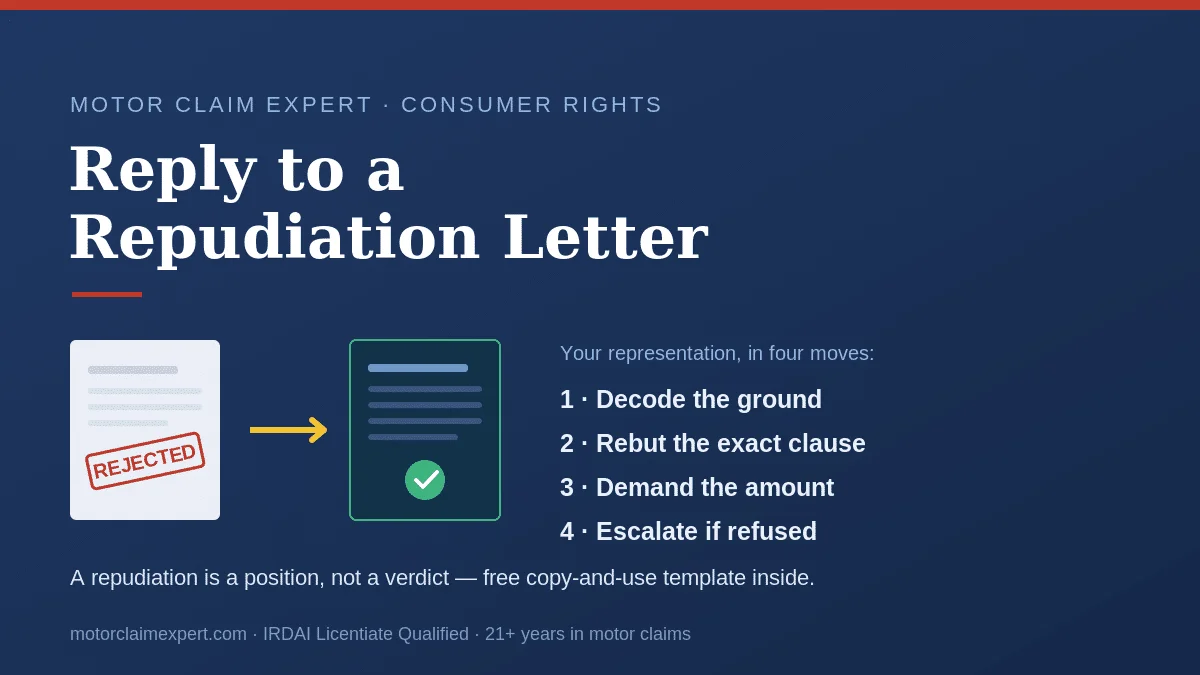
A repudiation letter is a position, not a verdict — and your reply to it is the single most important document in the whole dispute. Most owners read the rejection, feel the injustice, and either give up or fire off an angry email. Neither works. What works is a calm, structured, evidence-led representation that quotes the insurer’s own ground back at it and dismantles it. In more than twenty-one years of handling motor claims, I have seen well-written representations settle claims that looked dead. This guide gives you the exact template, and shows you how to adapt it to the reason your claim was rejected.
First, decode the repudiation letter
Before you reply, read the letter for one thing: the specific ground. A proper repudiation must state the exact policy clause or condition the insurer is relying on — not a vague line like “policy conditions not satisfied.” Under the IRDAI’s policyholder-protection framework, a rejection is expected to be communicated in writing with reasons.
So your first move depends on what the letter says:
- If it names a clause (for example, delayed intimation, a consequential-loss exclusion, or a driver-related condition) — good. You now know exactly what to rebut.
- If it is vague — write back and demand the specific clause and reason in writing before anything else. An insurer that cannot articulate a precise ground has already weakened its own position.
The five things every winning reply contains
- A clean chronology. Policy, incident, intimation, survey, repudiation — dates in order, stated as facts.
- The exact ground, quoted and rebutted. Name the clause the insurer relied on and show precisely why it does not apply to you.
- Evidence, referenced. Every assertion tied to a document you enclose.
- A specific demand. The exact amount you want settled, with interest, and any deficiency-in-service point.
- A clear next step. A calm notice that you will escalate to IRDAI’s Bima Bharosa and the Insurance Ombudsman if it is not resolved.
The template: representation to the Grievance Redressal Officer
You must address this to the insurer’s Grievance Redressal Officer (GRO) — you cannot go to the Ombudsman without first giving the insurer’s grievance cell a chance to respond. Copy the template below, fill the bracketed fields, and keep it factual.
To,
The Grievance Redressal Officer,
[Insurer name], [Branch/Office],
[City]
Subject: Representation against repudiation of Claim No. [____], Policy No. [____] — request to reconsider and settle
Dear Sir/Madam,
1. I hold Policy No. [____], valid from [date] to [date], covering my vehicle [make/model, registration no.]. On [date of incident], [briefly state what happened]. I intimated the claim on [date] (Claim No. [____]), the surveyor inspected the vehicle on [date], and I submitted all documents sought.
2. By letter dated [date], the claim was repudiated on the ground that [state the exact clause/reason quoted by the insurer]. With respect, that ground does not apply to my claim because [state your rebuttal in one or two clear sentences — tie each point to an enclosed document].
3. The claim is genuine and verifiable, and the documents enclosed establish [the loss / the timeline / the cause] beyond doubt. I therefore request that the repudiation be withdrawn and my claim of ₹[amount] be settled, together with interest for the delay.
4. I request a final decision from the Grievance Redressal Officer at the earliest. If the grievance is not satisfactorily resolved, I will be constrained to escalate the matter to IRDAI’s Bima Bharosa portal and the Insurance Ombudsman.
Enclosures: policy schedule; claim intimation; surveyor’s report; repudiation letter; [photographs / FIR / medical records / correspondence as relevant].
Yours faithfully,
[Name] · [Signature] · [Date]
[Phone] · [Email] · [Address]
Keep a copy of everything, and send it by a mode that gives you proof of delivery (email plus, where useful, registered post).
How to adapt the reply to your rejection ground
The template stays the same; paragraph 2 — the rebuttal — changes with the ground the insurer cited. Here is how to aim it, with the deeper guide for each situation:
| If the ground is… | Aim your rebuttal at… |
|---|---|
| Delayed intimation | The claim is genuine and verifiable and the delay is explained; cite the Supreme Court’s reasoning in Om Prakash v. Reliance. |
| Consequential loss / engine damage | Whether the damage was direct or arose from restarting; see engine seizure and hydrostatic lock. |
| Low or reduced amount | The surveyor’s figure and the deductions; see disputing the surveyor. |
| No driver’s statement / driver condition | Whether the condition was actually breached; see rejection without a driver’s statement. |
A filled-in example: the rebuttal paragraph
Paragraph 2 — the rebuttal — is the part readers find hardest, so here is a worked version for a claim rejected on the ground of delayed intimation after a theft. Notice how short, specific and document-anchored it is:
That is the whole craft: name the clause, state the facts that defuse it, point to the enclosures, and — where it fits — cite the authority. Do the same for your ground using the table above.
What to attach
A representation is only as strong as the file behind it. Enclose, in order:
- The policy schedule (showing cover, IDV and any add-ons).
- The claim intimation and claim number.
- The surveyor’s report (ask for a copy if you do not have it).
- The repudiation letter itself.
- Your evidence — photographs, the FIR in a theft, medical records where a delay is explained by hospitalisation, and any correspondence.
Where it goes after you send it
The representation is step one of a defined escalation ladder:
- Grievance Redressal Officer. Give the insurer’s grievance cell a reasonable window — the policyholder-protection rules expect grievances to be dealt with in about two weeks — to reconsider.
- IRDAI Bima Bharosa (IGMS). If it is rejected or ignored, lodge the complaint on the regulator’s portal to create a tracked record.
- Insurance Ombudsman. For claims up to ₹50 lakh, this free forum can order the insurer to pay — our full guide is how to file and win at the Insurance Ombudsman.
For the overall picture, keep our motor claim process guide and what to do when a claim is rejected alongside this template.
Do’s and don’ts
| Do | Don’t |
|---|---|
| Stay factual and reference each document | Write an emotional or threatening letter |
| Quote and rebut the exact clause cited | Argue points the insurer never raised |
| Keep proof of delivery and copies | Miss the one-year Ombudsman window |
The bottom line
Insurers reject claims in a paragraph; owners win them back in a page. A repudiation is the start of a conversation you are entitled to have — on your facts, against a named clause, with your documents in order. Decode the ground, aim your rebuttal at exactly that ground, enclose your proof, ask for a specific amount, and set out your next step. Send it to the Grievance Redressal Officer, keep the record, and if the answer is still no, take it up the ladder. A calm, well-built representation is the most powerful — and most underused — tool a policyholder has.
Rejected on a specific ground? Pair this with our guides to acting on a rejected claim and the Insurance Ombudsman.
Frequently asked questions
If your reply is rejected, escalate: the consumer court (CPA 2019) treats a wrongful repudiation as a deficiency in service and can order the insurer to pay.
Repudiated for alcohol or a licence issue? These grounds are not automatic — see drunk driving / no valid licence claim rejection before you reply.
Can I challenge an insurance claim repudiation in India?
Yes. A repudiation is a position, not a final verdict. You can send a written representation to the insurer’s Grievance Redressal Officer rebutting the exact ground cited, and if that fails, escalate to IRDAI’s Bima Bharosa portal and the Insurance Ombudsman.
Who do I send my repudiation reply to first?
The insurer’s Grievance Redressal Officer (GRO). You cannot approach the Ombudsman without first giving the insurer’s grievance cell a chance to reconsider. Address your representation to the GRO of the branch that handled your claim.
What should a repudiation reply letter include?
A clean chronology (policy, incident, intimation, survey, repudiation), the exact clause cited and your rebuttal of it, your evidence referenced to enclosed documents, a specific demand for the amount plus interest, and a clear notice that you will escalate to Bima Bharosa and the Ombudsman if unresolved.
Does the insurer have to give a reason for rejecting my claim?
Yes. A proper repudiation must state the specific policy clause or condition relied on, in writing. If the letter is vague, write back and demand the exact clause and reason before you proceed further.
How long does the insurer have to respond to my grievance?
Under the IRDAI’s policyholder-protection framework, grievances are expected to be dealt with in about two weeks. If the grievance cell rejects it, only repeats the rejection, or does not reply, your path to the Ombudsman is open.
What if my claim was rejected only for delayed intimation?
Aim your rebuttal at that ground: show the claim is genuine and verifiable and the delay is explained, and cite the Supreme Court’s reasoning in Om Prakash v. Reliance General Insurance (2017), which held a genuine claim cannot be rejected solely for an explained delay.
Do I need a lawyer to reply to a repudiation letter?
No. The representation and the Ombudsman process are designed to be used by individuals directly, in plain language and free of cost. A clear, factual, well-documented letter is what wins — not legal jargon.
What if the grievance cell still rejects my claim?
Escalate. Lodge the complaint on IRDAI’s Bima Bharosa portal to create a tracked record, then approach the Insurance Ombudsman for claims up to Rs 50 lakh, within one year of the rejection. The Ombudsman’s award is binding on the insurer.
Sources & official references
- IRDAI regulation: the IRDAI (Protection of Policyholders’ Interests, Operations and Allied Matters of Insurers) Regulations, 2024 — an insurer must give the reasons for a repudiation in writing, which you are entitled to contest.
- Escalation: the IRDAI Bima Bharosa (IGMS) grievance portal, then the Insurance Ombudsman (Insurance Ombudsman Rules, 2017, amended 2021).
- Law: a wrongful repudiation is a deficiency in service actionable under the Consumer Protection Act, 2019.


