
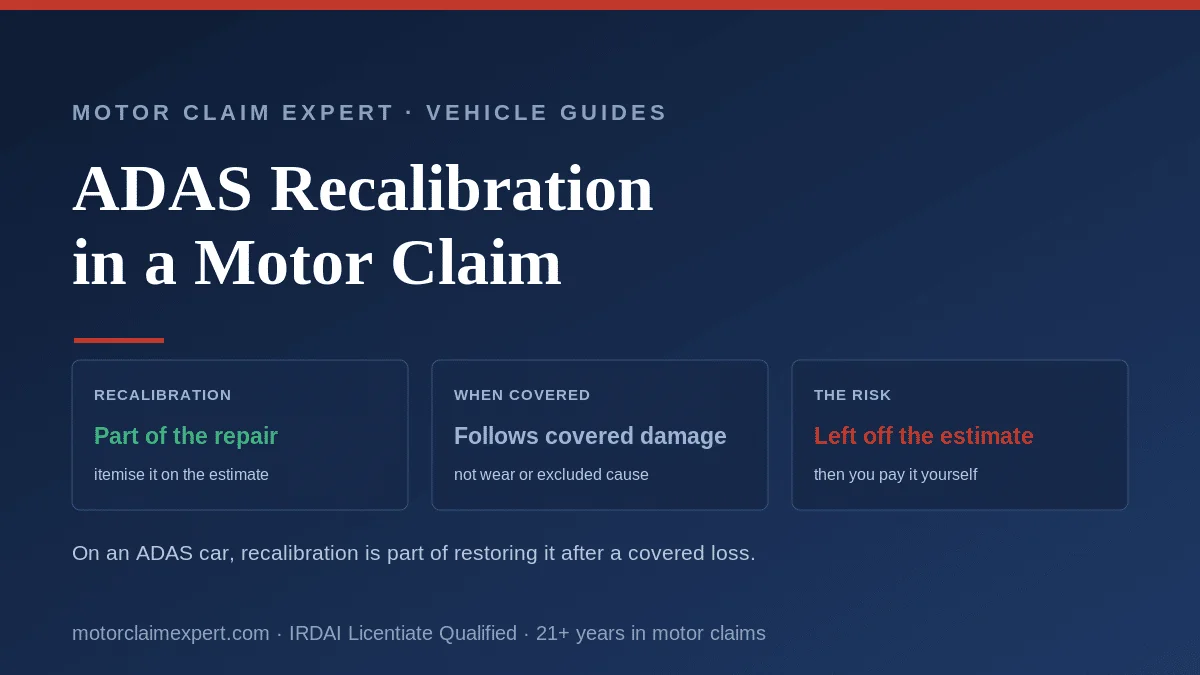
On a modern car, the windscreen and bumpers are no longer just glass and plastic — they carry the cameras and radar that run lane-keep, automatic emergency braking and adaptive cruise. Replace any of those parts after an accident and the ADAS sensors must be precisely recalibrated, or the safety systems can misjudge the road. For a claim, that recalibration is a real, billable cost — and it’s the line owners most often forget to raise, surveyors sometimes question, and disputes quietly turn on. This guide is not a general ADAS explainer; it’s about how an ADAS recalibration is actually treated inside a motor insurance claim in India.
Why ADAS changes the claim
The principle of a motor claim is indemnity — putting the car back to the condition it was in before the loss. On an ADAS-equipped car, “before the loss” includes safety systems that were correctly calibrated. So if a covered accident forces the replacement of a part the sensors sit on or behind, restoring the car properly requires recalibration; a windscreen swapped without recalibrating the camera behind it is not a complete repair. That’s the claims logic that makes recalibration a legitimate part of the bill — it isn’t an optional extra, it’s part of the repair.
Insider note — how a surveyor looks at recalibration: the assessor is checking two things. First, is it genuinely consequent on the accident? — recalibration triggered by replacing an accident-damaged windscreen or bumper is part of the covered repair; recalibration you’d have needed anyway (wear, a previous uninsured change) is not. Second, is it evidenced? — a workshop invoice line for “ADAS calibration” with the equipment/OEM procedure noted is far easier to pass than a vague verbal claim. Where an authorised workshop confirms the manufacturer mandates recalibration after that part replacement, the cost is hard to refuse. The friction almost always comes from recalibration being left off the estimate, not from insurers rejecting it on principle.
When it’s covered — and when it isn’t
| Situation | Recalibration on the claim? |
|---|---|
| Windscreen/bumper replaced due to a covered accident | Yes — part of restoring the car; itemise it |
| Sensor knocked out of alignment in the same accident | Yes — consequent on covered damage |
| Recalibration needed from wear or a prior change | No — not consequent on this loss |
| Damage from an excluded cause (e.g., unauthorised modification) | No — the underlying claim itself fails |
The deductions still apply
Recalibration being payable doesn’t mean the whole repair returns in full. The usual settlement mechanics still run: the compulsory deductible, and depreciation on the physical parts replaced (the glass, the bumper, the sensor housing) per the standard grid — though a zero-depreciation add-on removes that cut on eligible parts. Calibration labour itself is a service cost rather than a depreciating part. On a high-value ADAS repair this distinction matters, so read the settlement worksheet and check the calibration line survived it.
How to protect the recalibration in your claim
Never skip the recalibration to save a step. If a workshop offers to fit a new windscreen or bumper on an ADAS car without recalibrating, refuse — an uncalibrated camera can misread lanes or misjudge braking distance, which is a safety risk, not a saving. If the insurer resists paying for it, that’s a claim to pursue on evidence (OEM procedure + workshop report), not a reason to drive uncalibrated.
A worked example
ADAS makes cars safer and repairs more technical — and the claim only works if the recalibration is treated as what it is: part of restoring the car after a covered loss. Flag it early, get it itemised and evidenced, use a workshop equipped to do it, and check it survived the settlement. For the glass side of these repairs see our guide to windshield glass claims, and for how any damage claim is assessed end to end, the car damage claims guide and the motor insurance claim process.
Frequently Asked Questions — ADAS Recalibration Claims
Is ADAS recalibration covered by car insurance?
Generally yes, when the recalibration is required because a covered accident forced replacement of a sensor-carrying part such as the windscreen or bumper. It is treated as part of restoring the car. It is not covered when it stems from wear or an excluded cause.
Why does an ADAS car need recalibration after a repair?
Cameras and radar for lane-keep, automatic braking and adaptive cruise are mounted on parts like the windscreen and bumper. If those parts are replaced, the sensors must be recalibrated so the safety systems read the road correctly.
Will the insurer pay for ADAS calibration on a claim?
It is usually payable when it flows from covered accidental damage and is itemised on the estimate with the workshop noting the manufacturer’s requirement. Problems arise mainly when recalibration is left off the estimate, not because insurers reject it on principle.
Does depreciation apply to an ADAS claim?
Depreciation applies to the physical parts replaced (glass, bumper, sensor housing) per the standard grid, unless you hold a zero-depreciation add-on. The compulsory deductible also applies. Calibration labour is a service cost rather than a depreciating part.
What should I do to get ADAS recalibration paid?
Tell the surveyor and workshop the car has ADAS, get recalibration itemised as a named line on the estimate, ask the workshop to note the OEM requirement, use an equipped authorised workshop, keep the calibration report, and check the final worksheet.
Can I skip ADAS recalibration to save money?
No. Fitting a new windscreen or bumper without recalibrating can leave the camera misreading lanes or misjudging braking distance — a safety risk. If the insurer resists, pursue it with evidence rather than driving uncalibrated.
Who bears the ADAS recalibration cost?
If it is itemised and flows from a covered repair, the insurer generally bears it (subject to deductible and depreciation on parts). If it is omitted from the claim or arises from wear or an excluded cause, the owner ends up paying.
Sources & references
- Principle of indemnity in the Indian motor own-damage policy — restoring the vehicle to its pre-loss condition.
- Standard motor depreciation schedule (parts) and compulsory deductible; zero-depreciation add-on treatment.
- Vehicle manufacturer (OEM) recalibration requirements after replacement of ADAS sensor-carrying parts.


