
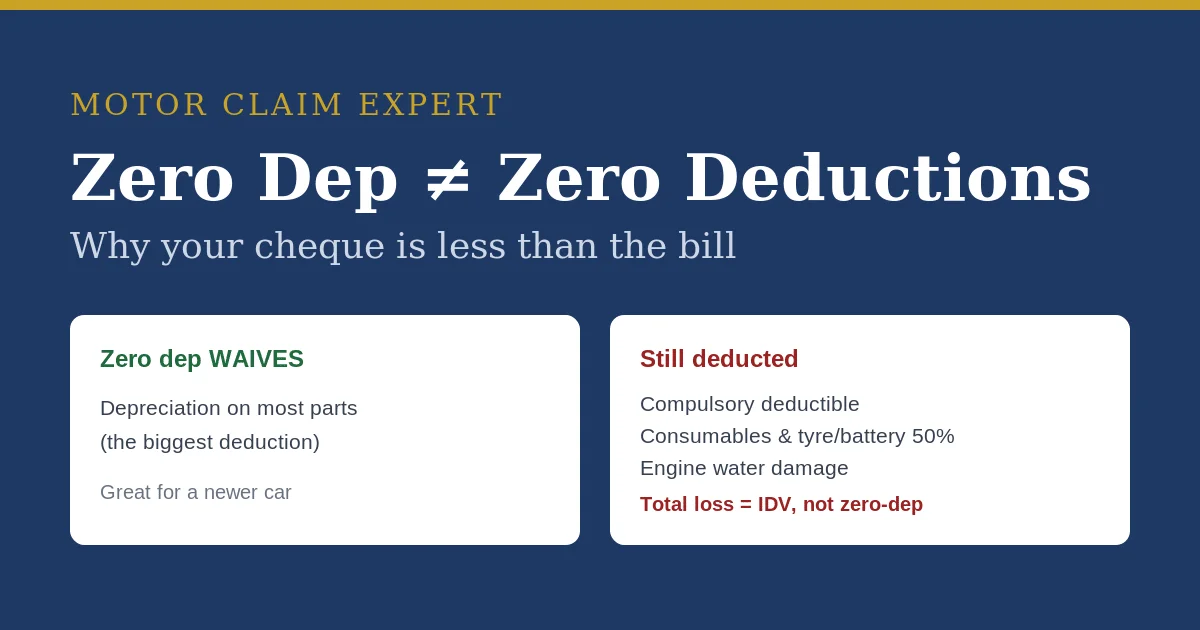
Short answer: “zero depreciation” does not mean zero deductions. It waives the depreciation on parts — which is the biggest deduction in an ordinary claim — but your settlement is still reduced by the compulsory deductible, consumables, a partial cut on tyres and batteries, and a few other items. So the cheque is almost always less than the garage bill, and that surprises people who assumed “zero dep” meant “fully paid.”
This guide explains exactly what zero depreciation removes, what it does not, and why — with a worked example so you know what to expect before you sign the bill. It builds on our depreciation grid and add-ons guides.
What zero depreciation actually removes
In a normal comprehensive claim, the insurer pays for replaced parts minus depreciation based on the car’s age — for plastic and fibre parts that can be 30–50%, so you pay a big share of a bumper or panel yourself. The zero-depreciation (bumper-to-bumper) add-on waives that depreciation on most parts, so you get the full cost of the new part. That is its real, valuable benefit, and for a car in its first few years it is usually worth the extra premium.
But “most parts” is not “everything,” and depreciation is not the only deduction in a claim.
What is still deducted — even with zero depreciation
| Still deducted | Why |
|---|---|
| Compulsory deductible (₹1,000 or ₹2,000) | A fixed amount you always bear on every own-damage claim, set by engine cc — zero dep does not remove it. |
| Voluntary deductible (if you opted for one) | If you chose a voluntary excess to lower your premium, you bear that too. |
| Tyres, tubes & batteries — often only 50% paid | Many zero-dep policies still apply ~50% depreciation to these; check your wording. |
| Consumables (engine oil, coolant, nuts, bolts) | Excluded unless you also bought a separate Consumables add-on. |
| Engine/water damage | Not covered by zero dep — needs a separate Engine Protection add-on. |
| Claim-count limit | Many insurers cap zero-dep claims (often around two) per policy year; beyond that, normal depreciation returns. |
Add these up and it is easy to see why a ₹60,000 repair does not become a ₹60,000 cheque even with zero dep. Each item is small on its own, but together they explain the gap between the estimate and the settlement.
Zero depreciation and a total loss: it doesn’t apply
One point catches people out badly. If the car is a total loss or theft, the zero-depreciation add-on is irrelevant — the claim is settled at the Insured Declared Value, the depreciated market value in your policy, not at “no depreciation.” Zero dep helps with repairs; it does nothing to raise a total-loss payout. That is set by your IDV, which is why choosing an adequate IDV matters as much as buying zero dep.
A worked example
Suppose an accident repair totals ₹50,000: ₹40,000 in body/plastic parts, ₹6,000 labour, ₹2,000 in a new battery, and ₹2,000 in consumables (oil, coolant). With a zero-dep policy on a <1500cc car:
• Parts depreciation on the ₹40,000: waived — you get it in full.
• Battery: paid at ~50% → you bear ~₹1,000.
• Consumables (₹2,000): not paid unless you have consumables cover.
• Compulsory deductible: ₹1,000.
So you bear roughly ₹1,000 + ₹2,000 + ₹1,000 = ~₹4,000, and the insurer pays ~₹46,000 — versus perhaps ₹30,000 without zero dep. Zero dep saved you a lot, but it was never going to be the full ₹50,000.
The misconceptions that cause disputes
- “Zero dep means I pay nothing.” No — the deductible, consumables and tyre/battery share remain.
- “Zero dep covers engine water damage.” No — that needs Engine Protect.
- “Zero dep raises my total-loss payout.” No — total loss is settled at IDV.
- “I can claim zero dep unlimited times.” Often capped per year; check the policy.
- “Consumables are automatically covered.” Only with a separate consumables add-on.
None of this makes zero depreciation a bad buy — for a newer car it is one of the most worthwhile add-ons, because it removes the single largest deduction. The point is to buy it understanding what it does and doesn’t do, so the settlement doesn’t feel like a shortfall. If your claim is settled for less than you expected and you believe a deduction was wrongly applied, ask the insurer for a written break-up first; a clear itemised settlement is your basis for a query or escalation.
Wondering whether to buy it at all? See our decision guide on zero dep vs comprehensive — is the add-on worth it for your car’s age.
Zero dep removes one big deduction, but others remain. See the complete list in every deduction on your repair bill, explained.
Frequently Asked Questions — Zero-Depreciation Deductions
Does zero depreciation mean no deductions at all?
No. Zero depreciation waives the depreciation on most parts, which is the largest deduction in an ordinary claim. But the compulsory deductible, any voluntary deductible, consumables, and a partial cut on tyres and batteries still apply, so your settlement is usually less than the full repair bill.
What is still deducted in a zero-depreciation claim?
Typically the compulsory deductible (₹1,000 or ₹2,000 by engine cc), any voluntary deductible you chose, consumables such as oil and coolant (unless you have a consumables add-on), and often ~50% of the cost of tyres, tubes and batteries. Engine water damage and total-loss settlements are also outside zero-dep.
Are tyres and batteries covered under zero depreciation?
Often only partially. Many zero-dep policies still apply around 50% depreciation to tyres, tubes and batteries, so you bear part of their cost. The exact treatment varies by insurer, so check your policy wording.
Is the compulsory deductible removed with zero dep?
No. The compulsory deductible is a fixed amount you bear on every own-damage claim, set by your car’s engine capacity, and zero depreciation does not remove it.
Does zero depreciation help in a total loss or theft claim?
No. Total-loss and theft claims are settled at the car’s Insured Declared Value (IDV) — its depreciated market value — not at “zero depreciation.” Zero dep only helps reduce deductions on repairs.
Are consumables covered under zero depreciation?
Not unless you also bought a separate Consumables add-on. Items like engine oil, coolant, nuts and bolts replaced during repair are normally excluded even with zero depreciation.
How many zero-depreciation claims can I make in a year?
Many insurers cap the number of zero-dep claims per policy year, commonly around two. Beyond the limit, normal depreciation may apply to further claims. Check your policy, as this varies between insurers.
Is zero depreciation still worth buying?
For a newer car — generally the first few years — it usually is, because it removes the biggest deduction (parts depreciation). Just buy it understanding that the deductible, consumables and tyre/battery share remain, so the payout won’t equal the full bill.


