
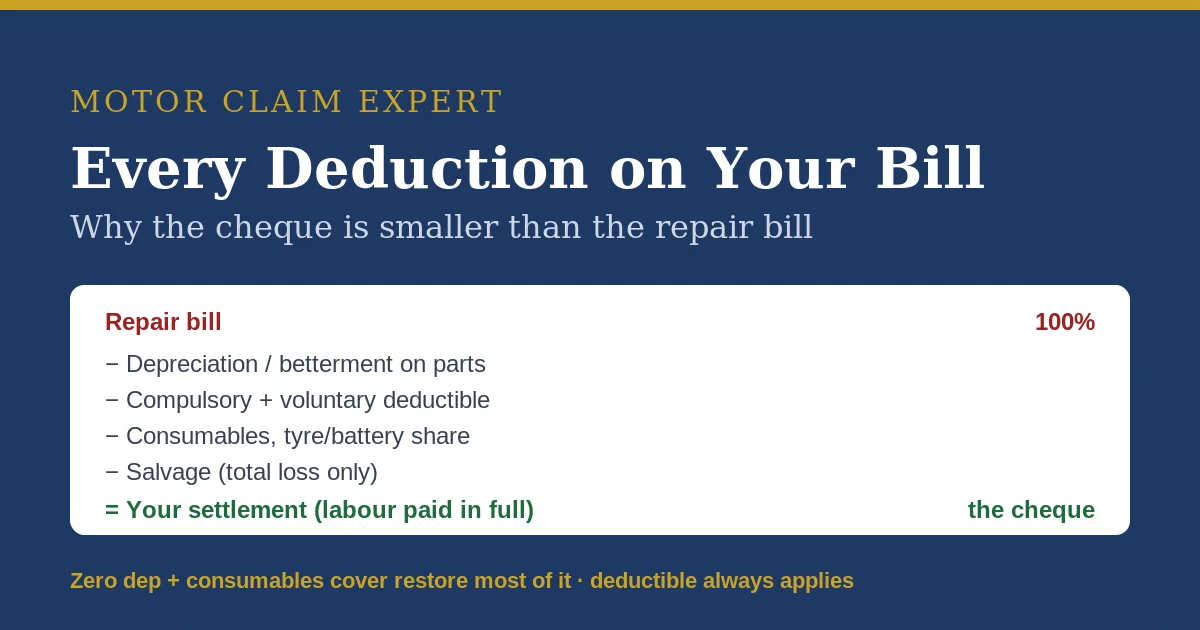
The cheque for a car repair claim is almost always smaller than the garage bill — and it is not one deduction but several stacked together. Depreciation (betterment) on parts, your compulsory and any voluntary deductible, consumables, a partial cut on tyres and batteries, and — in a total loss only — salvage. Each is small on its own; together they explain the gap between the estimate and the settlement. Importantly, a lower cheque is usually a correct settlement under your policy terms, not a short-payment. This page is the complete map of every line that reduces your claim: skim the table, then follow the link on any line you want to understand in depth.
Every deduction, at a glance
| Deduction | What it is | When it applies | Can you reduce it? |
|---|---|---|---|
| Depreciation / betterment on parts | The insurer pays the aged value of a replaced part, not a brand-new one — so you don’t get a free upgrade | Repair & total loss | Yes — a zero-dep add-on waives it on eligible repairs |
| Compulsory deductible | A fixed amount you always bear, set by IRDAI: ₹1,000 for cars up to 1500cc, ₹2,000 above | Every own-damage claim | No — it is regulatory |
| Voluntary deductible | An extra slice you opted into in exchange for a lower premium | Every OD claim, if opted | Yes — don’t opt for a high one if you claim often |
| Consumables | Engine oil, coolant, brake fluid, grease, nuts and bolts — excluded unless you buy a consumables add-on | Repair | Yes — buy a consumables add-on |
| Tyres, tubes & batteries | Paid at only about 50% because of rapid wear, even under zero dep | Repair | Partly — some add-ons help |
| Salvage (wreck value) | The value of the damaged shell, deducted only if you keep it | Total loss only | Yes — surrender the wreck |
| Rate / repair-vs-replace assessment | The surveyor may allow a repair rather than a replacement, or apply standard labour rates | Repair | Sometimes — with evidence |
Depreciation and betterment — the biggest cut
This is almost always the largest single deduction. When the insurer replaces a part, it pays for the aged value of the old part, not a new one — the logic being that a new part leaves the car “better than before,” and insurance restores you to your pre-loss position, not an improved one. That is what “betterment” means. The rate follows a standard schedule: metal parts depreciate by age (about 5% at a year old, rising to 50% by ten years), while rubber, nylon and plastic parts, tyres, tubes and batteries are cut a flat 50% at any age, fibreglass 30%, and glass nothing. Because modern bumpers, panels and lamp housings are largely plastic, depreciation bites even on a fairly new car. A zero-depreciation add-on waives this on eligible repairs; for the full part-by-part rates see the depreciation grid, and for what a zero-dep policy still deducts, see our zero-dep deductions guide.
The deductibles — the part you always bear
Two different things share the name “deductible,” and confusing them costs people money. The compulsory deductible is fixed by IRDAI — ₹1,000 for cars up to 1500cc and ₹2,000 above — and applies to every own-damage claim. You cannot remove it, and no add-on waives it. The voluntary deductible is a slice you choose to bear at claim time in return for a lower premium; it stacks on top of the compulsory one. A high voluntary deductible makes sense only if you rarely claim — if you claim often, it quietly eats into every settlement, and the premium saving may not be worth it. Check your policy schedule to see whether you have opted into one.
Consumables, tyres and batteries
Consumables — engine oil, coolant, brake fluid, grease, nuts, bolts and similar — are excluded from a standard policy unless you buy a consumables add-on. Tyres, tubes and batteries are commonly paid at only about 50% because they wear quickly, even under a zero-dep policy. Neither is large by itself, but on a bill that already carries depreciation and a deductible, they widen the gap between the estimate and the cheque.
Salvage — only in a total loss
Salvage appears only in a total loss. There, the settlement is the car’s IDV minus the value of the wreck minus the deductible — but the salvage line only reduces your cheque if you keep the wreck. Surrender it and you receive close to the full IDV; retain it and the salvage value is deducted. It never applies to ordinary repair claims.
Two worked examples: a repair claim and a total loss
Example A — a ₹60,000 repair on a three-year-old car up to 1500cc, without zero dep: plastic and painted parts ₹24,000, metal parts ₹16,000, labour ₹12,000, a new battery ₹5,000, consumables ₹3,000.
| Line | Deduction you bear |
|---|---|
| Plastic/painted parts ₹24,000 — depreciation at 50% | −₹12,000 |
| Metal parts ₹16,000 — depreciation at 15% (2–3 yrs) | −₹2,400 |
| Labour ₹12,000 — never depreciated | −₹0 |
| Battery ₹5,000 — paid at ~50% | −₹2,500 |
| Consumables ₹3,000 — not covered | −₹3,000 |
| Compulsory deductible | −₹1,000 |
| You pay out of pocket | ≈ ₹20,900 |
| Insurer pays | ≈ ₹39,100 |
Example B — a total loss. Say the IDV is ₹5,00,000 and the compulsory deductible is ₹1,000. If you surrender the wreck, you receive roughly ₹4,99,000. If you keep it and the assessed salvage is ₹80,000, the settlement is about ₹5,00,000 − ₹80,000 − ₹1,000 = ₹4,19,000 — plus a wreck you now have to sell yourself. The two routes are only worth comparing if you can sell the wreck for more than the ₹80,000 that was deducted.
Both examples are illustrative; actual parts prices, depreciation, IDV, salvage and deductibles vary by car, city and insurer.
How to legitimately keep more of your claim
- Buy zero dep if your car is eligible — it removes the single biggest deduction on repairs. Decide with our is-it-worth-it guide.
- Add a consumables add-on if you claim more than occasionally.
- Don’t opt into a high voluntary deductible if you tend to claim — the premium saving rarely covers what you then bear.
- On a total loss, surrender the wreck unless you can sell it for more than the salvage that would be deducted.
- Check the depreciation applied matches the grid and query the surveyor if a repairable part was booked as a costly replacement — see the garage-vs-surveyor gap.
- Skip claiming trivial dents to protect your no-claim bonus, which can be worth more than a small repair.
- Ask for an itemised settlement letter so every deduction is visible and you can spot an error.
Frequently Asked Questions — Car Insurance Claim Deductions
Why is my claim so much less than the repair bill?
Because several deductions stack: depreciation (betterment) on replaced parts, your compulsory and any voluntary deductible, unpaid consumables, a partial cut on tyres and batteries, and — in a total loss — salvage. Labour is usually paid in full. Much of the gap is legitimate, though some assessment reductions can be questioned.
What is betterment in a car insurance claim?
Betterment is the principle that insurance restores your car to its pre-loss condition, not a better one. In practice it means the insurer applies depreciation on a new replacement part, paying only a percentage — the same thing the depreciation grid describes.
Which deductions can I avoid?
Depreciation on most parts can be avoided with a zero-depreciation add-on, and consumables with a consumables add-on. The compulsory deductible cannot be avoided. The salvage deduction applies only in a total loss and only if you keep the wreck.
Is the deductible removed by zero depreciation?
No. Zero depreciation waives depreciation on parts, but the compulsory deductible, any voluntary deductible, and consumables (without a separate add-on) still apply.
Do I pay GST on my claim payout?
You do not pay GST on the reimbursement itself; the settlement is calculated net of the deductions above. GST treatment on the underlying repair is handled between the insurer and the garage, and does not add a charge to your payout.
Are tyres and batteries fully covered?
Often only partly. Many policies pay about 50% of tyres, tubes and batteries because of their fast wear, even under a zero-dep policy. Check your wording for the exact treatment.
Should I claim for a small dent?
Often not. Between the deductible and the depreciation, a small claim may leave little in your hand, and it can reset your no-claim bonus. Self-funding minor damage frequently works out cheaper over the policy’s life.
Sources & official references
- Tariff / standard schedule: the parts-depreciation schedule and the compulsory deductible (₹1,000 for cars up to 1500cc, ₹2,000 above) originate in the India Motor Tariff, 2002 and carry into today’s IRDAI-approved motor policy wordings.
- Policy wording: depreciation on parts, deductibles, the consumables exclusion and settlement of a total loss at IDV less salvage are set by your insurer’s IRDAI-approved motor policy wording.
- Product note: zero depreciation, consumables cover and similar are optional IRDAI-filed add-ons; their terms and pricing vary between insurers.


