
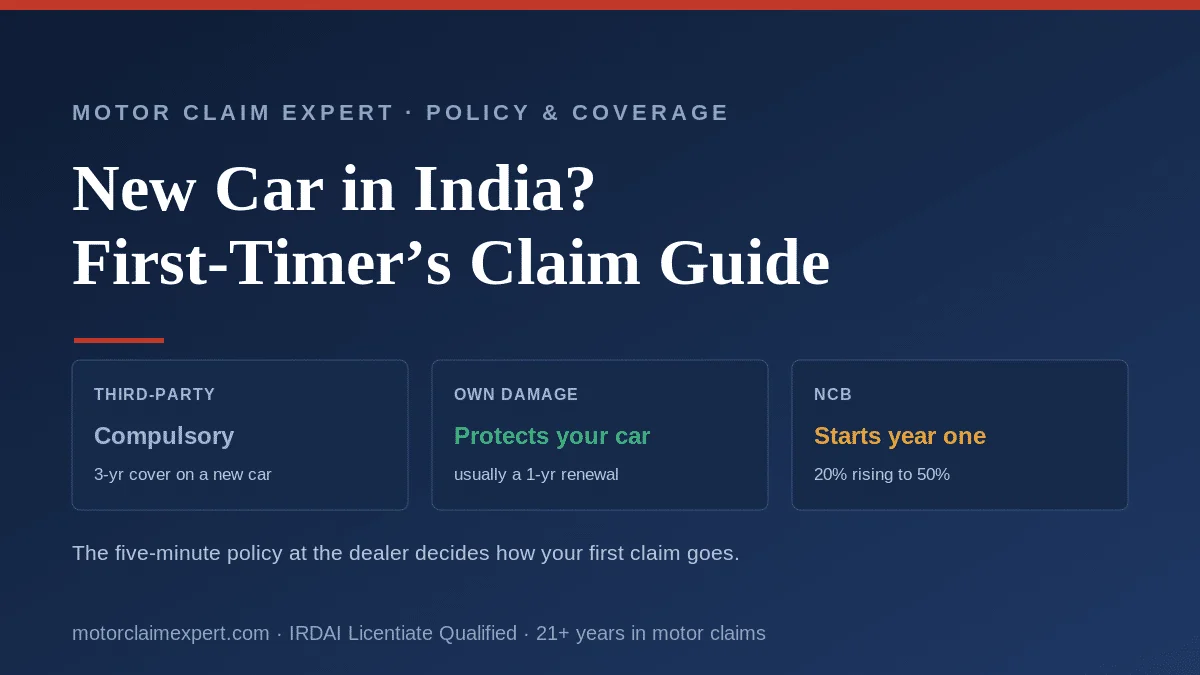
Buying your first car in India is a milestone — and the insurance is usually an afterthought handled at the dealer’s desk in five minutes. That five minutes decides how your first claim will go. Most first-time owners don’t choose their policy; they accept whatever the showroom bundles, never read it, and only discover the gaps when a claim is cut or refused. This guide is written for the beginner who wants to get it right from day one: what cover the law requires, what actually protects your car, and the handful of first-timer mistakes that quietly wreck a claim.
The three covers, in plain terms
Indian car insurance is built from three ideas. Understanding them is the whole game for a first-timer, because the dealer will use the words without explaining them.
| Cover | What it pays for | Do you need it? |
|---|---|---|
| Third-party (TP) | Injury/death or property damage you cause to others | Compulsory by law — you cannot drive without it |
| Own damage (OD) | Damage to your car — accident, fire, theft, floods | Optional in law, but essential for a new car |
| Comprehensive | TP + OD together (the usual choice) | Yes — this is what a first-time owner should hold |
The single most important thing to understand: a third-party-only policy pays nothing towards your own car. If you dent it, scrape it, flood it or have it stolen on a TP-only cover, the repair is entirely yours. That’s why, for a brand-new car, comprehensive is the sensible choice. The full breakdown is in our guide to third-party vs own-damage vs comprehensive.
Expert note — the “bundled” policy on a new car: since a regulatory change, a new private car must be sold with a long-term third-party cover of 3 years built in at registration (this is compulsory). The own-damage part, however, is usually taken as a 1-year cover alongside it — so a typical new-car policy is a bundled 3-year TP + 1-year OD. What this means for you: your own-damage cover expires after the first year even though the third-party runs for three. Miss that first OD renewal and your car is legally insured (TP) but has no protection of its own. Diarise the OD renewal date the day you buy.
Your No-Claim Bonus starts on day one
Every claim-free year is worth money: the No-Claim Bonus (NCB) is a discount on your own-damage premium for not claiming. It begins at 20% after your first claim-free year and climbs to 50% after five. It belongs to you, not the car, and it applies only to the own-damage part (never to third-party). The practical lesson for a beginner: for a small dent, it is often cheaper to pay the repair yourself and protect the bonus than to claim and reset it. Learn that habit early and your premiums stay low for years.
The first-timer mistakes that wreck a claim
Most first claims that go wrong were set up to fail at the point of purchase or in the first hour after an accident. These are the five that catch beginners.
Avoid these, and most first claims go smoothly. (1) Accepting the dealer’s default policy blind — the showroom’s bundled cover may carry a low IDV or the wrong add-ons; read it before you sign. (2) Choosing purely on the cheapest premium — a rock-bottom policy often means a low IDV, a smaller cashless-garage network and more out-of-pocket at claim time. (3) Starting repairs before the surveyor inspects — repair first and the claim can be reduced or refused; always intimate and let the survey happen first. (4) Not disclosing accurately — hiding a fact or a modification is a rejection trap. (5) Driving without your documents — no valid licence, RC or policy on you weakens any claim.
Set it up right — a first-buyer checklist
When the first claim comes
Sooner or later something happens — a car-park scrape, a monsoon puddle, a minor collision. The claim itself is straightforward if you follow the order: intimate the insurer first and get a claim number, don’t start repairs until the surveyor has seen the damage, use a network garage for a cashless settlement where you can, and keep every document. The full walk-through is in our own-damage claim walkthrough and the motor insurance claim process, and the papers you’ll need are listed in our claim documents guide.
A worked example
Insurance is the one part of buying your first car that you’ll be glad you understood. Hold comprehensive cover on a new car, keep the IDV honest, guard your own-damage renewal date, disclose truthfully, and never repair before the survey — and your first claim will be an inconvenience, not a loss. Start with the basics in third-party vs own-damage vs comprehensive and how the No-Claim Bonus works, and you’ll be ahead of most owners on the road.
Frequently Asked Questions — New Car Owners
Do I need insurance for a new car in India?
Yes. Third-party insurance is compulsory, and a new car must be sold with a 3-year third-party cover at registration. To protect your own car you also need own-damage cover, i.e. a comprehensive policy.
Is third-party or comprehensive better for a first-time owner?
Comprehensive, for a new car. Third-party pays nothing towards your own vehicle, so a dent, theft or flood would be entirely your cost on a third-party-only policy.
What is the 3-year insurance rule for new cars?
A new private car must be sold with a long-term 3-year third-party policy. The own-damage part is usually taken as a 1-year cover and renewed annually, so your own-damage protection can lapse after year one if you forget to renew it.
When does the No-Claim Bonus start for a new owner?
After your first claim-free year, at 20%, rising to 50% after five consecutive claim-free years. It applies only to the own-damage premium and belongs to you, not the car.
What are common first-time car insurance mistakes?
Accepting the dealer’s default policy without reading it, choosing only on the cheapest premium, starting repairs before the surveyor inspects, not disclosing facts accurately, and driving without your documents.
Can I claim if I repair my new car before the surveyor sees it?
It is risky. Insurers can reduce or reject a claim for repairs done before inspection. Always intimate the insurer first and let the surveyor assess the damage before repairs begin.
What should a first-time owner check before buying insurance?
Take comprehensive cover, confirm a realistic IDV, note both the third-party and own-damage dates, consider useful add-ons like zero-depreciation on a new car, and read the exclusions once.
Sources & references
- IRDAI — policyholder motor insurance guidance (third-party compulsory; long-term 3-year third-party cover for new cars).
- IRDAI-governed No-Claim Bonus slabs (20% after year one, up to 50%); applies to own-damage only.
- Standard Indian motor policy wording — own-damage perils, exclusions, IDV basis.


