
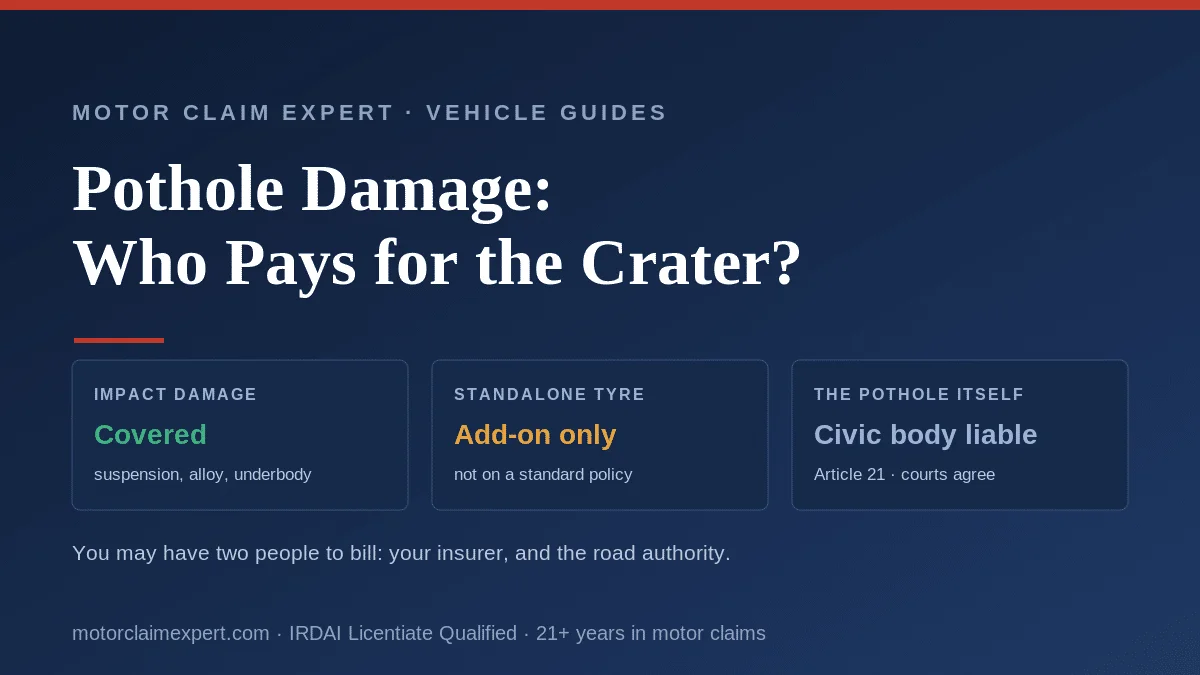
Every monsoon, India’s roads dissolve into a minefield of potholes, and every monsoon the same question follows the sickening bang of a wheel dropping into one: will my insurance pay for this? The honest answer is layered. Genuine impact damage to your car from a pothole is usually covered — but the tyre that burst, the alloy that cracked and the rubber bushes the surveyor will “depreciate” are each treated differently, and a careless claim can leave you paying more than you expected. There is also a second route most owners never consider: making the civic body that left the crater pay. This guide covers both.
Is pothole damage even covered?
Yes — if you hold a comprehensive or standalone own-damage policy, and if the damage is genuine accidental impact damage. Hitting a deep pothole is an accident: the sudden impact can bend a suspension arm, crack an alloy, knock the wheel alignment out, damage the steering rack or gouge the underbody, and all of that falls squarely within own-damage cover. What own-damage cover does not pay for is ordinary wear and tear — and that distinction is exactly where pothole claims get contested. If you’re unsure which policy you hold, our guide to third-party vs own-damage vs comprehensive lays out the difference.
Expert note — how the surveyor separates impact from wear: a pothole claim gets more scrutiny than most, because a worn-out suspension bush or an old, perished tyre can look like “pothole damage” to an owner but reads as age to a trained eye. The surveyor inspects the tyre sidewall, the rim, the wheel alignment, the underbody and the suspension components, and asks a simple question: is this a sudden impact pattern (a fresh gouge, a bent arm, a sidewall bulge from a single hit) or gradual deterioration (even tread wear, corrosion, perished rubber)? Impact damage is paid; deterioration is declined as wear and tear. This is why photographing the pothole and the fresh damage at the scene matters so much — it establishes the cause.
What’s covered, what needs an add-on
The single biggest surprise in a pothole claim is the tyre. Owners assume the burst tyre is the claim — but on a standard policy it’s often the one thing that isn’t paid.
| Part | On a standard comprehensive policy |
|---|---|
| Suspension, steering, underbody | Covered as accidental impact damage (metal parts depreciated by age; rubber bushes by ~50%) |
| Alloy wheel / rim | Covered if damaged in the same impact; standalone rim damage needs a Rim Protect add-on |
| Tyre (burst / sidewall) | Generally not covered on its own — a standalone tyre burst needs a Tyre Protect add-on |
| Consumables (oil, nuts, bolts, fluids) | Deducted from the payout unless you hold a Consumables add-on |
| Wheel alignment / balancing | Payable when it’s part of repairing genuine impact damage, not as routine maintenance |
The deductions that quietly shrink a pothole payout. Even a valid pothole claim rarely pays the full repair bill on a standard policy. Watch for three cuts: depreciation on the rubber and plastic suspension parts (bushes, mounts) at up to 50%; the compulsory deductible of Rs 1,000–2,000 that applies to every claim; and the tyre exclusion — if only the tyre burst and nothing else was damaged, there may be no claim at all. A zero-depreciation add-on removes the first cut; Tyre and Consumables add-ons remove the others. Know which add-ons you actually hold before you assume the whole bill is covered.
Should you claim it at all?
A pothole often does modest damage — an alignment, a bush, a rim straighten — that lands close to the deductible. As with any small claim, the maths is about the deductible and your No-Claim Bonus, not just the repair bill.
The second route: make the civic body pay
Here is what almost no owner acts on: the pothole should not have been there, and the authority that failed to fix it can be held responsible. Indian courts have been strikingly clear on this. The Supreme Court held decades ago, in Municipal Corporation of Delhi v. Subhagwanti (1983), that a civic body is liable for negligence in maintaining public infrastructure; courts have since treated the right to reasonably safe, pothole-free roads as part of the right to life under Article 21. As recently as 2025 the Bombay High Court fixed compensation for pothole deaths and injuries and insisted that civic authorities and road contractors be held accountable.
How to preserve the civic-liability option: at the scene, photograph the pothole (with something for scale), the fresh damage and the location; note the exact spot and the road-owning authority (municipal corporation, PWD, NHAI). File a written complaint to that authority and keep the acknowledgement. For property damage you can pursue the authority through a civil or consumer forum; for injury or worse, the constitutional and tort routes above apply. You don’t have to choose one path — many owners claim on their own insurance to get the car repaired quickly and pursue the civic body separately. Evidence gathered in the first ten minutes is what makes the second route possible.
Treat these rulings as confirmation that the principle is well established, not as a guarantee of any particular outcome — every civic claim turns on its own facts, the authority involved and the evidence you preserved. The strength of the route comes from settled law on public accountability, not from any single headline.
At the scene — your evidence checklist
A worked example
A pothole is one of the few road hazards where you may have two people to bill: your insurer for the impact damage, and the authority that let the crater form. Get the car repaired through your own-damage cover, know which deductions and exclusions to expect, and don’t let the civic route lapse for want of a photograph. For related specific-damage calls, see our guides to alloy-wheel damage and windshield glass claims; for monsoon-season protection, the engine-protection add-on; and for how claims are assessed end to end, the motor insurance claim process.
Frequently Asked Questions — Pothole Damage Claims
Does car insurance cover pothole damage in India?
Yes. Genuine accidental impact damage to your car from a pothole — suspension, steering, underbody, or an alloy cracked in the same impact — is covered under a comprehensive or standalone own-damage policy. Ordinary wear and tear is not covered.
Are tyres covered if they burst in a pothole?
Usually not on their own. A standalone tyre burst with no other damage is generally excluded from a standard policy; you need a Tyre Protect add-on for it. Tyres damaged in an accident that also damages the vehicle can be covered.
Is alloy wheel or rim damage from a pothole covered?
An alloy or rim damaged in the same impact as other covered damage is generally payable. Standalone rim damage with nothing else affected usually needs a separate Rim Protect add-on.
What deductions apply to a pothole claim?
Depreciation on rubber and plastic suspension parts (up to 50%), the compulsory deductible of Rs 1,000 to 2,000, and any consumables cost unless you hold a consumables add-on. A zero-depreciation add-on removes the depreciation cut.
Should I claim small pothole damage?
If the repair is close to your deductible, paying it yourself protects your No-Claim Bonus. For significant damage — a bent suspension arm, cracked alloy or steering damage — claiming is worthwhile because the cost far exceeds the deductible and NCB loss.
Can I claim compensation from the municipality for pothole damage?
Indian courts have repeatedly held civic bodies and road contractors liable for pothole damage and deaths, treating safe roads as part of the right to life under Article 21. You can pursue the road authority through a civil or consumer forum — preserve photos and file a written complaint.
What should I do at the scene of pothole damage?
Stop safely, photograph the pothole and the damage with a landmark for location, note the road-owning authority, avoid driving further on a damaged wheel, intimate your insurer promptly, and file a written complaint with the civic body.
Sources & references
- Indian comprehensive / standalone own-damage motor policy wording — accidental impact damage cover, tyre and rim exclusions, consumables.
- Standard motor depreciation schedule (rubber/plastic parts) and compulsory deductible (Rs 1,000 up to 1500cc, Rs 2,000 above).
- Supreme Court of India — Municipal Corporation of Delhi v. Subhagwanti (1983), on civic liability for negligent maintenance of public infrastructure.
- Bombay High Court (2025) — compensation fixed for pothole deaths and injuries, holding civic bodies and contractors accountable; right to safe roads under Article 21.


