
A stone flicks off a truck on the highway, and by evening a tiny chip has crept into a spidery crack across your windscreen. It is the most common damage a car suffers in India — and also the most misunderstood at claim time. Should you claim it or pay yourself? Will it cost you your No-Claim Bonus? Will the insurer knock off depreciation on a five-year-old car’s glass? A windshield claim has its own quirks that make it different from every other own-damage claim, and knowing them can be the difference between a free replacement and an expensive mistake. This guide walks through exactly how a car glass claim works.
Is windshield damage even covered?
Yes — if you hold a comprehensive (own-damage) or standalone own-damage policy. A cracked or shattered windscreen is accidental external damage to your car, which is exactly what own-damage cover is for, whether the crack came from a flying stone, a fallen branch, vandalism or a collision. The one situation where you are not covered is if you hold only a third-party policy: third-party insurance pays for damage you cause to others, never to your own vehicle. If you are unsure which you have, our guide to third-party vs own-damage vs comprehensive explains the three building blocks.
The one rule that makes glass different: zero depreciation
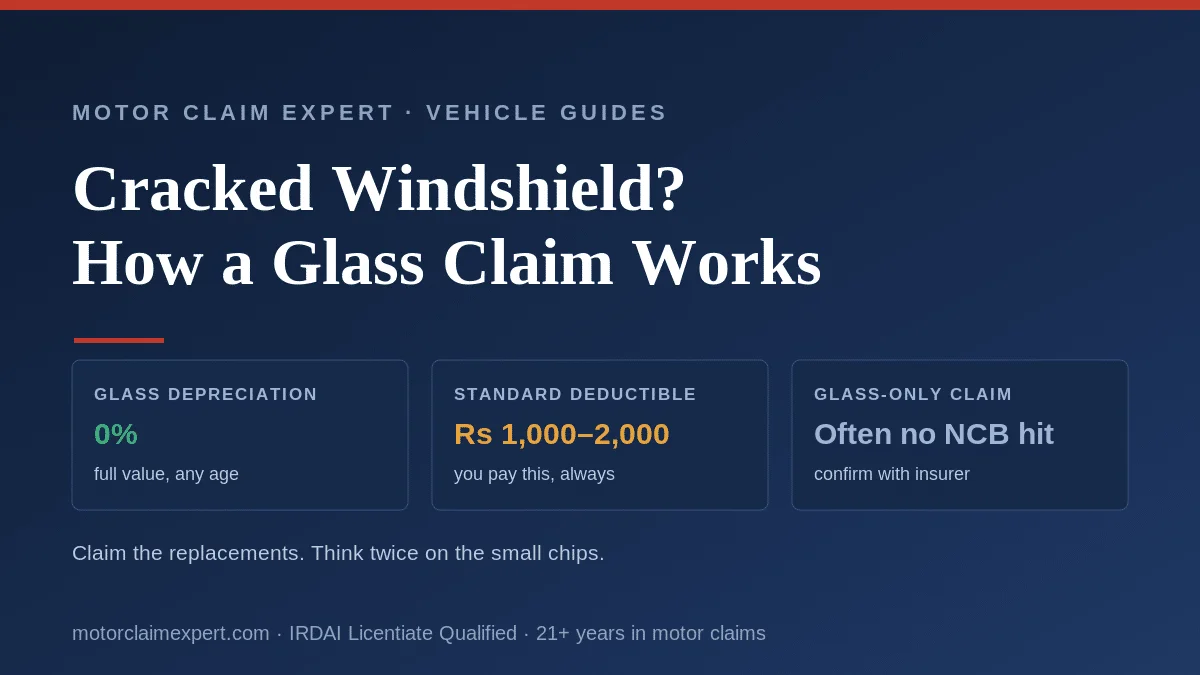
Here is the single most useful fact about a glass claim, and the one most owners never learn. In a normal motor claim, the insurer applies depreciation to replaced parts based on the car’s age — plastic and rubber parts are cut by a flat 50%, metal parts by an age-based percentage — so on an older car you bear a chunk of the bill yourself. Glass is the great exception. Under the standard Indian motor depreciation schedule, glass attracts nil depreciation. A windshield on a seven-year-old car is reimbursed at exactly the same full rate as one on a brand-new car.
Expert note — why this matters more than a zero-dep add-on: people buy a zero-depreciation add-on precisely to stop the insurer deducting depreciation on replaced parts. But for glass you already have that benefit built in — the standard depreciation rate on glass is 0% whether or not you bought zero-dep. So a windshield replacement is one of the few claims where an owner on a plain comprehensive policy and an owner with zero-dep are treated identically on the glass itself. Do not let anyone tell you your old car’s windshield will be “depreciated” — on glass, there is nothing to depreciate.
Will a glass claim cost me my No-Claim Bonus?
This is the question that stops people claiming, and the honest answer is: usually not, but it depends on your insurer. Your No-Claim Bonus is a discount — up to 50% off your own-damage premium after five claim-free years — and it normally resets to zero the moment you make any own-damage claim. Many insurers, however, treat a windshield-only claim as a special case and do not reset the NCB for it, precisely because they would rather you fix a dangerous cracked screen than drive on it to protect a discount.
Do not assume — confirm it in writing. “Glass claims don’t affect NCB” is common industry practice, not a guaranteed rule, and it varies between insurers and policy wordings. Before you lodge the claim, ask your insurer the specific question: “Will a windshield-only claim reset my No-Claim Bonus?” and get the answer on email or chat. If it does protect your NCB, claim freely. If it doesn’t, weigh the claim against the NCB you would lose (see the maths below) — on a small crack, keeping a 45–50% discount can be worth far more than the repair.
The catch: the compulsory deductible
Every own-damage claim in India carries a compulsory (standard) deductible — an amount the insurer subtracts from every settlement, which you bear yourself. It is fixed at Rs 1,000 for cars up to 1500cc and Rs 2,000 for cars above 1500cc, and it applies to a glass claim exactly as to any other. If your windshield replacement is billed at Rs 12,000, the insurer pays Rs 11,000 (on a sub-1500cc car) and you pay the Rs 1,000 deductible. That is fine for a full replacement — but it is the whole reason a small glass claim can be pointless: if a chip can be repaired for Rs 800, there is nothing left for the insurer to pay once the Rs 1,000 deductible is applied.
Repair or replace — and should you even claim?
Not every crack needs a new windshield, and not every replacement needs a claim. Two decisions sit on top of each other: the technical one (can it be repaired, or must it be replaced?) and the financial one (is it worth claiming?).
| Damage | Usual fix | Claim it? |
|---|---|---|
| Small chip / star (coin-sized) | Resin repair, often Rs 500–1,500 | Usually not — likely below the deductible; pay it yourself and keep it clean |
| Crack in driver’s line of sight | Replacement (a repair leaves distortion) | Yes — safety issue; replacement cost usually well above the deductible |
| Long crack / spreading damage | Replacement | Yes — glass has zero depreciation, so the payout is strong |
| Shattered / smashed screen | Replacement | Yes — always claim; check if ADAS recalibration is also needed |
The modern twist: ADAS and windshield cameras
On newer cars there is a complication that did not exist a decade ago. Many models now mount the camera and sensors for ADAS (advanced driver-assistance systems — lane-keep, automatic emergency braking, adaptive cruise) on the windshield itself. Replace the glass and those sensors must be precisely recalibrated, or features like automatic braking can misjudge distances. Recalibration is a real, billable cost — and it is a part of the claim owners routinely forget to raise.
If your car has ADAS, insist the recalibration is included: when you lodge a windshield claim on an ADAS-equipped car, tell the surveyor and the garage up front that the glass carries a camera and will need recalibration, and make sure that line appears on the estimate. Skipping it doesn’t just cost you money — it can leave your safety systems reading the road wrongly. We cover this in depth in our guide to ADAS calibration and insurance claims.
How to make the claim, step by step
A glass claim is one of the simplest there is — there’s usually no FIR, no third party and no dispute over how it happened. The mechanics are straightforward:
A worked example
A cracked windshield feels like bad luck, but it’s the one claim where the rules quietly work in your favour: full-value glass with no depreciation, and often no hit to your bonus. Get the two decisions right — repair the small stuff yourself, claim the replacements, and always confirm the NCB position first — and a broken screen costs you little more than a deductible. For the wider picture of how claims are assessed and settled, start with the motor insurance claim process, and for another common “small damage — claim or not?” call, see our guide to alloy-wheel damage claims.
Frequently Asked Questions — Windshield Glass Claims
Is a cracked windshield covered by car insurance?
Yes, if you have a comprehensive or standalone own-damage policy. A cracked or shattered windscreen is accidental external damage, which own-damage cover pays for. A third-party-only policy does not cover your own glass.
Is depreciation deducted on a windshield claim?
No. Glass carries nil (0%) depreciation under the standard Indian motor depreciation schedule, so the windshield is reimbursed at full cost regardless of the car’s age, even without a zero-depreciation add-on.
Does a windshield claim affect my No-Claim Bonus?
Often not. Many insurers treat a windshield-only claim as a special case and do not reset the NCB for it, but this is insurer-specific, not guaranteed. Confirm your insurer’s position in writing before you claim.
Is there a deductible on a glass claim?
Yes. The compulsory (standard) deductible applies to every own-damage claim: Rs 1,000 for cars up to 1500cc and Rs 2,000 above 1500cc. This is why a small chip that costs less to repair than the deductible is not worth claiming.
Should I repair or replace a chipped windshield?
A small coin-sized chip can usually be resin-repaired cheaply. A crack in the driver’s line of sight, a long or spreading crack, or a shattered screen needs replacement — and replacement usually justifies a claim.
Does a new windshield need ADAS recalibration?
If your car mounts its ADAS camera and sensors on the windshield, yes — the sensors must be recalibrated after replacement or features like automatic braking can misjudge distances. Make sure recalibration is included on the claim estimate.
Can I get a windshield replaced cashless?
Yes, at an authorised or network glass vendor tied up with your insurer. A cashless job means you pay only the compulsory deductible and the insurer settles the balance directly with the vendor.
Sources & references
- Standard Indian motor depreciation schedule — glass rated at nil (0%) depreciation on replaced parts.
- Standard (compulsory) deductible under the Indian motor own-damage policy — Rs 1,000 up to 1500cc, Rs 2,000 above 1500cc.
- IRDAI-governed No-Claim Bonus slabs (20% to 50%); windshield-only NCB treatment varies by insurer and policy wording.
- Insurer motor policy wordings on glass replacement, cashless network garages and ADAS recalibration.


