
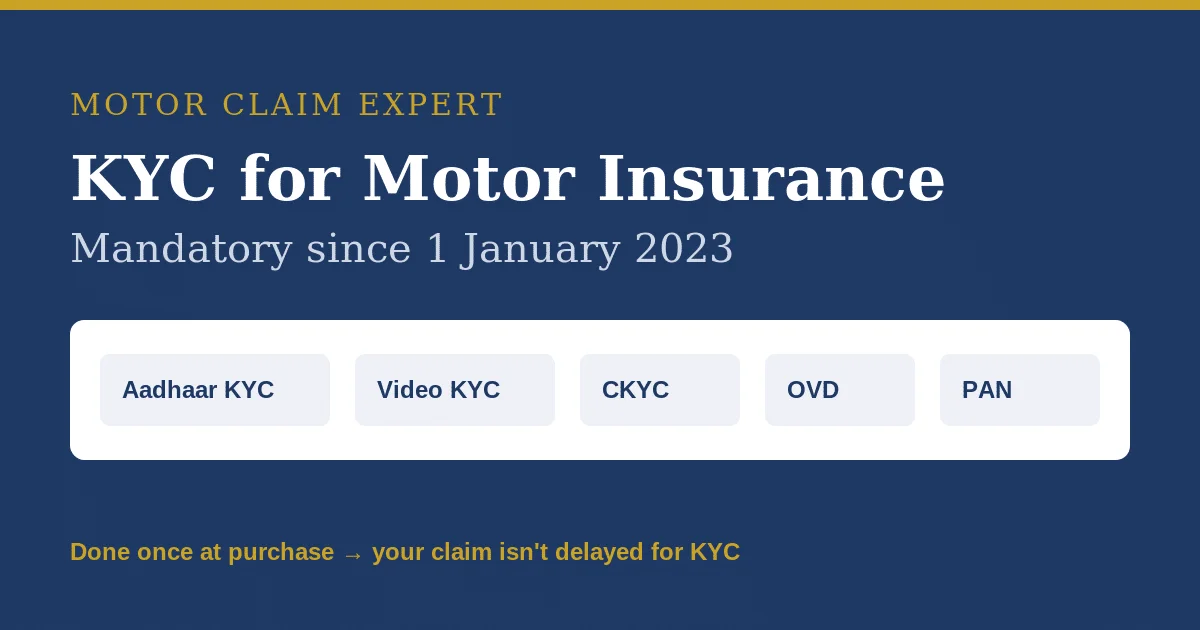
Since 1 January 2023, KYC is no longer optional in motor insurance. IRDAI made Know Your Customer verification mandatory for every insurance policy — including car and bike — regardless of premium. Most people now complete it when they buy or renew, and forget about it. But KYC quietly resurfaces at the worst possible moment: at claim time, an incomplete or mismatched KYC can hold up your settlement even when everything else is in order.
This guide explains what the KYC rule actually requires, the ways you can complete it, and — the part the insurer brochures skip — how it affects a claim, including theft and death claims where someone else is collecting the money. It sits alongside our claim documents checklist, where KYC is now part of the core set.
What the 2023 KYC rule requires
KYC means proving your identity to the insurer using an approved document or method. Under the IRDAI norm effective 1 January 2023, it applies to all new policies and renewals, for individuals and companies, with no exemption for small premiums. The intent is a one-time, verified identity on file — which is also why, once your KYC is complete, the insurer should not need to re-collect it at claim stage.
The ways you can complete KYC
| Method | How it works |
|---|---|
| Aadhaar-based / Digital KYC | Verify identity using Aadhaar (with consent) — the fastest, most common route. |
| Video KYC | A short live video verification with the insurer, done from your phone. |
| CKYC (Central KYC) | If you already have a CKYC number from a bank or another insurer, it can be reused. |
| Officially Valid Documents (OVD) | Passport, voter ID, driving licence, etc. — used where Aadhaar can’t be authenticated (injury, illness, age). |
| PAN | A self-attested PAN copy is commonly required and also serves as identity proof. |
You only need one valid route to be verified. Keep an identity document handy and, if you have a CKYC number, use it — it is the quickest way to avoid repeating the process.
The good news for claims: because KYC is now captured up front, a claim should not be delayed to collect it — if your KYC is already complete and current. The friction only appears when it is missing, outdated, or the details don’t match your claim.
How KYC affects a claim
KYC becomes a claim issue in a few specific situations. Knowing them in advance turns a possible hold into a non-event:
- Incomplete or outdated KYC. If your identity was never fully verified — common on older policies migrated into the new regime — the insurer may ask you to complete KYC before releasing payment. Do it promptly; it is quick via Aadhaar or video KYC.
- A name or detail mismatch. If the name on your KYC doesn’t match the policy or the vehicle’s RC, expect a query. Consistency across documents matters as much as the documents themselves.
- The payee isn’t the policyholder. In a theft or total-loss claim settled to a financier, or a death claim paid to a nominee or legal heir, the recipient’s KYC is needed too — because the insurer is paying money to that person.
KYC for nominees, financed and company-owned vehicles
Whenever the money goes to someone other than the original policyholder, the insurer must verify that recipient:
- Death claims: the nominee or legal heir completes KYC, since the settlement is paid to them.
- Financed vehicles: where the claim clears an outstanding loan, the financier’s details are already on file; your KYC still needs to be current for any balance paid to you.
- Company-owned vehicles: the entity’s KYC (and authorised signatory) applies, not just an individual’s.
How to keep KYC from ever slowing your claim
- Complete KYC at purchase or renewal and confirm it shows as verified.
- Keep your identity details consistent across the policy, PAN, Aadhaar and RC.
- Update KYC after any change of name or address so it never goes stale.
- Have a document ready (Aadhaar/PAN/OVD) so that if a recipient’s KYC is needed at claim time, it takes minutes, not days.
KYC is the least glamorous part of a motor policy and, done once, the easiest to forget. But it is now the first identity gate every claim passes through. A verified, consistent KYC on file means your claim is judged on its merits — not held up over who you are.
Frequently Asked Questions — KYC for Motor Insurance Claims
Is KYC mandatory for car insurance in India?
Yes. Since 1 January 2023, IRDAI has made KYC mandatory for all insurance, including car and bike, for every new policy and renewal, regardless of the premium amount. It applies to individuals and companies alike.
What documents are accepted for insurance KYC?
You can complete KYC through Aadhaar-based or digital KYC, video KYC, or a Central KYC (CKYC) number. Officially Valid Documents such as a passport, voter ID or driving licence are accepted where Aadhaar can’t be authenticated, and a self-attested PAN copy is commonly required.
Do I have to do KYC again when I make a claim?
Not if your KYC is already complete and current. Because KYC is now collected when you buy or renew, insurers generally don’t re-collect it at claim time. You may be asked to complete it only if it is missing, outdated, or the details don’t match your claim.
Can my claim be delayed because of KYC?
It can, if your KYC is incomplete, outdated, or inconsistent with the policy or the vehicle’s RC — or if the payment is going to someone other than you (a nominee, legal heir or financier) whose KYC also needs verifying. Completing it promptly, usually via Aadhaar or video KYC, clears the hold quickly.
Who needs to do KYC in a death or theft claim?
Whoever receives the money. In a death claim, the nominee or legal heir completes KYC. In a theft or total-loss claim on a financed car, the financier’s details are on file and your own KYC must be current for any balance paid to you.
What is CKYC and can I reuse it?
Central KYC (CKYC) is a central registry of verified identities. If you already have a CKYC number from a bank or another insurer, you can usually reuse it for your motor policy instead of repeating the whole process, which saves time.
What KYC applies to a company-owned car?
For a company-owned vehicle, the entity’s KYC applies, along with verification of the authorised signatory, rather than only an individual’s identity. Keep the company’s KYC current to avoid delays on any claim.
How do I complete KYC quickly?
The fastest routes are Aadhaar-based digital KYC or a short video KYC from your phone, both of which take only a few minutes. Keeping a PAN and one Officially Valid Document handy means you can complete or update KYC on the spot if a claim ever requires it.
Sources & official references
- IRDAI regulation: mandatory KYC for insurance is set by the IRDAI Master Guidelines on Anti-Money Laundering / Counter-Financing of Terrorism (AML/CFT), under which full KYC became compulsory from 1 January 2023.
- Law: the KYC framework derives from the Prevention of Money-Laundering Act, 2002.


