
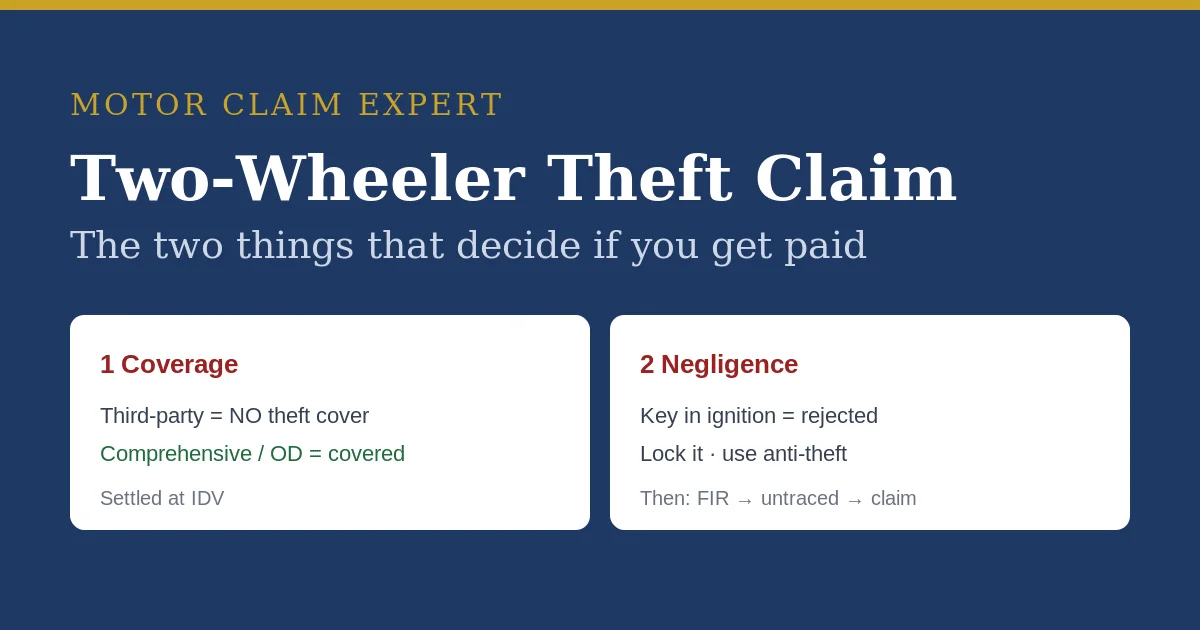
Two-wheelers are the most-stolen vehicles in India, and yet the theft claim that should protect you fails more often than it should — usually for two reasons unique to bikes. The first is a coverage surprise: a huge number of two-wheelers carry only third-party insurance, which does not cover theft at all. The second is negligence: a key left in the ignition or a bike parked casually is exactly the situation insurers use to deny a theft claim.
This guide is written specifically for two-wheeler owners. It starts with the question that decides everything — does your policy even cover theft? — then walks the claim process and the bike-specific traps. The step-by-step mechanics (FIR, untraced report, transfer forms) are identical to a car and covered in depth in our theft-claim process guide; here we focus on what is different for a bike.
First, the question that decides your claim: is theft even covered?
Every bike on an Indian road must carry third-party insurance by law. But third-party cover only pays for damage or injury you cause to others — it does nothing for the loss of your own bike. Theft is only covered under a comprehensive (own-damage) policy or a standalone own-damage policy.
| Your policy | Is bike theft covered? |
|---|---|
| Third-party only (the legal minimum) | No — theft is not covered at all |
| Comprehensive (third-party + own damage) | Yes — theft is covered, up to the IDV |
| Standalone own-damage | Yes — theft is covered, up to the IDV |
If you bought only the cheapest legal cover, a stolen bike is an uninsured loss. Check your policy schedule now, before anything happens — the word to look for is “own damage” or “comprehensive.” If it isn’t there, upgrading at renewal is the single most valuable thing you can do.
The negligence trap that sinks bike theft claims
Even with the right policy, theft cover carries one big condition: the loss must not have been facilitated by your own negligence. For two-wheelers, this is where most claims die, because the everyday habits are risky:
- Key left in the ignition. The classic — and a near-automatic rejection. Insurers treat it as inviting the theft.
- Bike left unlocked or without the steering/handle lock engaged.
- Parked in an unsafe spot and left unattended for long periods.
Protect the claim before the theft: always remove the key, engage the handle lock, and use an additional lock or an anti-theft device. These aren’t just deterrents — they are the evidence that you took “reasonable care,” which is exactly what the insurer checks when a theft claim comes in.
The claim process for a stolen bike
If theft is covered and you took reasonable care, the process is the same sequence as any total-loss theft claim:
- File an FIR immediately at the nearest police station and get a copy — mandatory for a theft claim.
- Intimate your insurer within 24–48 hours and note the claim number; a late report is a common reason bike claims are questioned.
- Notify the RTO so the registration can’t be misused.
- Obtain the police “untraced” report — usually 30–90 days after the FIR. Settlement can’t be finalised without it.
- Submit the documents: signed claim form, FIR, untraced report, RC, policy copy, driving licence, RTO transfer forms (28/29/30, and 35 if financed), and both original keys. See the full list in our claim documents checklist.
The transfer forms and key surrender exist for the same reason as with a car: once the insurer pays, ownership of the bike passes to it, so it can claim the vehicle if it is ever recovered. The full mechanics — and what happens if the bike turns up later — are covered in our theft-claim process guide and recovered-vehicle guide.
What you get paid — and how long it takes
A stolen bike is settled at its Insured Declared Value — the depreciated value in your policy, not the price you paid — less any deductible. Because two-wheeler values are lower, IDVs are modest, which is all the more reason not to under-insure to save a few hundred rupees of premium. Settlement typically takes anywhere from a few weeks to two or three months, with the police untraced report being the main wait.
The three things that most often reduce or reject a bike theft claim
- No theft cover. A third-party-only policy simply doesn’t pay for theft — check before you rely on it.
- Negligence. Key in the ignition, unlocked bike, or no reasonable precautions.
- Delay or missing documents. A late FIR/intimation, a missing untraced report, or absent keys/transfer forms.
If a genuine, properly-covered claim is still rejected, a clean file lets you reply to the repudiation and escalate to the Ombudsman or consumer court. But for two-wheelers, the two decisions that matter most happen long before the theft: buy comprehensive cover, and never leave the key in the bike.
Frequently Asked Questions — Two-Wheeler Theft Claims
Does two-wheeler insurance cover theft?
Only if you have a comprehensive or standalone own-damage policy. Third-party-only bike insurance — the legal minimum — does not cover theft of your own vehicle at all. Check your policy schedule for “own damage” or “comprehensive” cover.
Can I claim theft on a third-party bike policy?
No. Third-party insurance only covers damage or injury you cause to others. The loss of your own bike to theft is covered only under a comprehensive or own-damage policy.
What is the process to claim insurance for a stolen bike?
File an FIR immediately, intimate your insurer within 24–48 hours, notify the RTO, obtain the police untraced report (usually 30–90 days later), and submit the documents — signed claim form, FIR, untraced report, RC, policy, driving licence, RTO transfer forms and both original keys. The insurer then settles at the bike’s IDV.
Will my claim be rejected if I left the key in the bike?
Very likely. Leaving the key in the ignition, or leaving the bike unlocked, is treated as negligence that facilitated the theft — a standard ground for denying a two-wheeler theft claim. Always remove the key and engage the lock.
How much will I get for my stolen bike?
The claim is settled at the bike’s Insured Declared Value (IDV) — its depreciated value as shown in your policy — less any deductible, not the original purchase price. This is why choosing an adequate IDV at renewal matters even on a modestly-priced bike.
How long does a bike theft claim take?
Usually a few weeks to two or three months. The main delay is the police untraced report, which typically comes 30–90 days after the FIR; the insurer can only finalise settlement once it has that report.
Do I need to surrender the keys for a bike theft claim?
Yes. You must hand over both original keys, along with the RC and signed RTO transfer forms, so that ownership can pass to the insurer once the claim is paid — the same requirement as for a stolen car.
Does an anti-theft device help my claim?
Yes. Beyond deterring theft, an anti-theft device and locking up are evidence that you took reasonable care, which supports your claim if the theft still happens. Some insurers also offer a small premium discount for approved anti-theft devices.


