
A stolen car is a total-loss claim with a legal twist: before the insurer pays you the car’s value, it has to be able to take legal ownership of the vehicle in case it is ever recovered. That single fact explains everything about the theft-claim process — the transfer forms, the surrendered keys, the wait for a police “untraced” report, and why the whole thing takes three to four months rather than three to four weeks.
This is the complete, step-by-step guide to claiming for a stolen car in India — what to do in the first hour, the documents that actually move the claim, and the mistakes that get theft claims reduced or rejected. It pulls together the pieces we cover separately: the FIR, the claim documents, the IDV that sets your payout, and the discharge voucher you sign at the end.
The first 24 hours: FIR and intimation
Two things must happen fast, and in this order:
- File an FIR immediately at the nearest police station, with the date, time, place and full vehicle details, and obtain a copy. Theft is a cognizable offence — the FIR is non-negotiable, and its absence alone will sink the claim.
- Intimate your insurer the same day. Every policy has a reporting window, and a delayed intimation is a standard reason theft claims are questioned. Note the claim number.
Do both even if you are hopeful the car will turn up. You can always withdraw a claim; you cannot easily backdate an FIR.
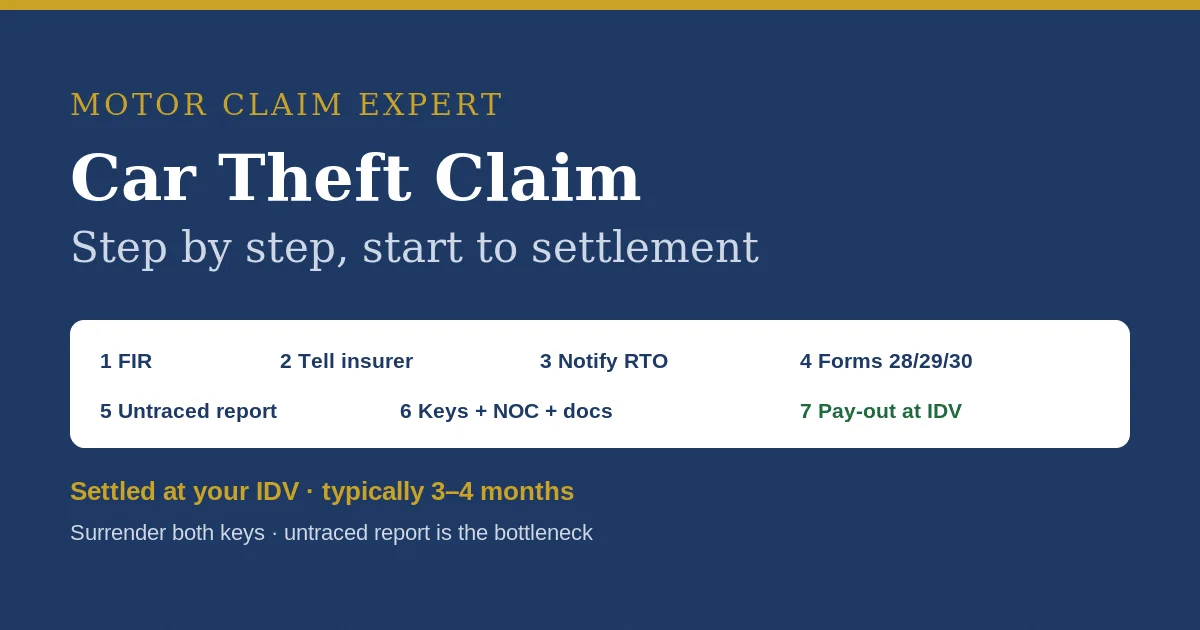
The full sequence, step by step
| Step | What you do — and why |
|---|---|
| 1. FIR | Register the theft with police; get a copy. Legally establishes the loss. |
| 2. Intimate insurer | Report within the policy window; open the claim. |
| 3. Notify the RTO | Inform the Regional Transport Office where the vehicle is registered that it has been stolen. |
| 4. Submit RTO forms | Forms 28, 29 and 30 (and Form 35 if the car is financed) — these enable transfer of ownership to the insurer once settled. |
| 5. Untraced report | About a month after the FIR, ask the police for the “untraced” / “no-trace” report confirming the vehicle can’t be found. Settlement cannot be finalised without it. |
| 6. Collect & submit documents | FIR, untraced report, policy, signed claim form, RC, driving licence, both original keys, RTO transfer forms, financier NOC, subrogation letter. |
| 7. Insurer investigation | The insurer verifies the FIR and circumstances, sometimes via an investigator. |
| 8. Settlement at IDV | Approved claims are paid at the Insured Declared Value, less any deductible; you sign the discharge voucher and hand over ownership. |
The RTO forms — what each one does
These are the documents people find most confusing, but the logic is simple: they exist to transfer the stolen vehicle’s ownership to the insurer after it pays you, so that if the car is recovered, it belongs to the insurer.
| Form | Purpose |
|---|---|
| Form 28 | No Objection Certificate for transfer / removal of the vehicle. |
| Form 29 | Notice of transfer of ownership of the vehicle. |
| Form 30 | Application for intimation and transfer of ownership. |
| Form 35 | Termination of the hypothecation (loan) — needed only if the car is financed, signed by the financier. |
You typically sign these undated and blank so the insurer can complete the transfer if and when required. If the car is on a loan, you also need a No Objection Certificate from the financier before the claim can be paid to you.
Both keys, always. Insurers ask you to surrender both original keys. A missing key invites the classic question — was the car left unlocked or with a key inside? — which is treated as negligence and can reduce or defeat the claim. Keep your keys safe from the day you buy the car.
Why it takes three to four months
The bottleneck is Step 5. The police need time to search before they will certify the vehicle as untraced, and that certificate usually comes around 30 days or more after the FIR — sometimes longer, depending on the station. Only then can the insurer finalise settlement. The rest of the file (forms, keys, NOC) you can prepare in parallel so that the day the untraced report arrives, nothing else is holding up your money.
What you get paid: the IDV
A theft claim is settled at the Insured Declared Value — the figure in your policy, based on the car’s make, model, age and depreciation — not the price you originally paid. This is why the IDV you choose at renewal matters so much: set it too low to save on premium, and you cap your own theft payout. Understand exactly how it is calculated in our guide to IDV, and before you sign the discharge voucher, confirm the amount matches your IDV less only the agreed deductible.
What reduces or rejects a theft claim
- Delay. A late FIR or late intimation is the most common killer of an otherwise valid theft claim.
- A missing key. Not surrendering both keys raises a negligence question the insurer will press.
- Key left in the car / doors unlocked. Theft “facilitated by negligence” is a recognised ground to deny.
- No untraced report. The claim cannot be settled without the police certificate.
- Incomplete transfer papers. Missing Forms 28/29/30/35 or a financier NOC stalls payment.
If a genuine theft claim is rejected or settled short despite a complete file, that is not the end. A clean document trail is exactly what makes a reply to the repudiation letter, an Insurance Ombudsman complaint, or a consumer court case succeed.
And if the car turns up later? See what happens when a stolen car is recovered after the claim is paid — including the buy-back option.
In a theft claim, the recipient’s KYC must be current — see KYC for motor insurance claims (2023 rules) for how it applies to nominees and financiers.
Riding a two-wheeler? The process is the same, but bikes have their own traps — see our two-wheeler theft claim guide, starting with whether your policy even covers theft.
Frequently Asked Questions — Car Theft Insurance Claims
How do I claim insurance for a stolen car in India?
File an FIR immediately and intimate your insurer the same day, notify the RTO and submit Forms 28, 29 and 30 (plus Form 35 if financed), obtain the police “untraced” report about a month later, and submit the full document set — including both original keys and a financier NOC. After investigation, the insurer settles the claim at your car’s IDV.
How long does a car theft insurance claim take?
Usually three to four months. The main delay is the police “untraced” report, which is typically issued around 30 days or more after the FIR, and settlement cannot be finalised until the insurer has it.
What is an untraced report and why do I need it?
It is a police certificate stating that the stolen vehicle could not be found after investigation. Insurers require it because a theft claim is a total loss — they will only pay once the police confirm the car is untraced, usually about a month after the FIR.
What are Forms 28, 29, 30 and 35 in a theft claim?
They are RTO forms that transfer ownership of the stolen vehicle to the insurer once the claim is paid. Form 28 is the NOC for transfer, Form 29 is the notice of transfer, Form 30 is the transfer application, and Form 35 terminates the hypothecation for a financed car. You usually sign them undated and blank.
Why do I have to surrender both keys?
Insurers ask for both original keys to check that the theft was not facilitated by negligence, such as leaving a key in the car. A missing key raises a negligence question that can reduce or reject the claim.
How much will I get for my stolen car?
The claim is settled at your car’s Insured Declared Value (IDV) — based on its make, model, age and depreciation — less any deductible. It is not the original purchase price, which is why choosing an adequate IDV at renewal matters.
What if my stolen car was on a loan?
You need a No Objection Certificate from the financier and Form 35 to terminate the hypothecation. The settlement is usually routed to clear the outstanding loan first, with any balance paid to you, unless the financier consents otherwise.
Can a car theft claim be rejected?
Yes — most commonly for a delayed FIR or intimation, a missing key, evidence the car was left unlocked or with a key inside, or a missing untraced report or transfer form. If a genuine claim is wrongly rejected, you can reply to the repudiation and escalate to the Ombudsman or consumer court.
Sources & official references
- Regulation: transfer/deregistration Forms 28, 29, 30 and 35 are prescribed under the Central Motor Vehicles Rules, 1989.
- Law: the FIR is registered under the Bharatiya Nagarik Suraksha Sanhita, 2023, s.173 (formerly CrPC s.154).
- Policy wording: a theft/total loss is settled at the Insured Declared Value per your insurer’s IRDAI-approved motor policy wording.


