
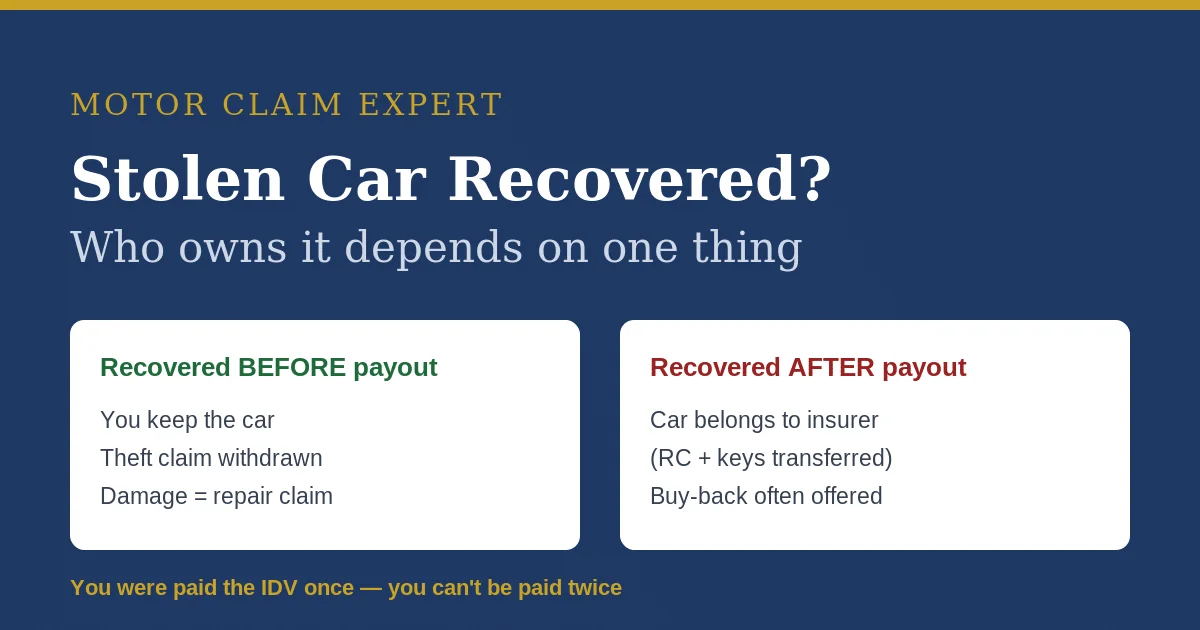
It is one of the strangest twists in motor insurance: your car is stolen, the claim is paid, you have moved on — and months later the police recover the vehicle. Whose car is it now? The instinctive answer, “mine,” is usually wrong. Once a theft claim is settled, the answer turns entirely on who legally owns the car at the moment it is found — and that changed the day you signed the transfer papers.
This guide explains exactly what happens when a stolen car is recovered, both before and after the claim is paid, the buy-back option many people don’t know exists, and why the paperwork from the original theft-claim process decides everything.
The pivot point: has the claim been settled yet?
Everything hinges on timing, because a paid theft claim transfers ownership of the car to the insurer:
| Recovered… | Who owns the car | What happens |
|---|---|---|
| Before settlement | You | You take the car back; the theft claim is withdrawn and any damage is handled as a normal own-damage repair claim. |
| After settlement | The insurer | The car legally belongs to the insurer (you transferred the RC and signed the subrogation letter). It decides what happens next — often offering you a buy-back. |
Recovered before the claim is settled
If the police trace the car while your claim is still open — before the untraced report and payout — the situation is simple. The theft claim does not proceed, because the loss it was meant to cover (a permanently missing car) hasn’t happened. You keep the vehicle. If it was damaged during the theft or joyride, that damage is assessed and settled as an ordinary own-damage claim, subject to your policy terms and deductible. Tell your insurer immediately that the car has been found; do not simply take it and stay quiet.
Recovered after the claim is paid: the car is the insurer’s
Here is the part most people get wrong. When your theft claim was settled, you did three things that transferred ownership: you handed over both keys, you transferred the Registration Certificate to the insurer using Forms 28, 29 and 30, and you signed a letter of subrogation. Legally, the car is now the insurer’s property. So when it is recovered, the insurer — not you — decides what happens to it.
Why this is fair, not a loss to you: you were already paid the car’s full value (its IDV). If you also kept the recovered car, you would be compensated twice for one loss — which insurance does not permit. Subrogation simply lets the insurer recover what it paid out; it cannot profit beyond that.
The buy-back option
Being paid does not mean you can never see your car again. In practice, many insurers offer the original owner the first chance to buy the recovered vehicle back. The usual arrangement is that you refund the claim amount you received (often adjusted for the car’s current condition and any depreciation), and ownership is transferred back to you. Whether this is offered, and on what terms, is at the insurer’s discretion — it is a common industry courtesy, not a statutory right — so if you want your car back, say so promptly when the insurer notifies you of the recovery.
If you don’t want it back, the insurer will typically dispose of the vehicle — usually through salvage sale or auction — to recover the amount it paid you.
What if the car was financed?
If your stolen car was on a loan, the theft settlement was routed to clear the outstanding finance first, and the hypothecation was terminated using Form 35 with the financier’s No Objection Certificate. When such a car is recovered, ownership still sits with the insurer, and any buy-back is arranged directly between you and the insurer — the earlier loan is already settled and out of the picture.
Your responsibilities either way
- Inform the insurer at once if the police contact you about a recovery, whenever it happens.
- Don’t quietly keep a recovered car after you’ve been paid — the RC is no longer in your name, and using or selling a car you don’t own creates legal problems.
- Decide on buy-back quickly if you want the car; the insurer may otherwise move to dispose of it.
- Keep your records — the FIR, untraced report, settlement letter and the discharge voucher — so any transfer back to you is clean.
The recovered-car scenario feels like a windfall, but it is really a bookkeeping question: you were made whole once, and the law simply prevents you from being paid twice for the same car. Knowing that in advance turns a confusing phone call from the police into a straightforward decision — take the buy-back, or let the insurer keep what is now, legally, its vehicle.
Frequently Asked Questions — A Recovered Stolen Car
If my stolen car is recovered after the insurance claim is paid, do I get it back?
Not automatically. Once the claim is settled, ownership of the car transfers to the insurer through the RC transfer (Forms 28, 29 and 30) and the subrogation letter you signed. The recovered car is the insurer’s property, though many insurers offer you the first option to buy it back.
How does the buy-back work?
You typically refund the claim amount you were paid — often adjusted for the vehicle’s current condition and depreciation — and ownership is transferred back to you. It is offered at the insurer’s discretion as a courtesy, not as a legal right, so tell the insurer promptly if you want the car back.
What happens if the car is recovered before my claim is settled?
You keep the car and the theft claim does not proceed, because the permanent loss it covered hasn’t occurred. Any damage caused during the theft is handled as a normal own-damage repair claim, subject to your policy terms and deductible.
Why does the insurer own my recovered car?
Because you were already paid the full insured value (IDV) for it. Under the principle of subrogation, keeping both the payout and the car would mean being compensated twice for one loss, which insurance does not allow. Ownership therefore passes to the insurer when it pays the claim.
Do I have to tell the insurer if the police find my car?
Yes, always — whether the recovery happens before or after settlement. Staying quiet and keeping a recovered car you no longer legally own can create serious legal problems, since the RC is in the insurer’s name once the claim is paid.
Can the insurer make a profit if it sells my recovered car?
No. Subrogation only allows the insurer to recover the amount it paid you. If a salvage or auction sale realises more than that, the excess is not meant to be a profit for the insurer beyond recovering its outlay.
What if my recovered car was on a loan?
The theft settlement already cleared the outstanding loan and terminated the hypothecation using Form 35 and the financier’s NOC. When the car is recovered, ownership sits with the insurer, and any buy-back is arranged directly between you and the insurer.
How long can a stolen car take to be recovered?
There is no fixed period — some vehicles are traced within weeks, others long after the claim is settled, and many are never found. That uncertainty is exactly why the process transfers ownership to the insurer at settlement, so the outcome is clear whenever a recovery happens.


