
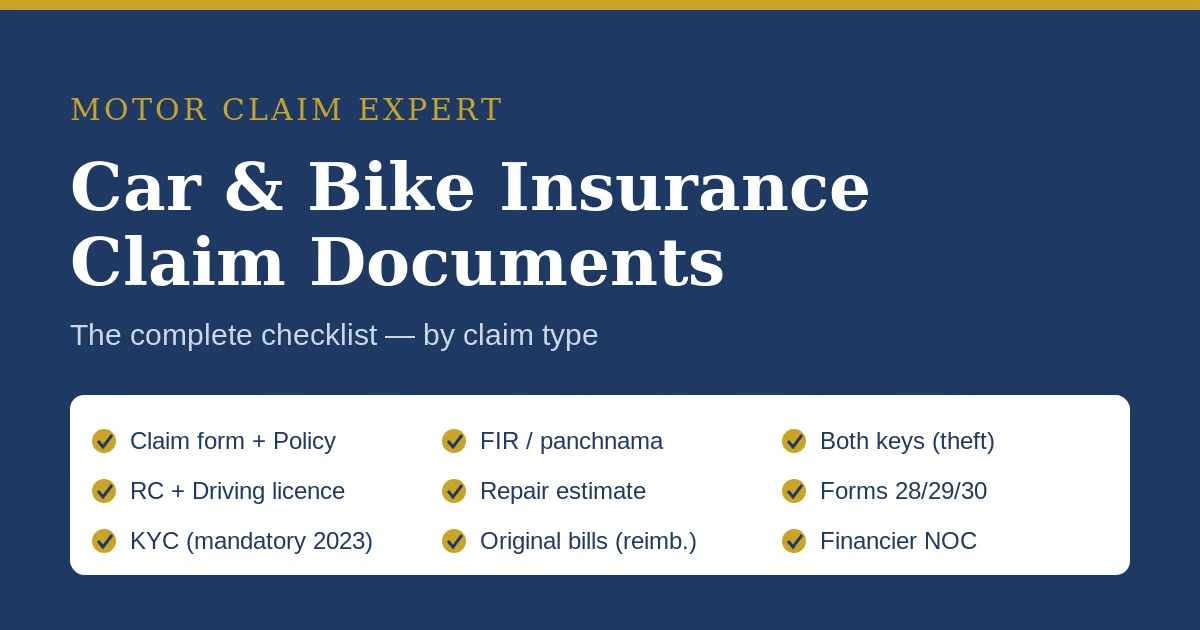
Most motor claims are not won or lost on the road — they are won or lost in the paperwork. A genuine, covered loss can still be delayed for weeks, settled short, or rejected outright simply because a single document was missing, filed late, or contradicted something else in the file. This is the checklist we wish every policyholder had before they called their insurer.
It is organised the way claims actually happen: a small core set you always need, followed by the extra documents each scenario adds — accident, theft, total loss, flood, fire and third-party. For each, you will see not just what to submit but why the insurer asks for it, because understanding the “why” is what stops a claim from stalling.
The core document set — needed for almost every claim
Whatever went wrong, these are the documents an Indian motor insurer will expect first. Keep clear scans and the originals ready; you submit copies for intimation and produce originals for verification or reimbursement.
| Document | Why the insurer needs it |
|---|---|
| Duly filled & signed claim form | The formal request; unsigned or blank sections are a common reason files are returned. |
| Policy copy (or policy number) | Confirms cover was live on the date of loss and shows your IDV, add-ons and deductibles. |
| Registration Certificate (RC) | Proves ownership and that the vehicle insured is the vehicle damaged. |
| Driving licence of the person driving | A valid, appropriate licence is a policy condition; an invalid licence is a standard rejection ground. |
| KYC document (Aadhaar/PAN/passport) | Mandatory since 1 January 2023 under IRDAI’s KYC norms for every policy and claim. |
| Photos/videos of the damage & scene | Fixes the extent and cause of loss before repairs begin. |
The KYC requirement is the newest addition and the one people forget. Since IRDAI made it compulsory from 1 January 2023, insurers can hold settlement until identity is verified — but you can complete it digitally through Aadhaar-based, video or Central KYC (CKYC), so it need not slow you down if you keep it ready.
Golden rule: intimate the claim first, gather documents second. Report the incident to your insurer immediately — ideally within 24–48 hours — and note the claim number. A perfect document file submitted after an unexplained delay can still trigger the late-intimation objection.
Accident (own-damage) — cashless vs reimbursement
For an own-damage accident, the documents you need depend on how you are settling the claim. This is the single biggest source of confusion, so it is worth separating clearly (our full guide to cashless vs reimbursement covers the trade-off in depth).
| Cashless (network garage) | Reimbursement (any garage) |
|---|---|
| Core set + repair estimate from the network garage | Core set + repair estimate |
| Insurer settles the garage directly — you pay only deductible + depreciation | Original tax invoice & itemised bills |
| No original bills needed from you | Payment proof (you pay first, then claim) |
| Satisfaction/delivery note at handover | Bank details / cancelled cheque for transfer |
The distinction that trips people up: in reimbursement you must keep every original bill and pay upfront; photocopies or estimates are not enough for final settlement. In cashless, the garage and insurer exchange the paperwork, so your job is mainly the claim form, KYC and the delivery note. Either way, the surveyor’s assessment — not the garage bill alone — sets the sanctioned amount.
When is an FIR or panchnama needed for an accident? Not for every dented bumper. Insurers generally require a police report for third-party injury or death, for major damage, and (as an internal threshold at many insurers) where damage is likely to exceed roughly ₹50,000. For a minor solo scrape, a signed statement usually suffices — but confirm with your insurer before you skip it, because a missing report on a large claim is hard to fix later.
Theft — the heaviest document set
A theft claim is really a total-loss claim, so the insurer must be able to take legal ownership of the vehicle if it is ever recovered. That is why the paperwork is far heavier than for a dent — and why theft claims stall most often on documentation.
| Theft-specific document | Purpose |
|---|---|
| FIR (filed immediately) + final “untraced” police report | Confirms the theft and closes the police search before settlement. |
| Both original keys surrendered to the insurer | Establishes the vehicle was secured; a missing key invites a negligence query. |
| Original RC, RTO theft intimation & letter to the RTO | Flags the vehicle as stolen and starts transfer formalities. |
| Forms 28, 29 & 30 (signed, undated, blank) + Form 35 if financed | Transfer of ownership and removal of the hypothecation once settled. |
| Subrogation letter, Letter of Undertaking & Discharge Voucher | Transfers your rights in the vehicle to the insurer against payment. |
| NOC from the financier (if under loan) | The bank must consent before the claim is paid to you. |
| Service booklet, warranty card, previous policy details | Establishes the vehicle’s identity, history and continuous cover. |
Before you sign the discharge voucher, make sure the settlement figure matches your IDV — signing it “in full and final settlement” can close your right to dispute the amount later.
Total loss / constructive total loss (the 75% rule)
When repair estimates cross about 75% of IDV, the claim is treated as a constructive total loss and settled like a theft — you get the IDV, the insurer takes the wreck. The document set is therefore the theft set minus the untraced report, plus the surveyor’s total-loss report. Expect to hand over the RC, both keys, and the same transfer forms (28/29/30, and 35 if financed), the subrogation letter and the financier NOC.
Natural disaster, flood and fire
For flood, cyclone or fire damage the core set applies, plus strong dated photographic and video evidence of the water line or fire damage and the location. The single most important rule is behavioural, not documentary: do not attempt to start a flooded engine. Cranking a water-logged engine converts a covered flood loss into consequential damage the policy excludes — no document will rescue that claim. For fire, a fire-brigade report strengthens the file where one was called.
Third-party claims
If your vehicle injured a person or damaged someone else’s property, third-party claims are handled differently — often through the Motor Accident Claims Tribunal. Keep the FIR, your policy copy, driving licence and RC, and do not admit liability or settle privately at the scene; the tribunal, not the garage counter, decides third-party compensation.
The five documentation mistakes that get claims rejected
Across every scenario above, the same avoidable errors recur. Each maps to a rejection ground we cover in depth:
- Late intimation. Even a fully documented claim can fail if reported days later without explanation — see your rights when a claim is delayed.
- A licence problem. An expired, wrong-class or invalid licence for the driver is a standard repudiation trigger.
- Undeclared modifications or fuel kits. An undeclared CNG/LPG kit or structural change contradicts the policy and the RC.
- Estimates that don’t match the survey. Inflated or padded garage estimates invite scrutiny and reduce trust in the whole file.
- Signing away your rights. Accepting a low figure on a discharge voucher, or a non-standard deduction, before you have checked it.
If a claim is rejected despite correct documents, that is not the end of the road: a well-documented file is exactly what makes a reply to the repudiation letter, an Insurance Ombudsman complaint or an IRDAI Bima Bharosa complaint succeed.
How to submit — the right sequence
Documents work best in the right order. Intimate the claim and get a claim number; submit the claim form with the core set and KYC; let the surveyor inspect before major repairs; then, for reimbursement, submit original bills and payment proof for settlement. Keeping this sequence — and a personal copy of everything you hand over — is the difference between a claim that closes in days and one that drags for weeks. For the full end-to-end walkthrough, see our motor insurance claim process guide.
Once you have the documents, the next step is the form itself: see our section-by-section guide to filling a motor insurance claim form without triggering a rejection.
Confused about which police record to attach? Our guide on FIR vs panchnama explains which one your specific claim needs.
Theft claims need a heavier document set. Our step-by-step car theft claim guide walks through the FIR, untraced report, RTO forms and keys.
KYC has been part of the core document set since 2023 — see our guide to KYC for motor insurance and claims for what counts and how to complete it fast.
For a stolen bike, first check the policy covers theft at all — our two-wheeler theft claim guide explains why third-party cover doesn’t.
What are the basic documents required for any car insurance claim in India?
A duly signed claim form, your policy copy or number, the vehicle’s Registration Certificate (RC), the driving licence of the person who was driving, a KYC document (mandatory since 1 January 2023), and clear photos or videos of the damage. Every other document is added on top of this core set depending on the type of claim.
Is a KYC document really mandatory for a motor claim now?
Yes. IRDAI made KYC compulsory for all insurance, including motor, from 1 January 2023. You can complete it digitally through Aadhaar-based KYC, video KYC or Central KYC (CKYC), so keep an identity document ready to avoid a settlement hold.
Do I need an FIR for a small accident?
Not usually for a minor solo dent. An FIR (or police panchnama) is generally required for theft, for third-party injury or death, and for major damage — many insurers apply an internal threshold around ₹50,000. When in doubt, ask your insurer before skipping it, because a missing report on a large claim is very hard to add later.
What extra documents does a theft claim need?
A theft claim is a total-loss claim, so you must enable ownership transfer: the FIR and the final “untraced” report, both original keys, the original RC, Forms 28, 29 and 30 (and Form 35 if the vehicle is financed), a subrogation letter, letter of undertaking, discharge voucher, and an NOC from your financier if there is a loan.
Do I need original bills for a cashless claim?
No. In a cashless claim the insurer settles the network garage directly, so you pay only your deductible and depreciation share. Original bills and payment proof are needed for reimbursement claims, where you pay the garage first and then claim the amount back.
What documents are needed for a flood or fire claim?
The core set plus dated photos and videos of the water line or fire damage. For fire, a fire-brigade report helps where one attended. Critically, never try to start a flood-submerged engine before the survey — doing so converts a covered flood loss into excluded consequential damage that no document can recover.
Can a claim be rejected even if all my documents are correct?
It can, if a policy condition was breached — late intimation, an invalid licence, an undeclared modification, or driving under the influence. But a complete, consistent document file is your strongest asset if you need to reply to a repudiation letter or escalate to the Ombudsman or IRDAI’s Bima Bharosa portal.
Should I keep copies of everything I submit?
Always. Keep a dated copy or scan of every document and form you hand over, note your claim number, and get an acknowledgement. If a dispute arises later, your own record of what was submitted and when is often the deciding evidence.


