
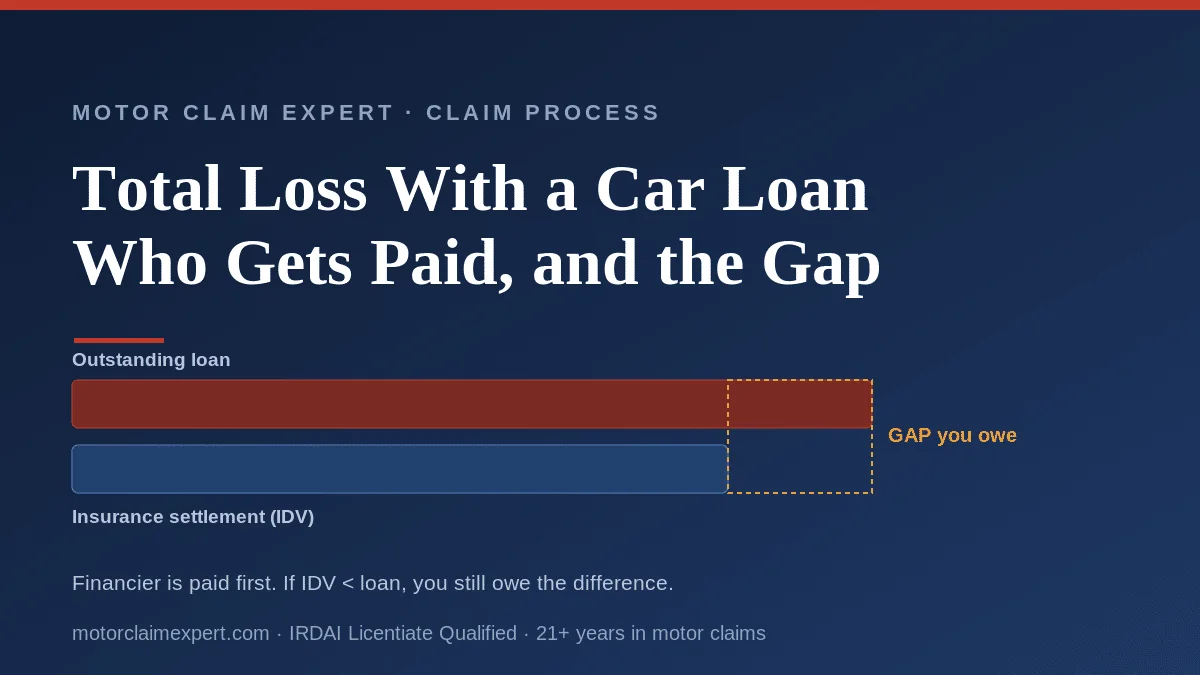
A total loss is stressful enough. When the written-off car is still on a loan, a second question lands immediately: who gets the insurance money — you or the bank — and what happens to the loan? The answer is governed by the hypothecation on your policy, and it holds a nasty surprise for owners in the early years of a loan: it is entirely possible for your car to be written off and for you to still owe money afterwards. This guide explains exactly how a total-loss settlement works on a financed car, and how to avoid the gap that catches people out.
What hypothecation does to a total-loss claim
When you finance a car, the lender’s interest is recorded two places: as hypothecation on the Registration Certificate, and as an endorsement on your insurance policy naming the financier. That endorsement makes the lender the loss payee for the amount you still owe. So on a total loss — whether an actual write-off or a constructive total loss under the 75% rule — the insurer doesn’t simply hand you the cheque. It settles with the financier up to the outstanding loan, and only the balance, if any, comes to you.
Who gets paid first — the money flow
| Step | What happens |
|---|---|
| 1. Settlement fixed | Insurer sets the payout = IDV − compulsory excess − salvage (if you retain it) |
| 2. Financier paid first | The outstanding loan is cleared from the settlement, as loss payee |
| 3. Balance to you | Anything left after the loan is paid comes to you |
| 4. Shortfall on you | If the settlement is less than the loan, you owe the financier the difference |
The two outcomes that decide everything
Whether a financed total loss ends cleanly or painfully comes down to one comparison: your IDV versus your outstanding loan.
| Situation | What it means for you |
|---|---|
| Settlement ≥ loan | Loan cleared, you receive the surplus — the clean outcome |
| Settlement = loan | Loan cleared, nothing extra — you walk away even |
| Settlement < loan | Loan not fully cleared — you still owe the gap out of pocket |
The negative-equity trap: a new car loses value fast, but the loan balance falls slowly in the early years (you’re mostly paying interest). So in year one or two, the IDV — which tracks the depreciated value — can easily be lower than what you owe. Write the car off then, and the insurance clears only part of the loan, leaving you paying EMIs on a car you no longer have. This is the single biggest financial risk of a financed total loss.
How to avoid the gap
Two protections, decided at policy time, not claim time: a return-to-invoice (RTI) add-on pays the original invoice value on a total loss instead of the depreciated IDV — usually enough to cover the loan in the early years. And setting your IDV correctly (not artificially low to save premium) keeps your total-loss payout aligned with the car’s real value. On a financed car in its first two or three years, RTI is less a luxury than insurance against still owing money on a wreck.
Closing the loan and the paperwork
Once the settlement is agreed, a financed total loss has a paperwork trail the financier and the RTO both need. Getting it in order is what actually closes the loan and ends your liability.
Insider note: don’t stop your EMIs the moment the car is written off. The loan is live until the financier confirms it’s closed from the settlement; a missed EMI in the gap can dent your credit score even though a claim is in progress. Keep paying until you have the closure confirmation in writing.
A worked example
A financed total loss is really two settlements running at once — the insurer’s with the financier, and yours with the gap between them. Know which outcome you’re heading for before it happens: check your IDV against your loan balance at each renewal, hold return-to-invoice while the loan is young, keep paying EMIs until closure is confirmed, and complete the NOC and Form 35 to end the hypothecation cleanly. For the settlement mechanics themselves, see total loss and the 75% rule and the full claim walkthrough; if the insurer’s total-loss valuation itself looks wrong, know how to dispute it.
Frequently Asked Questions — Total Loss With a Car Loan
Who gets the insurance money if my financed car is a total loss?
The insurer pays the financier first, as loss payee, up to your outstanding loan. Any balance after the loan is cleared comes to you.
Can I still owe money after my car is written off?
Yes. If the insurance settlement (IDV less deductions) is less than your outstanding loan, you owe the financier the shortfall even though the car is gone.
Why is my IDV lower than my loan balance?
A car depreciates quickly while the loan balance falls slowly in the early years, since early EMIs are mostly interest. So in year one or two the IDV can be below what you still owe.
How do I avoid owing money on a written-off financed car?
Hold a return-to-invoice add-on in the early years and set your IDV correctly, so the total-loss payout is enough to clear the loan.
What is return-to-invoice and does it help with a loan?
Return-to-invoice pays the car’s original invoice value on a total loss instead of the depreciated IDV, which usually clears the loan in full and can even leave a surplus.
Should I stop paying EMIs after a total loss?
No. The loan stays live until the financier confirms it is closed from the settlement. A missed EMI in that gap can hurt your credit score even while the claim is in progress.
What paperwork closes the loan after a total loss?
The financier’s foreclosure or settlement letter and a No-Objection Certificate, plus Form 35 to remove the hypothecation from the RC, and surrender of the salvage.
Sources & official references
- IRDAI-approved Indian Motor policy wording — hypothecation endorsement, IDV and total-loss settlement.
- Central Motor Vehicles Rules — Form 35 (termination of hypothecation on the RC).
- IRDAI (Protection of Policyholders’ Interests) Regulations, 2024 — claim settlement.


