
For a truck, tempo, taxi or bus owner, the vehicle isn’t a possession — it’s the business. So when it’s in an accident, the claim isn’t just about repairs; it’s about getting the earning asset back on the road without the loss falling on you. A commercial-vehicle claim runs on the same bones as a private-car claim, but with a decisive difference: it is judged against a stack of compliance documents — permit, fitness, the right class of driving licence, load limits — any one of which, if lapsed or breached, can turn a valid-looking claim into a rejected one. This guide walks the full process and, more importantly, the compliance checks that actually decide the outcome.
What makes a commercial claim different
A private car is covered for social and personal use; a commercial vehicle is a licensed transport vehicle, and the law regulates how it may operate. That regulation flows straight into the insurance contract. Where a private-car claim rarely turns on paperwork beyond the policy and RC, a commercial claim is assessed against the vehicle’s entire operating-compliance stack — because those documents are the conditions on which it was legally allowed to be on the road, earning, in the first place. (This is different from a private car misused for commercial work, which fails for the opposite reason — it never had commercial cover at all.)
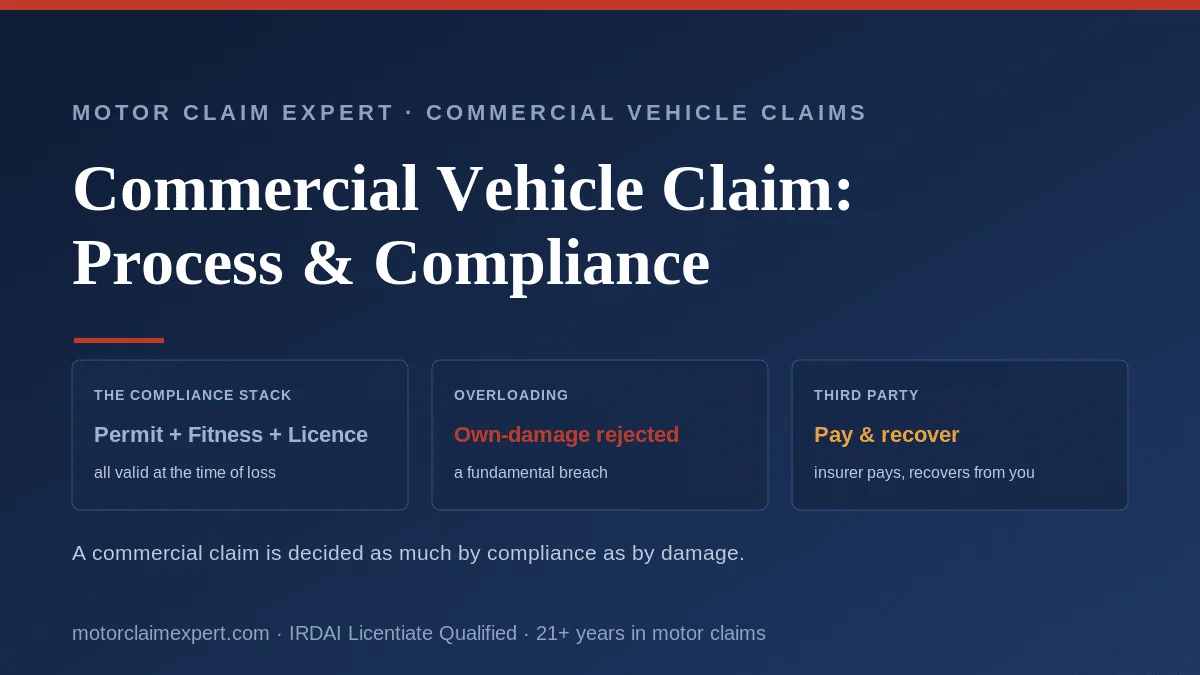
Insider note — the compliance stack a surveyor checks: on a commercial loss, the assessor verifies that each of these was valid at the moment of the accident: the route/goods permit under Section 66 of the Motor Vehicles Act; the certificate of fitness under Section 56 (renewed annually for commercial vehicles, unlike a private car); the driver’s licence with the correct vehicle-class endorsement (a light-motor licence does not cover a heavy goods or heavy passenger vehicle); plus a valid RC, PUCC and policy. A lapse in any one — most commonly an expired permit or fitness certificate — is a recognised ground to repudiate the own-damage claim. This is why the paperwork is not bureaucracy; it is the claim.
The claim process, step by step
Documents that decide a commercial claim
| Document | Why it matters to the claim |
|---|---|
| Permit (s.66) | A transport vehicle may not ply without one; an expired/wrong permit is a repudiation ground |
| Certificate of fitness (s.56) | Renewed annually for commercial vehicles; an expired FC can make the vehicle non-compliant |
| Driver’s licence (correct class) | Must carry the right endorsement (e.g., heavy goods/passenger); wrong class defeats the claim |
| Goods receipt / load challan | Establishes the load — used to check against the permitted laden weight (overloading) |
| RC, PUCC, policy | The baseline validity documents; all must be current at the time of loss |
The three breaches that sink commercial claims
Guard these three above all. (1) Overloading — carrying beyond the permitted laden weight is treated as a fundamental breach; if the vehicle was overloaded at the time of the accident, insurers can reject the own-damage claim in full and the load challan is the evidence. (2) Expired permit or fitness certificate — plying without a valid s.66 permit or s.56 fitness certificate makes the vehicle non-compliant and gives a clean repudiation ground. (3) Wrong licence class — a driver holding only a light-motor-vehicle licence at the wheel of a heavy goods or passenger vehicle is, for claim purposes, effectively unlicensed for that vehicle. Any one of these can turn a genuine accident into an unpaid one — so they’re the checks to run before every trip, not after a crash.
The third-party twist: pay and recover
Here is a crucial distinction owners miss. Even where a compliance breach lets the insurer reject your own-damage claim, that does not free it from the third-party liability. Indian courts have consistently applied a “pay and recover” approach: to protect an innocent accident victim, the insurer is directed to pay the third-party compensation first, and then recover that amount from you, the owner, because of the breach. So an expired fitness certificate or an overloaded truck doesn’t make the third-party victim your problem to pay directly — but it very much makes the money the insurer pays out your liability in the end. The compliance failure doesn’t dodge the cost; it just moves it onto your books.
If the vehicle is a total loss
Written off? The settlement rides on the IDV. When a commercial vehicle is damaged beyond economical repair, it’s settled as a total loss at its Insured Declared Value — so keeping the IDV realistic at each renewal directly protects your recovery. The write-off, salvage and loan-clearance mechanics work the same way as for any vehicle, covered in our guide to total loss with finance on the vehicle — which matters for the many commercial vehicles bought on a loan or hypothecation.
A worked example
A commercial-vehicle claim rewards the owner who treats compliance as part of the asset. Report the accident fast, file the FIR, and hand the surveyor a clean set of documents — permit, fitness, the right licence, load papers — and a genuine claim runs smoothly. Let any of those lapse, or run overloaded, and you hand the insurer a lawful reason to put the loss back on you, third-party costs included. For the general mechanics that sit underneath this, see the motor insurance claim process and the documents every claim needs; and because the driver’s licence class is so often the weak link, our guide to licence-based rejections is worth a read.
Frequently Asked Questions — Commercial Vehicle Claims
How do I file a commercial vehicle insurance claim in India?
Secure the scene and any injured people, file a police FIR, intimate the insurer immediately and get a claim number, submit the compliance documents (policy, RC, permit, fitness certificate, driver’s licence, PUCC, goods receipt/load challan and driver’s statement), cooperate with the surveyor, then repair on approval or settle a total loss at the IDV.
What documents are needed for a commercial vehicle claim?
The policy, registration certificate, route/goods permit, certificate of fitness, driver’s licence with the correct class, PUCC, the claim form, the FIR, the goods receipt or load challan, and the driver’s statement. All validity documents must be current at the time of the accident.
Can a commercial vehicle claim be rejected for overloading?
Yes. Overloading beyond the permitted laden weight is treated as a fundamental breach of the policy. If the vehicle was overloaded at the time of the accident, the insurer can reject the own-damage claim in full, using the load challan as evidence.
Does an expired permit or fitness certificate affect the claim?
Yes. Under Sections 66 and 56 of the Motor Vehicles Act, a transport vehicle must hold a valid permit and an annual certificate of fitness. Plying without either makes the vehicle non-compliant and is a recognised ground to repudiate the own-damage claim.
What driving licence is required for a commercial vehicle?
A licence with the correct vehicle-class endorsement for that vehicle. A light-motor-vehicle licence does not cover a heavy goods or heavy passenger vehicle, and driving the wrong class is treated, for claim purposes, as effectively unlicensed.
If my claim is rejected for a breach, do I still pay the third party?
Under the courts’ pay-and-recover approach, the insurer usually must still pay the innocent third-party victim first to protect them, and then recover that amount from you, the owner, because of the breach. So the cost ultimately falls on you.
How is a commercial vehicle total loss settled?
At the Insured Declared Value (IDV) — the insured value of the vehicle — less the deductible and salvage, the same basis as any total loss. Keeping the IDV realistic at renewal protects your recovery, especially on vehicles bought on a loan.
Sources & references
- Motor Vehicles Act, 1988 — Section 66 (necessity for permits) and Section 56 (certificate of fitness of transport vehicles).
- Requirement for a driving licence of the correct vehicle class/endorsement for transport vehicles.
- Overloading as a fundamental breach of the motor policy; own-damage repudiation on breach of permitted use.
- Judicial “pay and recover” principle — insurer pays the third-party victim and recovers from the owner on a policy/permit/fitness breach; IDV basis for total-loss settlement.


