
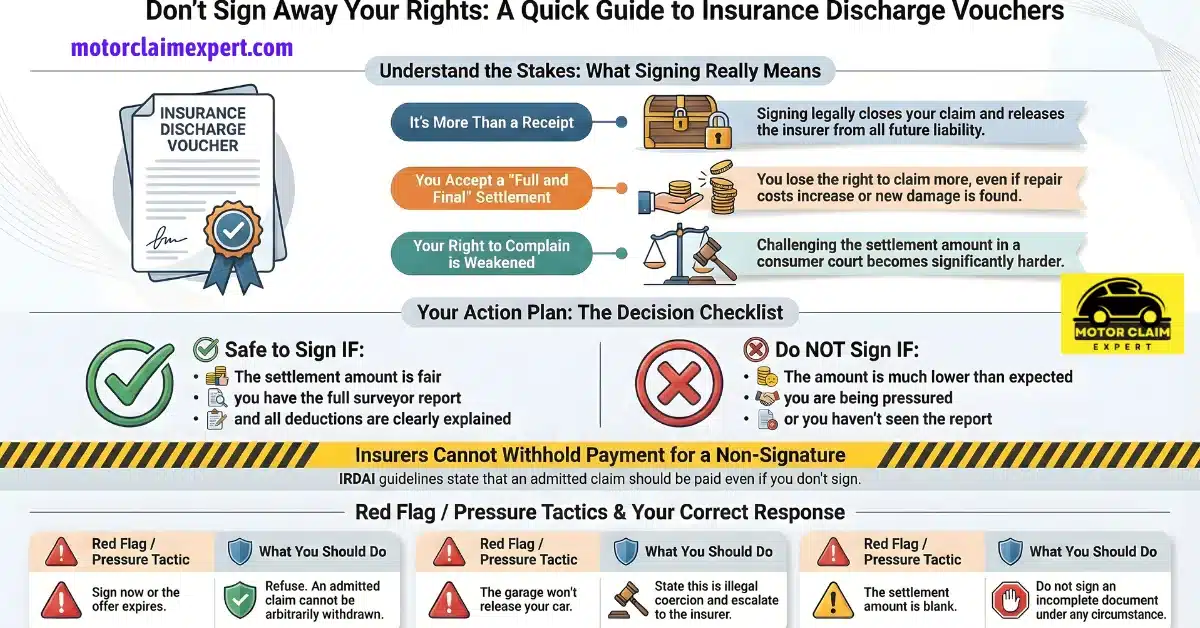
A discharge voucher is not just a payment receipt — it is usually a “full and final settlement” that releases the insurer from any further liability for that claim. Sign it without checking, and asking for more later becomes very hard. But you are not powerless. The IRDAI has directed that an insurer must not withhold an admitted claim simply because you have not signed a voucher, and the Supreme Court has held that a voucher signed under coercion or undue influence can be set aside. The practical rule is simple: verify the amount and every deduction before you sign, and if you are pressured to sign while a deduction is still in dispute, sign “under protest” and record your objection in writing.
What a discharge voucher actually is
A discharge voucher is a document the insurer issues stating that you have received a stated amount as claim settlement, that the payment is in full and final settlement, and that the insurer is released from any further liability for that incident. In effect it is a final receipt and a release. That second part is what matters: once you sign voluntarily, you are ordinarily treated as having accepted the amount as complete — which is why the moment before signing is the moment of maximum leverage, and the moment after is the moment of least.
Before you sign — the checklist
- The amount matches the surveyor’s assessment — and you have seen the full report, not just the final figure.
- Every deduction is explained in writing — depreciation, deductible, consumables, salvage — and you agree each is correct (if not, see disputing a reduced assessment).
- No deduction is still open. Do not sign a full-and-final voucher while a line is under query.
- No pressure or urgency tactics. A rushed “sign now or the payment stops” is exactly the situation the rules below protect you from.
Your rights — what the IRDAI says
The IRDAI has been explicit on this. By its circular of 24 September 2015, where the liability and the amount of a claim are established, an insurer shall not withhold the claim amount merely because the policyholder has not signed a discharge voucher; and insurers shall not use the voucher as an instrument of estoppel against policyholders who later approach a judicial forum. In other words, a signed voucher cannot lawfully be turned into a wall that blocks a genuine grievance, and an unsigned voucher cannot be used to sit on money the insurer has already admitted it owes.
“Under protest” — and what the courts have held
The legal position tracks the same logic. In National Insurance Co. Ltd. v. Boghara Polyfab Pvt. Ltd. (2009), the Supreme Court held that a full-and-final discharge signed voluntarily binds the claimant — but a discharge obtained by fraud, coercion or undue influence can be ignored, and the dispute pursued despite it. Earlier, in United India Insurance v. Ajmer Singh Cotton & General Mills, the Court held that the mere execution of a discharge voucher does not always deprive a consumer of a deficiency-in-service claim. The practical takeaway: if you are made to sign before a deduction is resolved, write “signed under protest” above your signature and send a short line to the insurer recording exactly what you are disputing. That single step preserves your right to reopen the amount.
How insurers use the voucher in practice
In everyday claims handling, the discharge voucher usually appears at the very end — presented together with, or just before, the payment. That timing is not accidental: it is the point where a policyholder most wants the money and is least inclined to argue over a depreciation line. A claims handler treats a clean, unqualified signature as the file closed. So the operational reality is that your leverage lives entirely in the pre-signature window, and the two things that keep it alive afterwards are the IRDAI position (payment of an admitted claim cannot be held hostage to the voucher) and the words “under protest”. Where a deduction is small and plainly correct, signing and moving on is sensible; where it is large or disputed, a qualified signature costs nothing and preserves everything. (Illustratively, if an insurer offers a settlement several thousand rupees short on a depreciation line you believe was wrongly applied, signing “under protest” lets you take the admitted amount now and still contest the shortfall.)
What if you have already signed?
Signing is not always the end of the road. If you signed a voluntary, informed voucher and simply changed your mind, you will usually be bound. But if you can show the signature was obtained under coercion, undue influence or misrepresentation — a threat to withhold payment, no chance to read the deductions, or a figure that did not match the report — the Boghara Polyfab line lets you pursue the claim regardless. Gather the evidence of how the signature was taken, then escalate to the insurer’s grievance cell, the Insurance Ombudsman, or a consumer court.
Frequently Asked Questions — Insurance Discharge Voucher
Should I sign the discharge voucher?
Only after you have verified that the amount matches the surveyor’s report and every deduction is explained and correct. Signing a full-and-final voucher closes the claim, so do not sign while a deduction is still in dispute.
Can the insurer withhold my claim if I don’t sign?
No. By its circular of 24 September 2015, the IRDAI directed that where liability and the claim amount are established, insurers shall not withhold payment merely because the policyholder has not signed a discharge voucher.
What does signing ‘under protest’ mean?
It means you accept the payment but formally record that you dispute part of it. Writing ‘signed under protest’ above your signature, and sending a line to the insurer stating what you dispute, preserves your right to reopen the amount.
I already signed the voucher — can I still claim more?
If you signed voluntarily and with full information, you are usually bound. But if the signature was obtained by coercion, undue influence or misrepresentation, the Supreme Court in Boghara Polyfab allows the claim to be pursued despite the voucher.
Is a discharge voucher the same as full and final settlement?
Yes — a discharge voucher typically records the payment as full and final settlement and releases the insurer from further liability for that claim, which is why the deductions should be resolved before you sign.
Can a signed voucher be used against me in a consumer complaint?
The IRDAI has directed that insurers must not use the discharge voucher as an instrument of estoppel against policyholders who approach a judicial forum, and courts have held that mere execution of the voucher does not always bar a deficiency-in-service claim.
What should I check before signing?
That the amount matches the surveyor’s assessment, that all deductions are explained in writing and correct, that no line is still under query, and that you are not being pressured to sign quickly.
Sources & official references
- IRDAI directive: the IRDAI circular of 24 September 2015 on discharge vouchers — insurers shall not withhold an admitted claim for want of a signed voucher, nor use the voucher as estoppel against a policyholder who approaches a judicial forum.
- Supreme Court judgment: National Insurance Co. Ltd. v. Boghara Polyfab Pvt. Ltd., (2009) 1 SCC 267 — a full-and-final discharge signed voluntarily binds, but one obtained by fraud, coercion or undue influence can be set aside; and United India Insurance v. Ajmer Singh Cotton & General Mills to similar effect.
- Regulation: the insurer’s claim-settlement duties sit within the IRDAI (Protection of Policyholders’ Interests) framework.


