
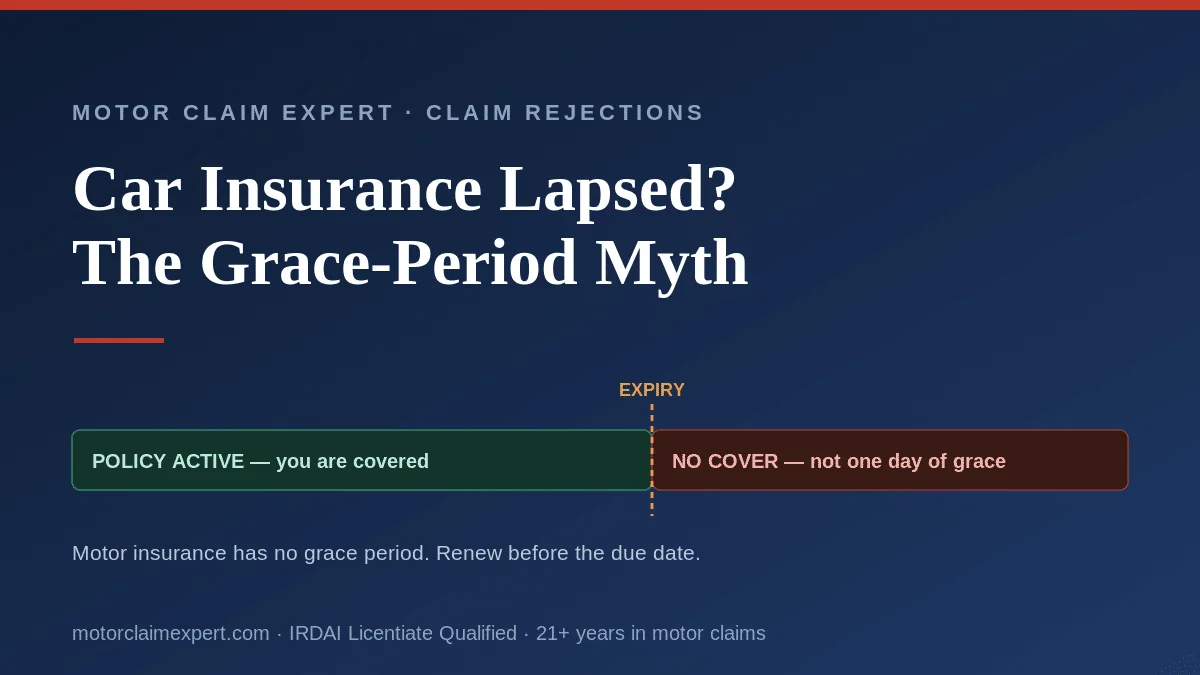
Here is a mistake that costs Indian motorists lakhs every year, made in perfect innocence: they assume car insurance has a “grace period” — a few forgiving days after the due date when you’re still covered. Life and health insurance work a little like that. Motor insurance does not. The moment your policy expires, the cover stops — completely and instantly. If you have an accident during that gap, there is no own-damage claim to make, you were driving illegally, and your No-Claim Bonus is on the clock. This guide explains exactly what a lapse means for a claim, and how to recover from one.
The grace-period myth — why motor is different
The confusion is understandable. Life and health policies often allow a grace window in which cover continues while you pay a late premium. Motor insurance is a one-year contract with a hard stop: cover runs to 23:59 on the expiry date and not a minute longer. There is no “we’ll still pay if it’s only a few days late.” An accident on day one of a lapse is treated exactly like an accident with no policy at all — because, in that moment, that’s what you have.
Don’t confuse “renewal grace” with “cover”. Some insurers let you renew shortly after expiry without a fresh proposal, and there’s a separate window to protect your No-Claim Bonus — but neither of those means you were covered during the gap. A renewal or NCB window is about paperwork and discounts, not about a loss that happened while the policy was dead.
What actually happens if you crash while lapsed
A lapse hits you in three separate places at once. Understanding each one shows why “I only forgot to renew” is no defence.
| Consequence | What it means |
|---|---|
| No own-damage payout | Your own repair bill is entirely on you — the OD cover didn’t exist at the time of loss |
| Personal third-party liability | If you injure someone or damage their property, you pay it yourself — there’s no insurer behind you |
| A traffic offence | Driving without valid third-party cover is punishable under the Motor Vehicles Act |
| Lost No-Claim Bonus | Miss the renewal window and years of accumulated discount reset to zero |
This is not the insurer “adding a condition” to escape a claim — a lapsed policy is a genuine, unambiguous absence of cover, which is different from a wrongful rejection. (For the cases where an insurer is in the wrong, see when an insurer can’t invent new claim conditions.)
The law: third-party cover is compulsory
Expert note: under Section 146 of the Motor Vehicles Act, no vehicle may be used in a public place without valid third-party insurance. Driving uninsured is an offence under Section 196, punishable with a fine of ₹2,000 and/or up to three months’ imprisonment for a first offence, and ₹4,000 for a repeat offence. So a lapse isn’t just a coverage gap — it’s a legal exposure every time the car moves. The own-damage part is optional; the third-party part is the law.
If you’re unsure what your policy actually covers in the first place, our guide to third-party vs own-damage vs comprehensive lays out the three building blocks.
Renewing after a lapse — the break-in inspection
Once a policy has lapsed, you generally cannot just pay online and be instantly covered as before. Because the vehicle was uninsured for a period, insurers protect themselves against people trying to insure an already-damaged car. Expect a break-in inspection: the insurer inspects the vehicle (in person or via a self-inspection app) before issuing a fresh policy, and own-damage cover typically begins only after that inspection clears — it is not backdated to fill the gap.
Protecting your No-Claim Bonus after expiry
Save your discount while you still can: your No-Claim Bonus — often 20% to 50% off the own-damage premium after several claim-free years — survives a lapse only if you renew within the permitted window after expiry (traditionally 90 days, which some insurers now extend). Renew after that window and the NCB drops to zero, and you start rebuilding from scratch. If you’ve lapsed, treat renewal as urgent for this reason alone. How NCB behaves in other situations is covered in NCB after a total loss.
A worked example
The safest money you’ll ever spend is an on-time renewal. Motor insurance gives you no grace period, so set a reminder well before the due date, renew a few days early, and never let the car move on a dead policy. If you’ve already lapsed, renew today, accept the break-in inspection, and protect your NCB before the window closes. For the wider picture of how claims work and where they fail, start with the motor insurance claim process and the reasons claims get rejected.
Frequently Asked Questions — Lapsed Policy
Does car insurance have a grace period in India?
No. Unlike life or health insurance, motor insurance has no grace period. Cover ends the moment the policy expires, and any loss during the gap is uninsured.
What happens if I have an accident after my car insurance has lapsed?
There is no own-damage payout, you personally bear any third-party injury or damage you cause, you were driving illegally, and your No-Claim Bonus is at risk.
Is it illegal to drive with a lapsed policy?
Yes. Section 146 of the Motor Vehicles Act makes third-party cover compulsory, and driving uninsured is an offence under Section 196 — a fine of Rs 2,000 and/or up to three months’ imprisonment for a first offence, and Rs 4,000 for a repeat offence.
Can I backdate my car insurance to cover a lapse?
No. Cover starts fresh from the renewal date, usually after a break-in inspection. A loss that happened during the uninsured gap remains uninsured.
What is a break-in inspection?
After a lapse, the insurer inspects the vehicle before issuing a new policy so it is not covering pre-existing damage. Own-damage cover typically begins only after that inspection clears.
Will I lose my No-Claim Bonus if my policy lapses?
Only if you fail to renew within the permitted window after expiry, traditionally 90 days, which some insurers now extend. Miss the window and the accumulated NCB resets to zero.
How soon should I renew after my policy expires?
Immediately. You cannot legally drive until you are insured again, and renewing quickly protects your No-Claim Bonus and avoids a longer uninsured gap.
Sources & official references
- Motor Vehicles Act, 1988 — Section 146 (compulsory third-party insurance) and Section 196 (penalty for driving uninsured).
- IRDAI-approved Indian Motor policy wording — one-year term, no grace period, break-in inspection on renewal after lapse.
- IRDAI No-Claim Bonus rules — NCB retention on renewal within the permitted window after expiry.


