
The gig economy has quietly turned lakhs of ordinary cars into part-time earners — a few Uber or Ola rides after office hours, weekend food or parcel deliveries, a car rented out on a self-drive app. It feels harmless, even smart. But there’s a clause buried in every private car policy that most of these drivers have never read, and it can turn a valid-looking claim into a flat rejection: the moment you use a privately-insured car for hire or reward, you step outside what the policy covers. This guide explains the clause, why it bites, and how to run your car commercially without voiding your cover.
The clause hiding in your policy
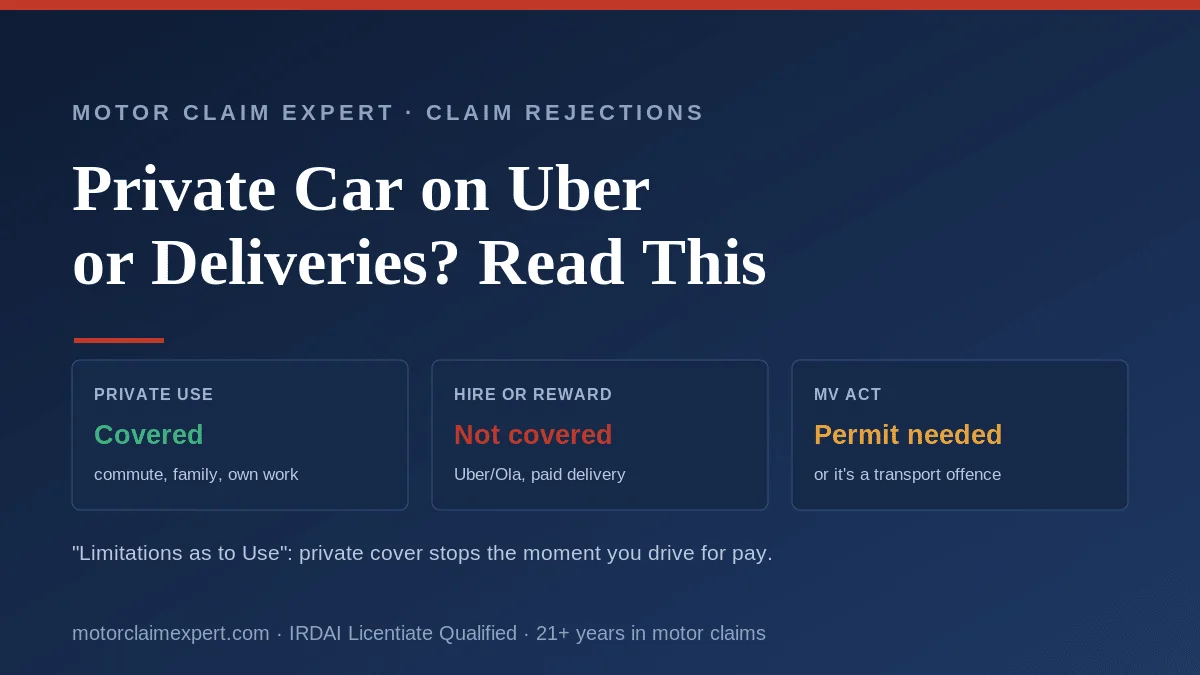
Every standard Indian private car policy carries a section headed “Limitations as to Use.” It defines the permitted use of the car — and, by doing so, defines what falls outside cover. In the standard wording, the policy covers use for any purpose except hire or reward, carriage of goods (other than samples or personal luggage), organised racing, speed testing, and use connected with the motor trade. In plain terms: drive the car for yourself, your family and your own work, and you’re covered; drive it for payment from others, and you’re not.
This is not the insurer inventing a condition at claim time — unlike the situations in our guide to when an insurer cannot add new conditions, the use limitation is a clear, printed term of the contract you agreed to. That’s exactly why it holds up: the exclusion is genuinely in the policy.
Expert note — why “hire or reward” is the real test: the dividing line isn’t whether other people were in the car, it’s whether the car was being used for payment. Commuting with colleagues, dropping a friend, carrying your own shopping — all private. Carrying a passenger who booked and paid through an app, or a parcel you’re delivering for a fee, is “hire or reward.” At a serious claim, an insurer can check aggregator trip logs, delivery records and the circumstances of the accident; if the loss happened while the car was being used commercially, the limitation clause applies and the claim is exposed. The risk you were charged a private premium for is not the risk of a working taxi.
Two problems stack: uninsured and unlawful
A private car run commercially fails on two fronts at once, and people usually only discover the second after the first. Beyond the insurance exclusion, the Motor Vehicles Act requires a vehicle used to carry passengers or goods for hire to be registered as a commercial (transport) vehicle and to hold the appropriate permit. A privately-registered car ferrying paying passengers is operating without a permit — a transport offence in its own right, quite apart from the claim being void.
| Use of your private car | Covered on a private policy? |
|---|---|
| Commuting, family trips, personal errands | Yes — this is exactly what it’s for |
| Driving to and for your own business/job | Yes — the insured’s own occupation is included |
| Carrying paying passengers via Uber/Ola | No — hire or reward; needs commercial cover + permit |
| Food/parcel delivery for a fee | No — carriage of goods for reward |
| Renting the car out (self-drive apps) | No — commercial use; needs the right policy |
Where the grey areas really are — and aren’t. Genuine cost-sharing carpooling, where friends chip in for fuel with no profit, is generally not “hire or reward” and sits closer to private use. But regular, app-based, for-profit driving is squarely commercial, and calling it “carpooling” won’t survive scrutiny if the trips were booked and paid through an aggregator. The clause bites hardest exactly where the money is clearest: a fare, a delivery fee, a rental. If you’re being paid by strangers to move them or their goods, assume you need commercial cover — don’t gamble a claim on a favourable reading of a grey area.
Is my use commercial? — a quick test
How to earn from your car without voiding cover
Do it properly and you’re both legal and insured: if you intend to drive commercially, convert the vehicle to commercial (transport) registration, obtain the appropriate permit, and buy a commercial vehicle / passenger-carrying insurance policy rated for that use. The premium is higher because the risk genuinely is — a car on the road for hire all day is exposed far more than a family car. Some insurers also offer specific covers or endorsements for app-based drivers; ask your insurer directly and get the permitted use confirmed in writing. The extra cost is trivial next to a rejected claim on a car you also earn your living from.
And whatever you do, don’t try to hide the commercial use — declaring your car honestly is the same principle that governs every claim. Concealing how the car is really used is a form of misrepresentation and non-disclosure, which is a rejection trap all of its own.
A worked example
Earning from your car is perfectly legitimate — doing it on a policy that was never priced for it is where people come unstuck. The private car you insured for social, domestic and pleasure use, plus your own work, is not insured to work as a taxi or a delivery van. If you want it to earn, register it commercially, get the permit, and buy the cover that matches. If a claim has already been refused on a use ground, check whether your use genuinely crossed the “hire or reward” line before accepting it, and if it didn’t, you can dispute the rejection. For the wider map of why claims fail, start with why motor claims get rejected, and for how coverage is defined in the first place, third-party vs own-damage vs comprehensive.
Frequently Asked Questions — Private Car, Commercial Use
Can I drive my private car for Uber or Ola on a normal car insurance policy?
No. A private car policy excludes use for hire or reward under the Limitations as to Use clause. Carrying paying passengers via an app needs commercial vehicle / passenger-carrying insurance and the appropriate permit.
Will my claim be rejected if I use my private car for food delivery?
If the loss happens while you are delivering goods for a fee, the claim can be rejected as carriage of goods for hire, which a private policy does not cover. You need commercial cover for that use.
What is the Limitations as to Use clause?
It is a standard clause in every private car policy defining permitted use. It covers use for any purpose except hire or reward, carriage of goods for hire, racing, speed testing and motor-trade use. Commercial use falls outside cover.
Is using a private car for commercial purposes illegal in India?
Yes. Under the Motor Vehicles Act, a vehicle carrying passengers or goods for hire must be registered as a commercial vehicle and hold the appropriate permit. Plying a private car for hire without a permit is a transport offence.
Is carpooling with cost-sharing allowed on a private policy?
Genuine cost-sharing carpooling with no profit is generally treated as private use. But regular, app-based, for-profit driving is commercial, and labelling it carpooling will not survive scrutiny if trips were booked and paid through an aggregator.
How do I insure a car I use for ride-hailing or delivery?
Convert it to commercial (transport) registration, obtain the appropriate permit, and buy a commercial or passenger-carrying policy rated for that use. Some insurers offer covers or endorsements for app-based drivers; confirm the permitted use in writing.
My claim was rejected for commercial use — can I dispute it?
If your use genuinely did not cross the hire-or-reward line, you can dispute the rejection through the grievance route. But where the car was clearly being used commercially at the time of loss, the exclusion is a valid, printed policy term.
Sources & references
- IRDAI-approved Private Car Package Policy wording — “Limitations as to Use” (excludes hire or reward, carriage of goods for hire, racing, speed testing and motor trade).
- Motor Vehicles Act, 1988 — commercial (transport) registration and permit requirements for carrying passengers or goods for hire.
- General principle of material breach of the policy contract as a ground for claim repudiation.


