
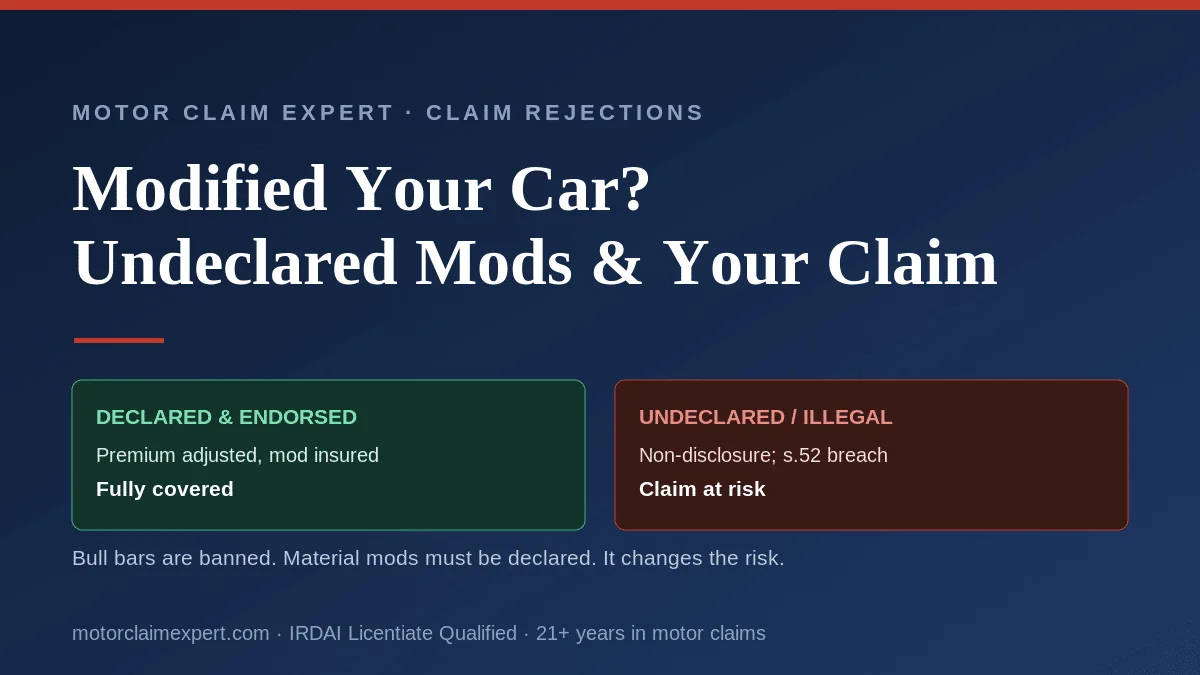
Alloy upgrades, an ECU remap, a bull bar, a lift kit, a louder exhaust, a roof rack, an aftermarket infotainment system — Indians love modifying their cars, and most owners assume it’s their business alone. It isn’t. Your insurance policy is priced on the car exactly as it was declared, and a modification you didn’t tell the insurer about can quietly turn a valid claim into a rejected one. Worse, some popular modifications are outright illegal. This guide explains which changes you must declare, which are banned, and precisely what an undeclared modification does to a claim.
Why a modification matters to your claim
Insurance is a contract based on the vehicle you disclosed. When you buy a policy, the insurer prices the risk on the car’s make, model, variant and specification. Change that specification materially — more power, altered structure, different safety behaviour — and you’ve changed the risk the insurer agreed to cover. If that change isn’t declared and endorsed on the policy, the insurer can treat it as a material non-disclosure and decline or cut the claim. It’s the same principle behind an undeclared CNG or LPG kit and other forms of non-disclosure.
The four kinds of modification
Not every change is equal in the insurer’s eyes. The test is whether it is material — does it alter the value, the risk, or the vehicle’s registered specification?
| Type | Examples | Declare? |
|---|---|---|
| Cosmetic | Wraps, decals, minor trim | Usually low-risk, but tell your insurer if in doubt |
| Accessories & value-adds | Alloys, infotainment, expensive audio, roof racks | Yes — to be covered, they must be declared and insured |
| Performance | ECU remap, exhaust, forced induction, engine swap | Yes — materially changes the risk |
| Structural | Lift kits, roll cages, bull bars, chassis changes | Yes — and often illegal without RTO approval (see below) |
The legal line: what the Motor Vehicles Act says
Some modifications aren’t just uninsured — they’re banned. Under Section 52 of the Motor Vehicles Act, a vehicle cannot be altered so that its specifications vary from those recorded in the Registration Certificate. In a 2019 ruling the Supreme Court reinforced this, holding that no vehicle may be modified in a way that changes the manufacturer’s original specifications. And bull bars and crash guards are specifically prohibited — a Ministry of Road Transport & Highways circular of December 2017 makes fitting them illegal, prosecutable under Sections 190/191. They also defeat the car’s crumple zone and can stop the airbags firing correctly — so they compromise both your legality and your safety.
What actually happens to your claim
Insider note — how the surveyor and insurer look at it: the question isn’t “was the car modified” but “was the modification material, and was it declared?” A surveyor at a serious loss will note non-standard parts, a remap flagged on the ECU, or an illegal fitment. Two things then hurt you: (1) an undeclared material modification is treated as non-disclosure — grounds to reject or reduce; and (2) if the modification contributed to the loss — a remap that stressed the engine, a bull bar that worsened the impact — the link between the mod and the damage makes rejection far more likely. A declared, endorsed modification, by contrast, is simply covered.
The right way: declare and endorse
Do this and your modified car stays fully covered: tell your insurer about any material modification and get it endorsed on the policy — the premium (and often the IDV) is adjusted, and the modified parts are then insured. For anything that changes the registered specification, get RTO approval first so the car remains legal. Keep the bills and endorsement copy. It costs a little more in premium; it costs nothing compared to a rejected claim on a written-off car.
A worked example
Modifying your car is fine — hiding it from your insurer isn’t, and fitting illegal parts is worse. Declare anything material, endorse it on the policy, keep it within the law, and your modified car is as insurable as any other. If a claim has already been rejected over a modification, check whether the insurer’s ground is actually sound — the rule that an insurer can’t invent new conditions still applies, and you can dispute a wrongful rejection. For the full picture of how claims work and fail, start with the reasons claims get rejected and the motor claim process.
Frequently Asked Questions — Modifications & Claims
Do I need to tell my insurer about car modifications?
Yes, for any material modification such as a performance change, structural change or valuable accessory. An undeclared material modification can be grounds to reject or reduce a claim.
Will a modification void my car insurance?
Not automatically. A declared and endorsed modification is covered. It is the undeclared material modification, or an illegal one, that puts a claim at risk.
Are bull bars and crash guards legal in India?
No. A Ministry of Road Transport and Highways circular of December 2017 prohibits them. Fitting one is an offence under the Motor Vehicles Act and it also compromises the car’s crumple zone and airbags.
Can I get insurance for a modified car?
Yes. Declare the modifications and get them endorsed on the policy, so the premium and IDV are adjusted and the parts are insured. Keep any structural change RTO-approved.
What is Section 52 of the Motor Vehicles Act?
It prohibits altering a vehicle so that its specifications vary from those recorded in the Registration Certificate. The Supreme Court reinforced this in a 2019 ruling.
Will an ECU remap affect my claim?
If it is undeclared, yes. A remap materially changes the risk, and if it contributed to an engine failure the link makes rejection likely. Declare and endorse it to stay covered.
My claim was rejected over a modification — what can I do?
Check whether the modification was genuinely material and whether the ground is sound. An insurer cannot invent conditions, and you can dispute a wrongful rejection through the grievance route.
Sources & official references
- Motor Vehicles Act, 1988 — Section 52 (alteration of vehicles) and Sections 190/191.
- Ministry of Road Transport & Highways circular, December 2017 — prohibition on bull bars and crash guards.
- Supreme Court of India (2019) — ruling reinforcing Section 52 against modifications that change the manufacturer’s original specifications.
- IRDAI-approved Indian Motor policy wording — material disclosure, endorsement of modifications and accessories.


