
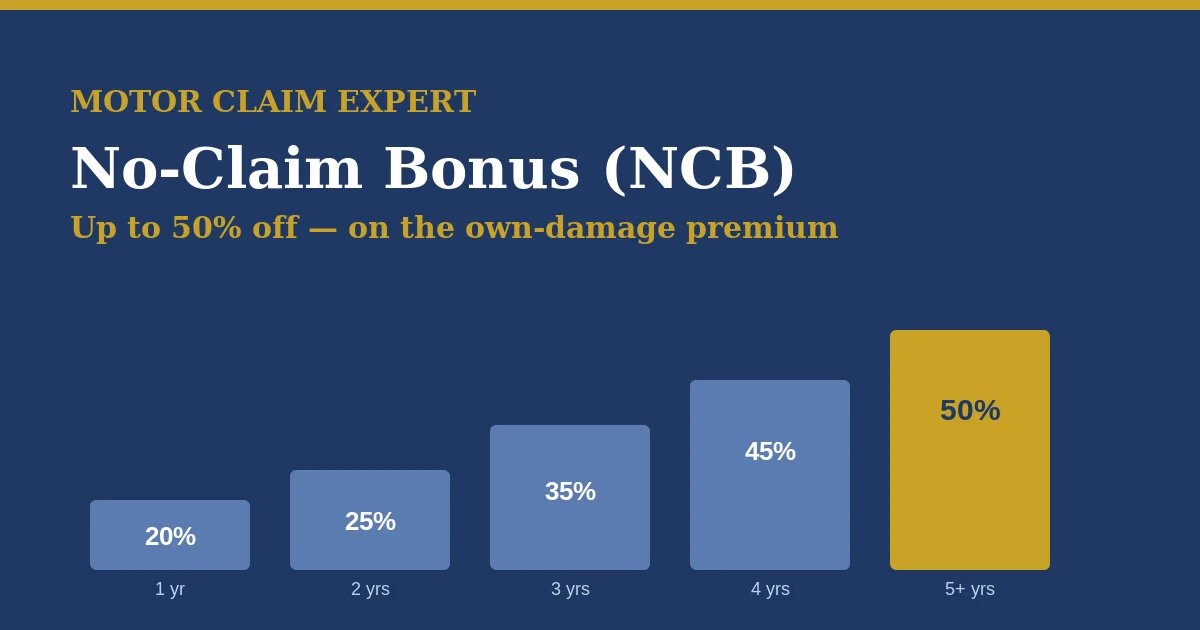
The No-Claim Bonus (NCB) is the reward for not claiming: a discount that climbs to 50% over five claim-free years. It is one of the largest savings on a motor policy — and one of the most misunderstood. Two things trip people up: it applies to only part of your premium, and a single claim can wipe out years of it. Once you understand both, it changes how you buy insurance and, just as importantly, when you decide to claim.
The NCB slab
NCB rises with each consecutive claim-free year, on a fixed IRDAI schedule:
| Claim-free years | NCB discount |
|---|---|
| After 1 year | 20% |
| After 2 years | 25% |
| After 3 years | 35% |
| After 4 years | 45% |
| After 5 years or more | 50% (maximum) |
The catch: it applies to the own-damage premium only
NCB is a discount on your own-damage (OD) premium — not the third-party (TP) portion, which IRDAI fixes and never discounts (the OD premium itself is priced off your IDV). So “up to 50% off” means 50% off the OD part of the bill, not the whole thing. On a car with an ₹18,000 OD premium, a 50% NCB saves ₹9,000 a year — real money, but the third-party premium, cess and any add-ons sit outside it. Reading the discount as applying to the full premium is the single most common NCB misconception.
One claim resets it — and that is the real cost
Make a single claim and your NCB drops to zero at the next renewal. Rebuilding from 0% back to 50% takes another five claim-free years. That is why the honest question before a small claim is not “can I claim?” but “should I?”
NCB Protection: insuring the bonus itself
The NCB Protection add-on lets you make a limited number of claims — often one, sometimes two, depending on the policy — without losing your accumulated bonus. It becomes worth its small premium once your NCB is large: protecting a hard-won 45% or 50% is far more valuable than protecting a first-year 20%.
It belongs to you, not the car — so it transfers
NCB attaches to the policyholder, not the vehicle. That has three practical consequences:
- Selling and buying a new car: apply for an NCB retention letter within 90 days of selling the old car. The certificate is valid for three years, and you use it to carry the bonus onto your new car’s policy.
- Switching insurer: your NCB carries over — the new insurer honours it against proof (the NCB certificate or renewal notice from your previous insurer). Changing insurers does not reset it.
- After a total loss: even if the car is written off, the NCB is yours and moves to your next vehicle.
Don’t let it lapse
NCB survives a change of car or insurer, but not a lapse. If you let the policy expire and renew more than 90 days after expiry, the accumulated NCB is lost. Renew within the 90-day window — ideally before expiry — to keep the bonus intact. A missed renewal can cost you years of built-up discount in one stroke.
A fake NCB is fraud
Because the savings are large, some buyers are tempted to claim a bonus they have not earned. Do not. Claiming an NCB you are not entitled to is a material misrepresentation, and insurers verify NCB with the previous insurer. A false declaration can lead to the claim being repudiated entirely — the opposite of a saving.
Myth versus reality
| What people assume | What is true |
|---|---|
| “50% NCB means half off my premium.” | It is 50% off the own-damage portion only; third-party premium is never discounted. |
| “A small claim won’t hurt.” | Any claim resets NCB to zero at renewal; the lost discount often exceeds a small claim. |
| “NCB stays with the car.” | It belongs to you and transfers to your next car, valid for three years via a retention letter. |
| “Switching insurer loses my NCB.” | It carries over with proof; only a lapse beyond 90 days actually destroys it. |
The bottom line
NCB is a discount you earn by not claiming, worth up to 50% of your own-damage premium after five clean years. Protect it: understand that it only reduces the OD portion, think twice before a small claim, add NCB Protection when the bonus is large, renew within 90 days, and carry your proof when you change car or insurer. Managed well, it is one of the most valuable — and most portable — benefits you hold as a motorist.
Frequently asked questions
One case trips people up: a write-off. See what happens to your NCB after a total loss — usually lost, unless you hold NCB Protection.
NCB applies to the own-damage part of your cover. For the policy types themselves, see third-party vs own damage vs comprehensive.
What is No-Claim Bonus (NCB) in car insurance?
NCB is a discount on your own-damage premium for every consecutive claim-free year. It starts at 20% after one year and rises to a maximum of 50% after five claim-free years. It rewards not claiming and can be one of the largest savings on a motor policy.
What are the NCB slabs?
The IRDAI schedule is: 20% after 1 claim-free year, 25% after 2 years, 35% after 3 years, 45% after 4 years, and 50% after 5 or more consecutive claim-free years. 50% is the maximum.
Does NCB apply to the whole premium?
No. NCB is a discount on the own-damage (OD) premium only. The third-party premium is fixed by IRDAI and is never discounted, and add-ons sit outside it too. So a 50% NCB is 50% off the OD portion, not half your total premium.
What happens to my NCB if I make a claim?
A single claim resets your NCB to zero at the next renewal, and rebuilding from 0% back to 50% takes another five claim-free years. For small damage, the lost discount can exceed the claim amount, so it is often cheaper to pay minor repairs yourself and keep the bonus.
What is NCB Protection and is it worth it?
NCB Protection is an add-on that lets you make a limited number of claims (often one, sometimes two) without losing your accumulated bonus. It is worth its small premium once your NCB is large — protecting a 45% or 50% bonus is far more valuable than protecting a first-year 20%.
Can I transfer my NCB to a new car or a new insurer?
Yes. NCB belongs to you, not the car. When you sell a car, apply for an NCB retention letter within 90 days; the certificate is valid for three years and transfers the bonus to your new car. When you switch insurer, the NCB carries over against proof from your previous insurer.
Can I lose my NCB by not renewing on time?
Yes. If you let the policy lapse and renew more than 90 days after expiry, the accumulated NCB is lost. Renew within the 90-day window — ideally before expiry — to keep it. A single missed renewal can wipe out years of built-up discount.
Is claiming a fake NCB a problem?
Yes. Claiming an NCB you have not earned is a material misrepresentation, and insurers verify NCB with the previous insurer. A false declaration can lead to the claim being repudiated entirely, so never overstate your bonus.


