
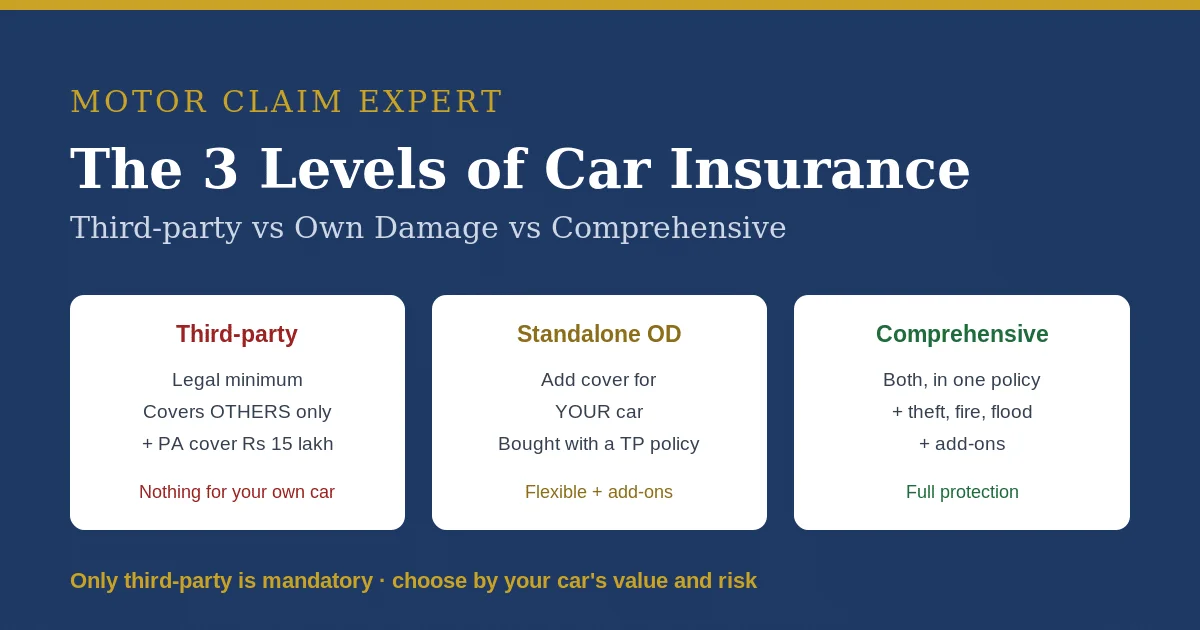
There are three levels of car insurance in India, and they are not really rivals — they are a ladder. Third-party is the legal minimum: it pays for injury and damage you cause to others, and nothing for your own car. Standalone own-damage adds cover for your own vehicle, bought alongside a third-party policy. Comprehensive combines both in one policy and also covers theft, fire and natural calamities. Which you need comes down to your car’s value, whether it is financed, and how much risk you are willing to carry yourself. This is the starting point for everything else in our coverage guides — it explains exactly what each level pays, corrects the two myths that trip most buyers up, and links to the deeper pieces on IDV, add-ons and deductions.
Third-party: the legal minimum
Third-party insurance is mandatory for every vehicle under Section 146 of the Motor Vehicles Act, 1988, and driving without it is an offence. It covers your legal liability to others: death or bodily injury you cause to a third party, and damage to their property or vehicle. Two figures are widely misunderstood. Liability for third-party death or injury is unlimited — the compensation is decided by a Motor Accident Claims Tribunal, not capped by your policy. Liability for third-party property damage is limited, commonly to ₹7.5 lakh per accident. What third-party never does is pay a single rupee towards your own car — not for an accident, not for theft, not for fire or flood. That is the gap the other two levels fill.
The ₹15 lakh owner-driver cover — separate, and now unbundled
Alongside the liability cover sits a compulsory personal accident (CPA) cover of ₹15 lakh for the owner-driver — protection for you, not for third parties, if you are injured or killed while driving your own car. This is a common point of confusion: the ₹15 lakh is a personal-accident sum insured, entirely separate from the third-party property limit. Since 1 January 2019 the IRDAI unbundled this cover: it can be issued as a stand-alone CPA policy rather than being locked into the motor policy, and if you already hold a personal-accident cover of at least ₹15 lakh, you do not need to buy it again. So it is compulsory to hold — but no longer automatically baked into every motor policy the way it once was.
Standalone own-damage: cover for your own car
A standalone own-damage (OD) policy covers damage to, and loss of, your vehicle — accident, theft, fire and natural calamity — but carries no third-party liability of its own. It exists because of the same 2019 reform: you can now hold a long-term third-party policy and buy a separate annual own-damage policy, even from a different insurer. It is mainly useful for owners unbundling a multi-year third-party policy; most buyers still find a single comprehensive policy simpler.
Comprehensive: the full picture in one policy
Comprehensive cover rolls third-party liability and own-damage into one policy, and adds protection against theft, fire and natural calamities such as flood and storm. It is the only level that lets you attach add-ons — zero depreciation, engine protection, consumables and the like — because those all ride on the own-damage section. For most owners of a car worth keeping, comprehensive is the sensible default; the tuning happens through the add-ons and the IDV, not the base level.
What actually pays — six real situations
The cleanest way to see the difference is to ask, for each thing that can go wrong, which policy actually pays:
| What happens | Third-party only | Standalone own-damage | Comprehensive |
|---|---|---|---|
| You damage another car or property | Pays (up to ~₹7.5 lakh) | No | Pays |
| You injure or kill a third party | Pays (unlimited, tribunal-set) | No | Pays |
| Your own car is damaged in an accident | No | Pays | Pays |
| Your car is stolen | No | Pays (at IDV) | Pays (at IDV) |
| Fire, flood or storm damages your car | No | Pays | Pays |
| You (owner-driver) are injured while driving | ₹15L PA* | —* | ₹15L PA* |
What each type covers, side by side
| Feature | Third-party | Standalone OD | Comprehensive |
|---|---|---|---|
| Legal liability to others | Yes | No | Yes |
| Damage to your own car | No | Yes | Yes |
| Theft / fire / natural calamity | No | Yes | Yes |
| Add-ons (zero dep, engine protect…) | No | Yes | Yes |
| Owner-driver ₹15L PA | Separate CPA | Separate CPA | Separate CPA |
| Satisfies the legal mandate | Yes | Only if paired with a TP policy | Yes |
Which should you choose?
- New or near-new car: comprehensive, almost always. The car’s value is high, a lender usually requires it, and you will want zero depreciation in the early years.
- Mid-life car (a few years old): comprehensive still usually makes sense, especially in flood-prone or high-theft areas; the premium gap over third-party is modest for the protection it buys.
- Old, low-value car: some owners drop to third-party once the IDV is small, since an own-damage payout would be limited anyway. Weigh that low IDV against paying for a total loss out of pocket.
- Whatever you choose, never let cover lapse — third-party is a legal requirement, and a gap can also cost you your no-claim bonus.
Building the right policy on top
Once you have chosen a level, the rest is tuning. Your IDV sets what a total loss or theft pays and drives the premium. Add-ons — zero depreciation, consumables, engine protection — close the gaps a plain comprehensive policy leaves. And it helps to understand the deductions that apply at claim time, so the cheque doesn’t surprise you. Get the level right first; then build on top of it.
Frequently Asked Questions — Car Insurance Types
What is the difference between third-party and comprehensive car insurance?
Third-party covers only the injury and damage you cause to others and is the legal minimum; it pays nothing for your own car. Comprehensive covers your own car too — accidents, theft, fire and natural calamities — plus the third-party liability, in a single policy. Comprehensive also allows add-ons.
Is comprehensive car insurance mandatory in India?
No. Only third-party insurance is legally mandatory. Comprehensive and own-damage cover are optional, though strongly recommended for a valuable car and usually required by lenders on a financed vehicle.
What does third-party insurance not cover?
It does not cover any damage to, or theft of, your own vehicle. If your car is damaged in an accident, stolen, or lost to fire or flood, third-party insurance pays nothing towards it — you bear that cost yourself.
What is standalone own-damage insurance?
It is a policy that covers only damage to your own car, bought alongside a separate third-party policy (which can be from a different insurer). It gives own-damage protection without a full comprehensive policy and can be customised with add-ons.
Is the ₹15 lakh personal accident cover included in all policies?
Yes. Compulsory owner-driver personal accident cover of ₹15 lakh is part of both third-party and comprehensive policies, unless you already hold a separate standalone ₹15 lakh personal accident policy, in which case you can be exempt.
Does comprehensive insurance cover flood and theft?
Yes. Comprehensive cover includes theft, fire and natural calamities such as floods, earthquakes and cyclones, as well as man-made events like riots. Some water-related engine damage needs a separate engine-protection add-on, though.
Should an old car have comprehensive insurance?
It depends on the car’s IDV. As the value falls, some owners move to third-party because an own-damage payout would be small. But if you cannot easily fund replacing the car after a total loss, keeping comprehensive can still be worthwhile.
Sources & official references
- Law: third-party motor insurance is mandatory under the Motor Vehicles Act, 1988, s.146; third-party death/injury liability is unlimited and determined by a Motor Accident Claims Tribunal, while third-party property-damage liability is commonly limited to ₹7.5 lakh.
- IRDAI reform: the compulsory owner-driver personal-accident cover of ₹15 lakh, and the unbundling that allows a stand-alone CPA policy and standalone own-damage cover, took effect from 1 January 2019 under IRDAI directions; an owner already holding a personal-accident cover of at least ₹15 lakh is exempt from buying it again.
- Policy wording: what own-damage and comprehensive cover pay — accident, theft, fire and natural calamity, settled with reference to IDV — is set by your insurer’s IRDAI-approved motor policy wording.
Related guides
- IDV Explained: How It’s Calculated and Why Higher Isn’t Always Better
- Car Insurance Add-ons Worth Paying For (and Which to Skip)
- Zero Dep vs Comprehensive: Is the Add-On Worth It?
- Every Deduction on Your Repair Bill, Explained
- Car Theft Insurance Claim: The Complete Step-by-Step Process
- No-Claim Bonus (NCB) Explained: Slabs, Protection, and Transfer
- Car Insurance for an Older Car
- Car Insurance for New Drivers in India
- EV Insurance & Claims: What’s Different for an Electric Car
- Motor Accident Compensation & the MACT Claim Process


