
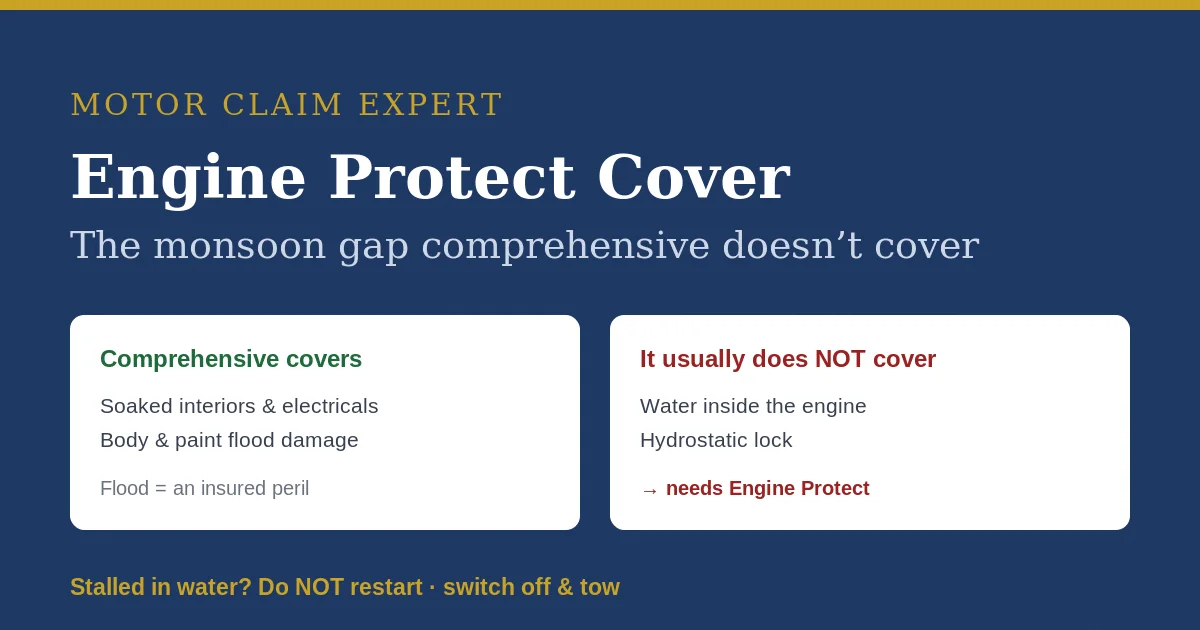
Short answer: a standard comprehensive policy covers your car for a flood — dents, soaked interiors, damaged electricals — but it usually does not cover the most expensive monsoon damage of all: water getting inside the engine. That specific gap is what an Engine Protection add-on fills. If your car sees waterlogged roads, this is the one add-on worth understanding before the rains, because a water-ingress engine repair can run from ₹50,000 to well over ₹3 lakh — and the base policy may not pay for it.
This guide explains exactly what comprehensive cover does and does not include in the monsoon, what Engine Protect adds, what it costs, and how to decide whether you actually need it. It pairs with our guides on flood claims and hydrostatic-lock rejections.
What comprehensive cover pays for in a flood — and the one thing it usually doesn’t
Flood, inundation and storm are named perils in a comprehensive own-damage policy, so the water damage to your car as an event is generally covered.
| Monsoon damage | Comprehensive policy (base) |
|---|---|
| Water-soaked upholstery, carpets, interiors | Generally covered |
| Electrical/electronic damage from submersion | Generally covered |
| Body/paint damage from flooding or debris | Generally covered |
| Engine damage from water entering the engine | Usually NOT covered — treated as consequential loss |
| Hydrostatic lock (from water in the cylinders) | Usually NOT covered without Engine Protect |
| Gearbox damage from water/oil ingress | Usually not covered without Engine Protect |
The reasoning insurers apply: the flood is the insured peril, but damage caused after water enters the engine — especially if the engine is cranked or restarted — is treated as consequential damage, which standard policies exclude. That single exclusion is where the biggest monsoon bills fall.
What the Engine Protection add-on actually covers
Engine Protect (sold under names like Engine Protect, Engine Secure or Engine & Gearbox Protection) is a paid add-on to a comprehensive policy. It typically covers repair or replacement of the engine and gearbox for damage from:
- Water ingression — water entering the engine, the classic monsoon risk;
- Hydrostatic lock — internal engine damage when water blocks piston movement;
- Leakage of lubricating oil — engine seizure from loss of lubrication; and
- Gearbox/differential damage from the above.
Exact inclusions vary by insurer and by the policy wording, so read the add-on schedule — some cover only water ingress and lubricant leakage, others add gearbox and child parts. It does not cover ordinary wear and tear or mechanical breakdown unrelated to these causes.
The rule that decides the claim, add-on or not: if your car stalls in water, do not try to restart it. Cranking a water-logged engine is what turns a survivable situation into a bent-connecting-rod, engine-replacement job — and even with Engine Protect, restarting can be argued as avoidable damage. Switch off, get it towed, photograph the water line, and inform your insurer.
What it costs
Engine Protect is one of the cheaper add-ons relative to what it protects — typically around ₹1,500 to ₹3,500 a year, depending on the car’s make, engine size and value. Against a potential ₹50,000–₹3,00,000 water-ingress repair, the maths is straightforward for the cars most at risk. It is usually available only on a comprehensive or standalone own-damage policy, and often only within the first few years of the car’s life, so add it at renewal rather than after a downpour.
Do you actually need it? A quick decision guide
Engine Protect is genuinely valuable for some owners and marginal for others. Weigh these factors:
| You likely NEED it if… | You may not need it if… |
|---|---|
| You live in a flood- or waterlogging-prone city | You are in a dry region with no waterlogging |
| Your car has low ground clearance (sedans, sports cars) | You have a high-clearance SUV parked and driven on high ground |
| The engine is expensive to repair or replace | The car is old with a very low IDV |
| You often drive through standing water | You can avoid flooded roads entirely |
For a low-slung car in Mumbai, Chennai, Bengaluru or any city that waterlogs, it is one of the most cost-effective add-ons you can buy. For a high-clearance vehicle in a dry area, it is optional. Consider it alongside your other add-on choices and your IDV, which sets your overall payout ceiling.
If your car is already water-damaged: the claim steps
- Do not restart the engine. This is the single most important action.
- Switch off, and arrange towing to a garage — don’t drive it out of the water.
- Photograph and video everything: the water line on the car, the surroundings, the registration plate, the date and location.
- Intimate your insurer immediately and note the claim number; a delayed report weakens the file.
- Let the surveyor inspect before repairs begin so the cause and extent are documented.
- Keep the towing bill and all records for the claim.
Whether the engine repair is paid then depends on your cover: with Engine Protect, water-ingress engine damage is generally payable; without it, that portion is usually declined as consequential, even though the rest of the flood damage to the car is covered.
Common mistakes that cost owners the claim
- Restarting the flooded engine — converts a covered situation into excluded consequential damage.
- Assuming “comprehensive” covers everything — it doesn’t include internal engine water damage without Engine Protect.
- Buying the add-on after the damage — it must be in force before the loss.
- Driving the car out of the water — moving a submerged car can worsen the very damage that isn’t covered.
Understood before the rains, Engine Protect is a small, targeted purchase that closes the most expensive gap in a monsoon claim. Understood after, it is usually too late. If your car spends the monsoon anywhere near standing water, check whether you have it — and if a claim is wrongly denied despite the right cover, a clean, well-documented file supports a reply to the repudiation and, if needed, escalation.
Zero dep won’t help here either — see what a zero-depreciation claim still deducts, including why engine water damage needs its own cover.
Frequently Asked Questions — Engine Protection Add-On
Does comprehensive car insurance cover engine damage from flooding?
Generally no. A comprehensive policy covers flood damage to the car as an event — interiors, electricals, body — but damage caused by water entering the engine (water ingress, hydrostatic lock) is usually treated as consequential loss and excluded. That gap is covered by a separate Engine Protection add-on.
What is the Engine Protection add-on?
It is a paid add-on to a comprehensive or own-damage policy that covers repair or replacement of the engine and gearbox for damage from water ingress, hydrostatic lock, leakage of lubricating oil and related causes — the expensive monsoon damage the base policy typically excludes.
How much does Engine Protect cover cost?
Usually around ₹1,500 to ₹3,500 a year, depending on the car’s make, engine and value. That is small relative to a water-ingress engine repair, which can run from ₹50,000 to over ₹3 lakh.
Is Engine Protect worth it for the monsoon?
For a low-ground-clearance car in a flood- or waterlogging-prone city, or if you often drive through standing water, it is one of the most cost-effective add-ons. For a high-clearance vehicle in a dry area with no waterlogging, it is optional.
Will my claim be paid if I restarted the flooded car?
Often not for the engine damage. Restarting or cranking a water-logged engine is treated as avoidable, consequential damage and can be declined even with Engine Protect. Always switch off and tow rather than restart or drive out.
Can I add Engine Protect after my car is flooded?
No. The add-on must be in force before the loss occurs. It is generally available only on a comprehensive or standalone own-damage policy and often only in the car’s earlier years, so it should be added at renewal.
Does Engine Protect cover normal breakdowns?
No. It covers engine and gearbox damage from specific causes such as water ingress, hydrostatic lock and lubricant leakage — not ordinary wear and tear or mechanical breakdown unrelated to those causes.
What should I do the moment my car stalls in water?
Switch off the ignition and do not restart it, arrange for towing rather than driving out, photograph the water line and surroundings, intimate your insurer immediately, and let the surveyor inspect before any repairs. Keep the towing bill and all records.


