
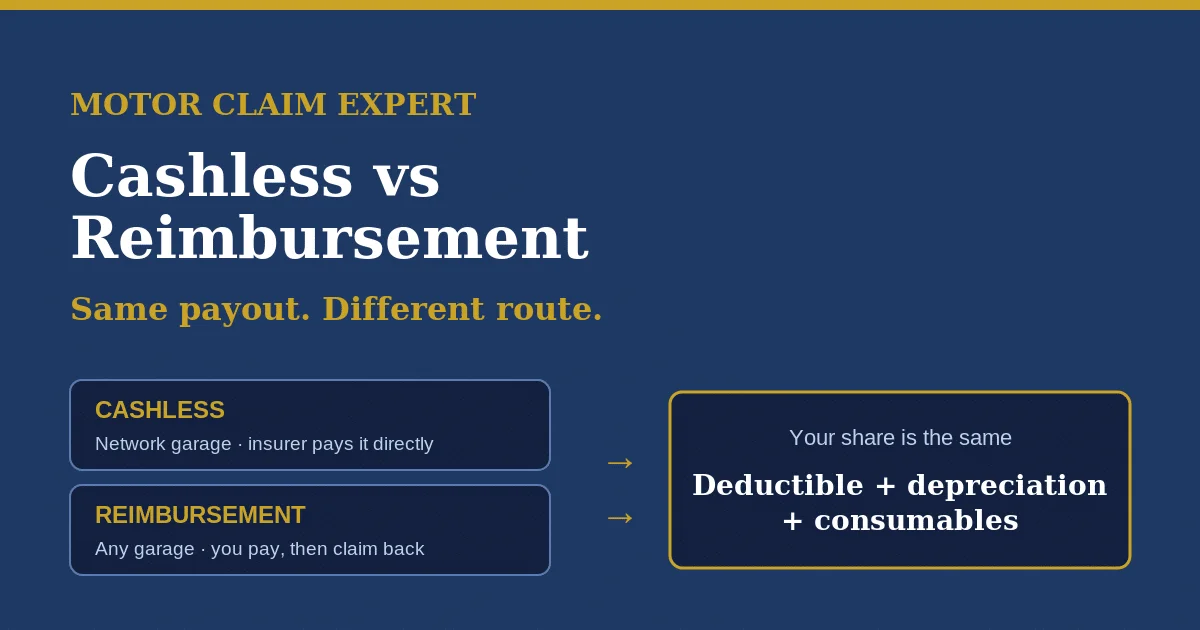
After an accident, your insurer offers two ways to settle a repair claim: cashless, where the insurer pays the garage directly, or reimbursement, where you pay the garage and claim the money back. Most guides frame this as convenience versus freedom. That misses the single most important fact: the amount you finally recover is the same either way. The route only decides who fronts the cash and who does the paperwork — not how much the claim is worth.
This guide explains exactly how each route works, what you pay under both (it is more than people expect), when each one is the smarter choice, and the step-by-step process for each.
How the two routes actually work
| Cashless | Reimbursement | |
|---|---|---|
| Where you repair | An insurer network garage | Any garage, including your trusted local one |
| Who pays the garage | The insurer pays the garage directly | You pay first, then claim it back |
| What you pay | Only your deductions (see below) | The full bill upfront; the insurer refunds its share later |
| Paperwork | Mostly handled by the garage and insurer | You collect and submit all bills, receipts and the claim form |
| Speed | Usually faster; less to chase | Slower; settlement comes after you submit documents |
In both cases the insurer sends a surveyor to assess the damage first. That assessment — not the route you pick — is what fixes the payable amount.
The big myth: “cashless means free”
Cashless does not mean the insurer pays every rupee. It means you don’t have to front the money — but you still bear the same deductions you would in a reimbursement claim. In a cashless claim the garage simply collects your share from you and the insurer’s share from the insurer. The deductions are identical in both routes:
| Deduction | What it is | How to avoid it |
|---|---|---|
| Compulsory deductible | A fixed amount you always bear — commonly ₹1,000 for private cars up to 1500cc and ₹2,000 above (per tariff); confirm on your schedule. | Cannot be waived. |
| Depreciation on parts | A percentage knocked off replaced parts based on their age (e.g. 50% on plastics/rubber, a sliding scale on metal). | A zero-depreciation add-on. |
| Consumables | Engine oil, coolant, nuts, bolts and similar. | A consumables add-on. |
| Betterment / uninsured parts | Anything outside your cover, or an upgrade over the original part. | You bear it in both routes. |
When cashless is the better choice
Cashless is usually the smarter default when a reputable network garage is within reach. It suits you when you don’t want to block a large sum of your own money, when the repair is expensive, and when you would rather the garage and insurer handle the coordination. Because there is less to submit and chase, cashless claims also tend to settle faster.
When reimbursement makes sense
Reimbursement earns its place in specific situations: when there is no network garage nearby, when you break down far from home and must use whoever is available, or when you have a trusted local mechanic you would rather not leave. There is also a practitioner reason: reimbursement gives you control over the repair and the paperwork, which matters if you anticipate a dispute — for example if you expect the insurer to under-assess the claim and you want your own detailed bills as evidence. The trade-off is that you carry the cash and the risk until the refund arrives.
The process, step by step
Cashless: intimate the claim to your insurer → take the car to a network garage → the surveyor inspects and the garage sends an estimate for approval → repairs proceed after authorisation → you pay only your share, the insurer settles the rest with the garage.
Reimbursement: intimate the claim → the surveyor inspects the vehicle (get this done before major repairs) → repair at your chosen garage → collect the tax invoice, itemised bill, and payment receipts → submit them with the claim form → the insurer refunds its share. If that refund drags, it is a delayed claim and you can press your timeline rights.
Where neither route applies: total loss
Cashless and reimbursement are both repair routes. If the damage crosses the write-off threshold — a constructive total loss — there is nothing to repair. The claim becomes a cash settlement of the IDV less salvage, and you sign a discharge voucher rather than choosing a garage. Knowing which situation you are in prevents wasted effort.
Myth versus reality
| What you assume | What is true |
|---|---|
| “Cashless means free.” | You still pay the deductible, depreciation and consumables — the garage just collects your share directly. |
| “Reimbursement pays more.” | The payout is identical; only the cash flow and paperwork differ. |
| “Cashless skips the surveyor.” | A surveyor assesses the damage in both routes; that fixes the amount. |
| “I can repair first and sort it out later.” | Get the surveyor’s inspection done before major repairs, especially for reimbursement. |
The bottom line
Cashless versus reimbursement is a choice about convenience, cash flow and garage freedom — not about how much your claim is worth. The surveyor’s assessment and your policy deductions decide the money; the route decides who pays the garage and who keeps the receipts. Choose cashless when a good network garage is nearby and you would rather not front the cash; choose reimbursement when you need a specific garage or want your own documentation for a claim you may have to fight.
Frequently asked questions
The documents you need differ by route — our claim documents checklist sets out exactly what cashless and reimbursement each require.
Whichever route you choose, the insurer works to a fixed clock. See the IRDAI motor claim timeline for how long each stage — survey, report and settlement — should take.
What is the difference between cashless and reimbursement car insurance claims?
In a cashless claim you repair at an insurer network garage and the insurer pays the garage directly, so you only pay your deductions. In a reimbursement claim you can use any garage but pay the full bill upfront and claim the insurer’s share back later. The final amount you recover is the same in both.
Is a cashless claim completely free?
No. Cashless means you don’t have to front the whole bill, but you still bear the same deductions as a reimbursement claim — the compulsory deductible, depreciation on parts, consumables and any betterment. The network garage simply collects your share from you and the insurer’s share from the insurer.
Do I get more money with a reimbursement claim?
No. The payout is decided by the surveyor’s assessment and your policy deductions, not by the route. Cashless and reimbursement produce the same net settlement; only the cash flow (who pays the garage first) and the paperwork differ.
When should I choose reimbursement over cashless?
Choose reimbursement when there is no network garage nearby, when you break down far from home, when you have a trusted local mechanic, or when you anticipate a dispute and want your own detailed bills as evidence. The trade-off is that you carry the cash and the risk until the refund arrives.
Does a cashless claim skip the surveyor inspection?
No. A surveyor assesses the damage in both routes, and that assessment fixes the payable amount and the deductions. Cashless just spares you fronting the money and most of the paperwork — it does not remove the inspection step.
What deductions apply to a car insurance repair claim?
The main deductions are the compulsory deductible (commonly ₹1,000 for private cars up to 1500cc and ₹2,000 above, per tariff — confirm on your schedule), depreciation on replaced parts, consumables such as oil and coolant, and any betterment or uninsured parts. A zero-depreciation add-on removes the depreciation cut; a consumables add-on removes that one.
Can I repair my car first and then claim reimbursement?
You should get the surveyor’s inspection done before major repairs. Repairing first and claiming later risks the insurer being unable to verify the damage, which can reduce or complicate the claim. Keep the tax invoice, itemised bill and payment receipts to submit with the claim form.
Do cashless and reimbursement apply to a total-loss claim?
No. Both are repair routes. If the damage crosses the constructive-total-loss threshold there is nothing to repair; the claim becomes a cash settlement of the IDV less salvage, and you sign a discharge voucher rather than choosing a garage.


