
The workshop estimate says ₹40,000. The insurer approves ₹27,000. Nothing has gone wrong — you have just met the depreciation grid, the fixed schedule that knocks a percentage off each replaced part before the claim is paid. Almost every “why did I get less?” question about a repair claim traces back to this grid, and once you can read it, you can check whether your own assessment was done correctly.
This guide sets out the exact depreciation percentages, how they are applied part by part, a full worked example, why labour is untouched, and how this grid is completely different from the IDV depreciation you may have already read about.
What actually reduces a repair claim
Three things stand between the estimate and the payout, and only the first is the subject of this guide:
- Depreciation on replaced parts — a percentage cut based on the part’s material and the car’s age.
- The compulsory deductible — a fixed amount you always bear (commonly ₹1,000 for cars up to 1500cc, ₹2,000 above).
- Consumables — oil, coolant, nuts and bolts, unless you have the add-on.
These apply the same whether you go cashless or reimbursement — the route never changes the maths. Depreciation is usually the largest of the three, so it is worth understanding precisely.
The parts depreciation grid
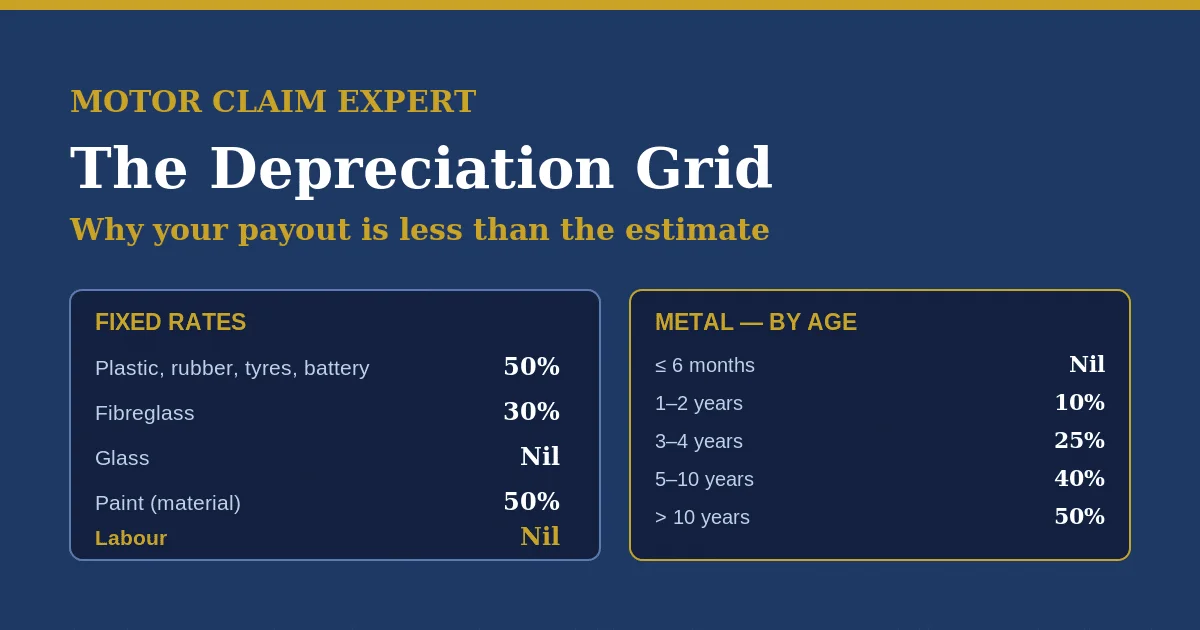
Some parts carry a fixed depreciation regardless of the car’s age:
| Part type | Depreciation |
|---|---|
| Rubber, nylon and plastic parts, tyres, tubes, batteries | 50% |
| Fibreglass components | 30% |
| All parts made of glass | Nil |
All metal and other parts follow an age-based scale instead, tied to the vehicle’s age:
| Age of vehicle | Depreciation on metal parts |
|---|---|
| Not exceeding 6 months | Nil |
| 6 months to 1 year | 5% |
| 1 to 2 years | 10% |
| 2 to 3 years | 15% |
| 3 to 4 years | 25% |
| 4 to 5 years | 35% |
| 5 to 10 years | 40% |
| Exceeding 10 years | 50% |
For painting, depreciation of 50% is applied to the material portion of the painting charge. Where the bill is consolidated, the material component is taken as 25% of the total painting charge — so, in practice, roughly an eighth of a consolidated paint bill is treated as depreciation.
Labour is not depreciated
This is the point most people miss and the one most worth checking: labour charges carry no depreciation. Depreciation applies only to the cost of parts and the material portion of paint. If a settlement looks unusually low, one of the first things to verify is that the surveyor did not quietly apply a percentage to the labour line.
This is not the IDV depreciation grid
There are two separate depreciation schedules in motor insurance and they are constantly confused. The IDV depreciation grid reduces the whole vehicle’s value to set your sum insured (and the total-loss payout). The parts depreciation grid on this page reduces the cost of individual replaced parts in a repair claim. They use different percentages and do different jobs — one values the car, the other prices a partial-loss claim.
How to reduce the depreciation hit
The zero-depreciation add-on (also called “bumper-to-bumper” or “nil-dep”) waives the parts depreciation, so the insurer pays the full cost of replaced parts. It is usually available for cars up to around five years old and often limits the number of nil-dep claims per year. It is the single most effective way to close the estimate-to-payout gap. Note what it does not cover: the compulsory deductible and consumables still apply unless separately added.
When the grid is applied wrongly
Because depreciation is applied part by part, small classification errors change the payout. A part that is genuinely metal being treated as plastic (50% instead of the age slab), the wrong age band, or depreciation slipped onto labour — each quietly reduces your settlement. The surveyor’s assessment is where these are set, so it is the document to check line by line. If the classification or the slab is wrong and the insurer will not correct it, that is a basis to contest the settlement.
Myth versus reality
| What you assume | What is true |
|---|---|
| “The insurer cut my claim unfairly.” | Most of the cut is the standard depreciation grid, applied per part — but it can be misapplied, so check it. |
| “Everything depreciates at the same rate.” | Plastics and tyres are fixed at 50%, glass is nil, metal follows an age slab, paint is on material only. |
| “Labour gets depreciated too.” | Labour carries no depreciation; only parts and paint material do. |
| “Zero-dep means zero deductions.” | Zero-dep waives parts depreciation only — the deductible and consumables still apply. |
The bottom line
The gap between your repair estimate and your payout is mostly the depreciation grid doing exactly what it is designed to do: fixed rates on plastics, tyres and glass, an age scale on metal, half the paint material, and nothing on labour. Learn to read those lines and you can tell a correct settlement from a mistaken one — and a zero-depreciation add-on is the cleanest way to make the gap disappear in the first place.
Frequently asked questions
Have zero-dep and still saw a deduction? See exactly what is still deducted in a zero-depreciation claim.
Because depreciation on parts is the biggest deduction, many owners weigh the zero-dep add-on. See whether zero dep is worth it for your car’s age.
Depreciation is a big reason the approved figure trails the garage bill. See the full picture of garage estimate vs surveyor-approved amount and what to do about the gap.
Depreciation is one of several deductions on a claim. For the full picture, see every deduction on your repair bill, explained.
How is depreciation calculated on a car insurance claim in India?
Depreciation is applied part by part before the claim is paid. Rubber, plastic, nylon parts, tyres, tubes and batteries are fixed at 50%; fibreglass at 30%; glass at nil. Metal and other parts follow an age scale from nil (under 6 months) up to 50% (over 10 years). Paint depreciation is 50% on the material portion only.
What is the depreciation rate on metal parts by car age?
The standard tariff scale for metal parts is: under 6 months nil; 6 months to 1 year 5%; 1 to 2 years 10%; 2 to 3 years 15%; 3 to 4 years 25%; 4 to 5 years 35%; 5 to 10 years 40%; over 10 years 50%.
Is depreciation applied to labour charges?
No. Labour charges carry no depreciation and should be paid in full. Depreciation applies only to the cost of replaced parts and the material portion of paint. If your settlement looks low, check that labour was not depreciated.
What is the depreciation on plastic parts and tyres?
Rubber, nylon and plastic parts, along with tyres, tubes and batteries, carry a fixed 50% depreciation regardless of the car’s age. This is why a new bumper or a tyre replacement is often only half paid unless you have a zero-depreciation add-on.
How is paint depreciation calculated?
Depreciation of 50% is applied to the material portion of the painting charge. When the bill is consolidated, the material component is taken as 25% of the total painting charge — so roughly an eighth of a consolidated paint bill is treated as depreciation.
Is the parts depreciation grid the same as IDV depreciation?
No. They are two different schedules. IDV depreciation reduces the whole vehicle’s value to set your sum insured and total-loss payout. The parts depreciation grid reduces the cost of individual replaced parts in a repair claim. Different percentages, different purpose.
How can I avoid depreciation on my claim?
A zero-depreciation (nil-dep or bumper-to-bumper) add-on waives the parts depreciation so the insurer pays the full cost of replaced parts. It is usually available for cars up to around five years old and may cap the number of nil-dep claims per year. The compulsory deductible and consumables still apply.
Can depreciation be applied wrongly, and what can I do?
Yes. A metal part classified as plastic, the wrong age band, or depreciation slipped onto labour each reduce the payout unfairly. Check the surveyor’s assessment line by line; if the classification or slab is wrong and the insurer will not correct it, you can contest the settlement through the grievance route and the Ombudsman.


