
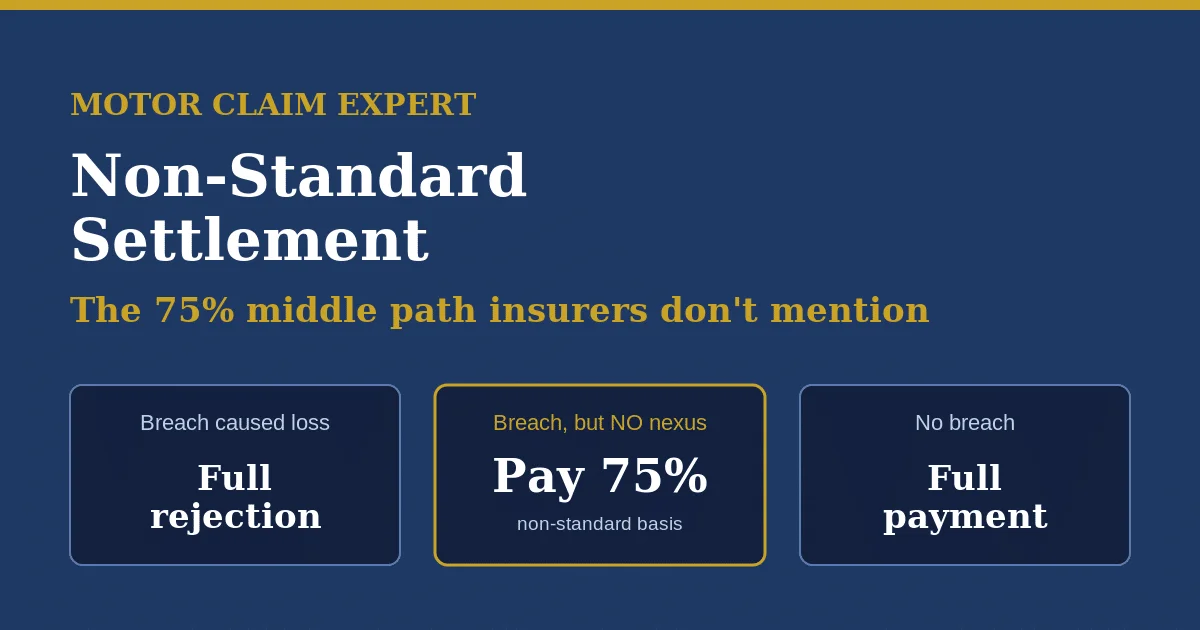
When an insurer finds a breach of a policy condition, it tends to present you with two options: full payment or nothing. Most people accept the “nothing” because they assume a breach is a breach. But Indian insurance law recognises a third path that sits between the two — the non-standard settlement, most often at 75% of the claim. It is one of the most useful rights a policyholder has, and one of the least explained.
This guide sets out what a non-standard settlement is, the Supreme Court rulings that force insurers to offer it, exactly when the 75% figure applies, and how to ask for it instead of accepting a total rejection.
What a non-standard settlement actually is
Insurers’ own claim-settlement guidelines contain a category called “settlement on a non-standard basis.” The idea is simple: where the policyholder has technically breached a condition but the breach did not cause or worsen the loss, the insurer pays a reduced percentage of the otherwise admissible claim rather than repudiating it in full. The most commonly applied figure is 75%. It is, in effect, a proportionate penalty for a technical lapse — not a licence to deny the whole claim.
The reason this matters: insurers rarely volunteer it. The first letter is almost always a full repudiation. The non-standard settlement is something you usually have to ask for by name.
The legal foundation: the “nexus to loss” principle
Three Supreme Court judgments built this doctrine, and every good non-standard-settlement argument rests on them:
| Case | What happened | What the Court held |
|---|---|---|
| B.V. Nagaraju v. Oriental Insurance Co. Ltd., (1996) 4 SCC 647 | A goods vehicle carried more people than permitted; it was hit by a gas tanker. | The “main purpose rule”: a breach that did not contribute to the accident is not fundamental. The exclusion is read down and the claim is payable. |
| National Insurance Co. Ltd. v. Nitin Khandelwal, (2008) 11 SCC 259 | A private car allegedly used as a taxi was stolen. | In a theft, the nature of use is not germane. The insurer cannot repudiate fully; the claim was settled on a non-standard basis at 75%. |
| Amalendu Sahoo v. Oriental Insurance Co. Ltd., (2010) 4 SCC 536 | A private car hired out was damaged; the insurer rejected for breach of the limitation-as-to-use condition. | Where a breach is not fundamental, the claim must be settled on a non-standard basis — up to 75% of the admissible amount — not rejected outright. |
The thread running through all three is nexus: did the breach actually cause or contribute to the loss — the same test that decides a consequential-loss flood claim? If not, a total rejection is unsustainable.
When the 75% rule applies — and when it doesn’t
The distinction is between a fundamental breach connected to the loss and a technical breach that had no bearing on it.
| Situation | Likely outcome |
|---|---|
| Delay in intimating the claim, but the loss itself is genuine | Non-standard settlement (typically 75%) |
| Private car used for hire, then stolen | Non-standard settlement (75%) — use is not connected to theft |
| An undeclared CNG/LPG kit, where the loss had nothing to do with the kit | Non-standard settlement (75%) |
| A few extra passengers, where they did not cause the accident | Claim payable (main purpose rule) |
| Driving under the influence that caused the accident | Full repudiation stands — the breach caused the loss |
| No valid driving licence, where driving competence caused the crash | Full repudiation likely — a fundamental, connected breach |
The regulator now backs the principle
This is no longer only case law. The IRDAI Master Circular on Protection of Policyholders’ Interests, 2024 states plainly that an insurer cannot repudiate a claim, in full or in part, where the breach of a warranty or condition is not relevant to the nature or circumstances of the loss. In other words, the “no nexus, no full rejection” rule that the courts built is now written into the regulator’s own rulebook — a powerful line to quote in any grievance.
How to actually get a non-standard settlement
If your claim has been rejected for a breach, do not treat the repudiation letter as final:
- Get the rejection in writing with the exact condition breached. You cannot argue nexus until you know precisely what the insurer is relying on.
- Show there is no nexus. Use the surveyor’s own report — if it does not attribute the loss to the breach, that is your strongest evidence.
- Ask for the non-standard settlement by name, in a written reply, citing Amalendu Sahoo and the 2024 circular, and requesting 75% rather than a total rejection.
- Escalate to the grievance officer and then the Insurance Ombudsman if the insurer holds firm; Ombudsman awards routinely apply the non-standard formula. If they simply go silent, treat it as a delayed claim and press your timeline rights too.
Myth versus reality
| What you are told | What the law says |
|---|---|
| “You breached a condition, so the claim is void.” | Only a breach connected to the loss is fundamental; an unconnected breach usually gets 75%. |
| “It’s full payment or nothing.” | Non-standard settlement is a recognised middle path in insurers’ own guidelines. |
| “This is just a consumer-court theory.” | Three Supreme Court judgments and the IRDAI 2024 circular back it. |
| “75% means the total-loss rule.” | That is a different 75% (the CTL repair threshold) — unrelated to settlement percentage. |
The bottom line
A breach of a policy condition is not automatically the end of your claim. If the breach had nothing to do with how the loss happened, the law — from B.V. Nagaraju in 1996 to the IRDAI circular of 2024 — points to a non-standard settlement, usually 75% of the admissible amount, rather than a total rejection. The recovery often turns on one move: knowing the remedy exists and asking for it by name.
Frequently asked questions
What is a non-standard settlement in motor insurance?
It is a settlement in which the insurer pays a reduced percentage of the otherwise admissible claim — most commonly 75% — instead of rejecting it in full, where the policyholder breached a condition but the breach did not cause or worsen the loss. It comes from insurers’ own claim-settlement guidelines and is backed by the Supreme Court.
When does the 75% rule apply to a rejected claim?
It typically applies where the breach has no nexus to the loss — for example delay in intimation on a genuine claim, a private car used for hire that is then stolen, an undeclared CNG kit where the loss was unrelated to it, or a few extra passengers who did not cause the accident. Where the breach caused the loss (such as drunk driving), full repudiation can stand.
Which court judgments support non-standard settlement?
Three Supreme Court cases: B.V. Nagaraju v. Oriental Insurance, (1996) 4 SCC 647 (the ‘main purpose rule’); National Insurance Co. v. Nitin Khandelwal, (2008) 11 SCC 259 (theft, 75% despite a use breach); and Amalendu Sahoo v. Oriental Insurance, (2010) 4 SCC 536 (up to 75% where the breach is not fundamental).
Is the 75% non-standard settlement the same as the total-loss 75% rule?
No. They are two unrelated figures. The Constructive Total Loss rule treats a car as a write-off when repair cost crosses 75% of the IDV. The non-standard settlement pays 75% of an admissible claim because of a minor breach. One decides whether the car is a total loss; the other decides how much of a disputed claim you recover.
Does IRDAI support non-standard settlement?
Yes. The IRDAI Master Circular on Protection of Policyholders’ Interests, 2024 states that an insurer cannot repudiate a claim, in full or in part, where the breach of a warranty or condition is not relevant to the nature or circumstances of the loss — codifying the courts’ nexus principle.
How do I ask for a non-standard settlement?
Get the repudiation in writing with the exact condition breached, use the surveyor’s report to show the breach did not cause the loss, and reply in writing asking for a non-standard settlement at 75% rather than a total rejection — citing Amalendu Sahoo and the 2024 circular. Escalate to the grievance officer and then the Insurance Ombudsman if needed.
Can the insurer refuse and reject the claim entirely?
It can try, but if the breach is not connected to the loss, a total rejection is generally unsustainable before the Ombudsman or a consumer commission, which routinely apply the non-standard formula. A fundamental breach that caused the loss is different and can justify full repudiation.
Is 75% always the figure, or can it be higher or lower?
75% is the most commonly applied figure from insurers’ non-standard settlement guidelines, but the percentage can vary with the nature of the breach, and in some cases (like the main-purpose-rule situations) the claim is payable in full. Treat 75% as the usual floor to argue from, not a fixed cap for every case.
Sources & official references
- Supreme Court judgments: National Insurance Co. Ltd. v. Nitin Khandelwal, (2008) 11 SCC 259; Amalendu Sahoo v. Oriental Insurance Co. Ltd., (2010) 4 SCC 536; and B.V. Nagaraju v. Oriental Insurance Co. Ltd., (1996) 4 SCC 647 — where a breach of a policy condition did not cause or aggravate the loss, the claim should be settled on a non-standard basis (commonly 75%) rather than repudiated in full.
- IRDAI regulation: the IRDAI Master Circular on Protection of Policyholders’ Interests, 2024 — insurers should not repudiate claims for breaches that are not germane to the loss.


