
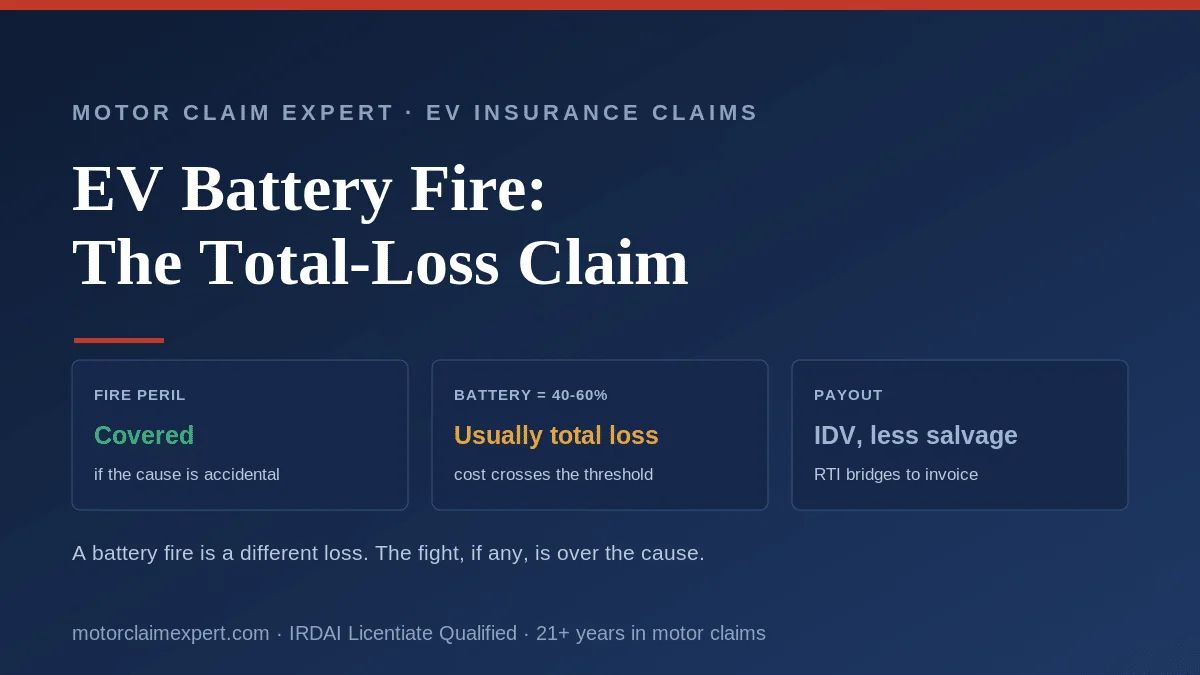
An electric car that catches fire is not a bigger version of a petrol-car fire — it’s a different kind of loss, and it plays out differently at claim time. A lithium battery in thermal runaway burns intensely, is very hard to extinguish, can reignite hours or days later, and usually destroys the single most valuable part of the vehicle. For the owner, that raises three anxious questions: is a battery fire even covered, will the car be written off, and how much will I actually get back? This guide answers all three, and explains the causation checks and valuation traps that decide the number on the cheque.
Is a battery fire even covered?
Yes, as a starting point. The standard Indian comprehensive (own-damage) motor policy lists fire, explosion and self-ignition among its covered perils, and that protection extends to an electric car’s battery pack. So an EV that suffers a genuine, accidental thermal-runaway fire is, in principle, a covered claim — the same way an accidental engine-bay fire would be on a petrol car. Where EVs differ is not whether fire is covered, but how fiercely the cause is examined, because a battery fire is expensive and its origin is not always accidental.
Insider note — how the surveyor investigates the cause: on a high-value battery fire, expect a careful origin investigation, sometimes with a forensic or manufacturer input. The question is whether the fire was accidental (covered) or traceable to an excluded cause. Four things shift a claim from payable to contested: an unauthorised modification to the battery or wiring; a manufacturing defect (which is the maker’s warranty problem, not the motor policy’s); clear negligence; and — the EV-specific trap — a delayed fire after water ingress, where the owner tried to power up or restart a flooded car and triggered a short. Establishing an accidental origin is the heart of the claim, which is why what you do in the first hour matters (see below).
Why a battery fire is almost always a total loss
This is the part owners underestimate. In an EV, the traction battery typically represents 40–60% of the car’s value — a replacement pack runs from roughly Rs 1–5 lakh on mainstream cars to Rs 8–12 lakh on premium models. A thermal-runaway event usually destroys the pack and damages the surrounding structure, wiring and cooling systems. Once the estimated repair — dominated by a full battery replacement — crosses the insurer’s write-off threshold (the constructive total loss, commonly assessed around the 75% rule), the car is declared a total loss rather than repaired. With a battery fire, that threshold is crossed far more easily than on an equivalent petrol car, where no single part carries such a share of the value.
| Factor | Petrol-car fire | EV thermal-runaway fire |
|---|---|---|
| Costliest part at risk | Engine/wiring — a fraction of value | Battery — 40–60% of value |
| Total-loss likelihood | Depends on spread | High — battery cost alone often crosses the threshold |
| Cause scrutiny | Moderate | High — accidental vs modification/defect/post-flood |
| Salvage value | Usual wreck value | Low — a burnt pack is hazardous, hard to resell |
What you’ll actually be paid
Once it’s a total loss, the settlement is built on the IDV — the car’s insured declared value, which for an EV is high precisely because it includes that expensive battery. From the IDV the insurer applies the policy deductible and accounts for salvage; in a normal total loss the wreck’s salvage value is factored in, but a fire-destroyed EV battery is hazardous and has little or negative resale value, which affects how the salvage is handled. The result is the depreciated settlement — often well below what you paid, especially on a newer car. This is exactly where the Return to Invoice add-on earns its keep: it pays the full invoice value instead of the depreciated IDV, closing the gap on a car you can no longer use.
The two mistakes that can cost you the claim. First, never try to restart, charge or move a flooded EV yourself. Water can create internal shorting bridges that cause a delayed thermal runaway — fires have started days after a flood when an owner powered the car back up — and doing so hands the insurer a negligence/causation argument. Second, declare and endorse any battery or electrical modification: an undeclared or unauthorised change near the pack is both a fire risk and an exclusion trap. After any thermal event, treat the car as unsafe, keep everyone away, and let the insurer’s process establish the cause. For the water-damage angle specifically, see our guide to flood-damaged vehicles.
What to do after an EV fire or thermal event
A worked example
An EV battery fire is frightening, but the claim logic is knowable. Fire is a covered peril, so an accidental thermal-runaway loss is generally payable — the fight, when there is one, is over cause. Because the battery dominates the car’s value, these events usually become total losses, settled at the battery-weighted IDV and reduced for salvage, which is why an owner who bought Return to Invoice ends up far closer to whole. Keep the cause clean — never restart a flooded EV, declare every modification — and let the insurer establish an accidental origin. For the wider EV picture, start with our EV insurance & claims hub, and for the fire-risk fundamentals, EV charging & fire safety and what your EV battery cover includes.
Frequently Asked Questions — EV Battery Fire & Total Loss
Is an EV battery fire covered by car insurance?
Yes, in principle. A comprehensive policy covers fire, explosion and self-ignition as standard perils, and that extends to the battery. An accidental thermal-runaway fire is generally payable, provided the cause is not an excluded one.
When is an EV fire claim not covered?
When the fire traces to an excluded cause: an unauthorised modification to the battery or wiring, a manufacturing defect (which is the maker’s warranty issue), gross negligence, or restarting a flood-damaged EV that triggers a delayed short.
Why does an EV battery fire usually become a total loss?
Because the battery is 40 to 60 percent of the car’s value and a replacement pack can cost several lakh. Once the repair estimate crosses the write-off threshold (assessed around the 75 percent rule), the car is declared a total loss rather than repaired.
How much will I be paid if my EV is a total loss?
The settlement is based on the IDV — the depreciated insured value, which for an EV is high because it includes the battery — less the deductible and salvage. A Return to Invoice add-on instead pays the full invoice value, closing the gap.
Does a burnt EV battery have salvage value?
Very little. A fire-damaged lithium pack is hazardous and hard to resell, so it contributes little salvage. This affects how the total-loss settlement is calculated compared with a conventional wreck.
Can restarting a flooded EV cause a fire?
Yes. Water can create internal shorting bridges in the pack that cause a delayed thermal runaway, and fires have started days after a flood when an owner powered the car back up. Never restart, charge or move a flooded EV yourself.
What should I do immediately after an EV fire?
Get everyone clear, do not move or restart the car, call the fire service and keep the report, photograph from a safe distance, and intimate the insurer at once so their surveyor can inspect and establish the cause before disposal.
Sources & references
- IRDAI-approved comprehensive motor policy wording — fire, explosion and self-ignition as covered own-damage perils; exclusions for modification, negligence and consequential causes.
- Industry cost data — EV traction battery at roughly 40–60% of vehicle value; replacement packs from about Rs 1–5 lakh (mainstream) to Rs 8–12 lakh (premium).
- Total-loss / constructive-total-loss assessment (commonly the ~75% rule) and IDV-based settlement less deductible and salvage.
- EV safety guidance — delayed thermal runaway after water ingress; do not power up a flooded EV.


