
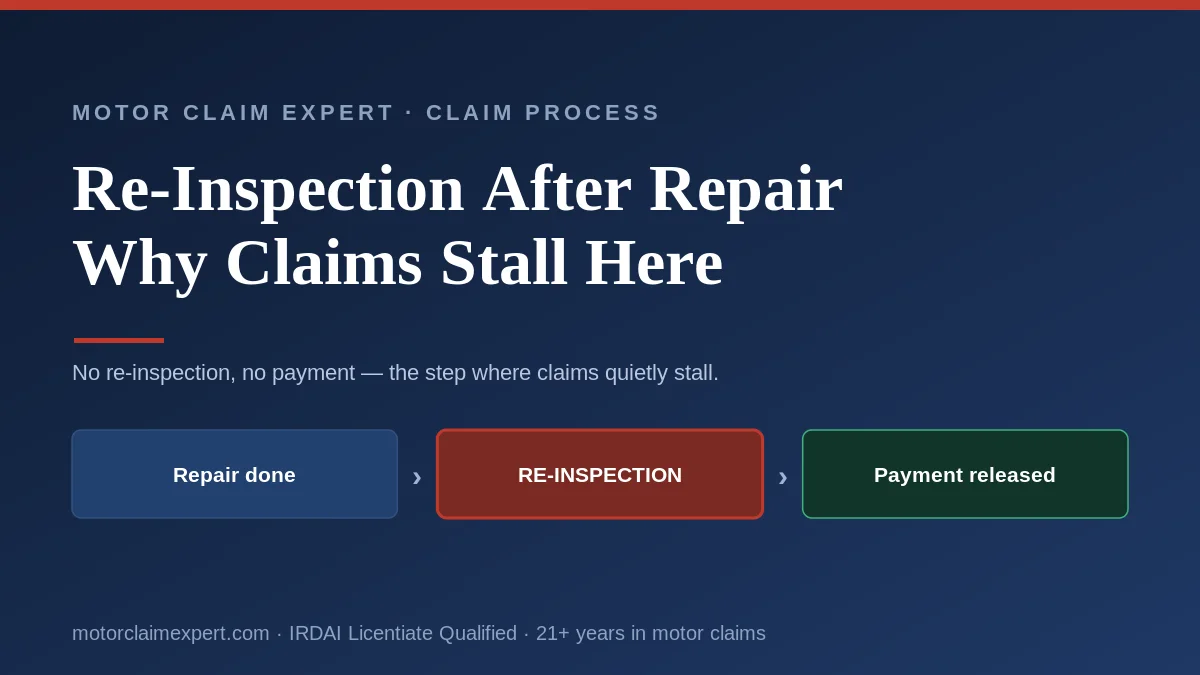
Most motor-claim guides stop at “repairs done, collect your car.” In reality there is one more gate — the re-inspection — and it is where a surprising number of claims quietly stall for weeks. The repairs are finished, the bill is ready, and then nothing moves. Almost always, the missing piece is a post-repair re-inspection the insurer needs before it will release payment. Understand this step and you remove the commonest cause of a “why hasn’t my claim been paid?” delay.
What re-inspection is — and why insurers insist on it
A re-inspection is a second look at your vehicle after the repair, as opposed to the first survey which assessed the damage before it. Its purpose is simple: to confirm that what the insurer paid for actually happened. Was the bumper that was billed as “replaced” genuinely replaced, or merely repaired and charged as new? Were all the approved parts fitted? Is the workmanship consistent with the estimate? Motor insurance carries real fraud risk — inflated bills, phantom parts, staged repairs — and re-inspection is the cheapest, most effective control the insurer has.
Where it sits in the claim timeline
Re-inspection is stage five of the six-stage own-damage claim — after repair, before settlement. On the full claim walkthrough it is the step between the garage finishing and the money arriving. The important point: the insurer’s 30-day settlement clock runs on a complete file, and an un-completed re-inspection keeps the file open. Skip or delay it and you delay your own payment.
What the re-inspector actually checks
| Check | What they’re confirming |
|---|---|
| Parts fitted | Each billed replacement part is physically present and new |
| Work matches estimate | Approved repairs were carried out — no billed-but-undone items |
| Replaced parts | Old parts are available to view or surrender (proof of replacement) |
| Workmanship | Quality is consistent with the claim and the vehicle is roadworthy |
| Invoice & documents | Final bill, payment proof and satisfaction voucher tally with the work |
Why claims stall at re-inspection
The usual causes of a stuck re-inspection: the owner collected the car and left before the insurer could re-inspect it; the garage discarded the replaced parts the insurer wanted to see; the final invoice didn’t match the approved estimate; or the file was submitted incomplete (missing payment proof or discharge voucher). Each one pauses the settlement clock — not because the claim is bad, but because the insurer can’t close its verification.
None of these is a rejection. They are process gaps, and every one is avoidable with a little coordination between you and the workshop before the car leaves the premises.
Cashless vs reimbursement: the re-inspection differs
Insider note: on a cashless claim the network garage usually coordinates the re-inspection directly with the insurer, so it happens almost invisibly before you drive away. On a reimbursement claim you carry the risk — if you pay the bill and collect the car before the insurer re-inspects, you can be left chasing a payment the insurer won’t release until it has verified the work. This is a major reason reimbursement claims run slower. See the trade-offs in cashless vs reimbursement.
How to pass re-inspection cleanly
Do these and the claim won’t stall: before you collect the car, confirm the insurer has re-inspected it (or that the network garage has arranged it); ask the garage to keep the replaced parts until the insurer confirms it doesn’t need them; make sure the final invoice matches the approved estimate line for line; and submit the complete file at once — final bill, payment proof, satisfaction/discharge voucher. If a re-inspection is pending, don’t disappear with the vehicle.
A worked example
Re-inspection is not an obstacle; it’s the insurer closing the loop before it pays. Treat it as the last item on your own checklist rather than an afterthought, and the difference between a claim that settles in weeks and one that drags for months often comes down to this single step. For the whole journey, see the own-damage claim walkthrough; if your settlement is being delayed beyond the 30-day limit for no good reason, know how to dispute it.
Frequently Asked Questions — Re-Inspection After Repair
What is re-inspection in a motor insurance claim?
A re-inspection is a post-repair check by the insurer confirming that the parts it approved were actually replaced and the approved work was actually carried out, before it releases payment.
Why is my car insurance claim stuck after the repairs are done?
Usually a pending re-inspection. The insurer has not yet verified the completed work, often because the car was collected too early or the replaced parts were discarded, so the settlement clock stays paused.
Is re-inspection required for a cashless claim?
Yes, but on a cashless claim the network garage usually coordinates the re-inspection with the insurer before you drive away, so it happens almost invisibly.
Do I need to keep the old replaced parts?
Often yes. Insurers may want to view or take back the replaced parts as proof of replacement, so keep them until the insurer confirms it does not need them.
How long does re-inspection take?
It is usually quick once arranged, but delays happen when the vehicle is not available or the file is incomplete. It must be done before the 30-day settlement clock can close.
Can a claim be rejected at re-inspection?
Re-inspection rarely rejects a genuine claim; it pauses payment until the work is verified. Discrepancies such as billed-but-undone items can, however, reduce the settlement.
How do I avoid delays at re-inspection?
Confirm the re-inspection before collecting the car, keep the replaced parts, match the final invoice to the approved estimate, and submit a complete file with payment proof and the satisfaction voucher.
Sources & official references
- IRDAI (Protection of Policyholders’ Interests) Regulations, 2024 — claim settlement turnaround.
- Insurance Act, 1938 — Section 64UM (survey and loss assessment).
- IRDAI-approved Indian Motor policy wording — claim verification and settlement conditions.


