
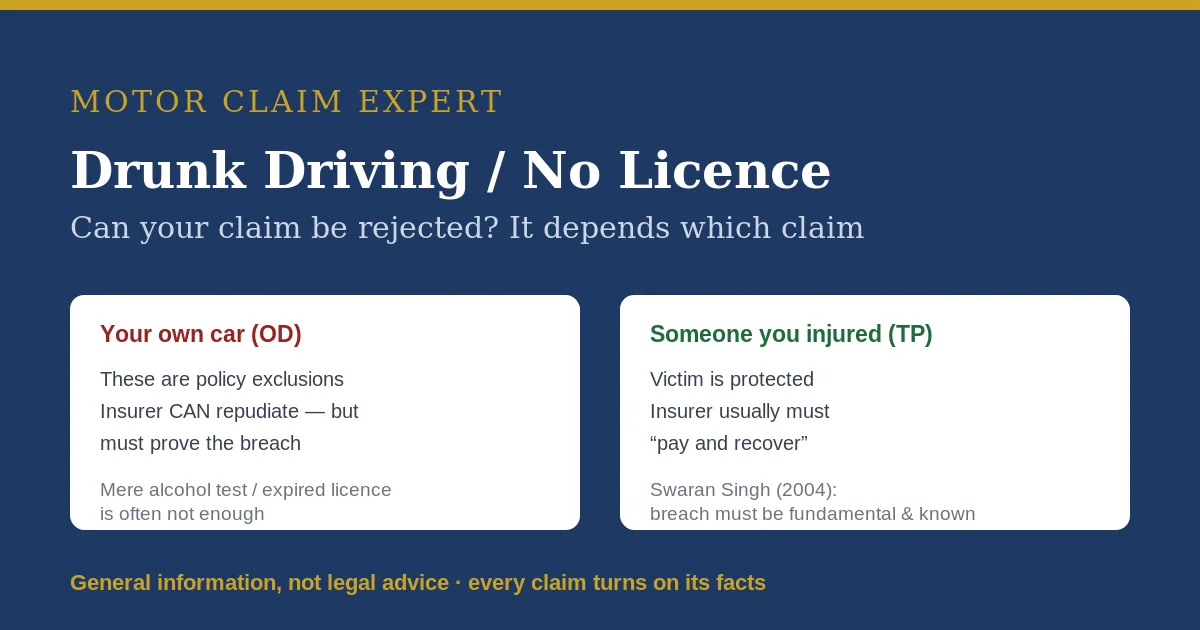
The honest answer is: it depends on which claim you mean, and on the facts. For damage to your own car, driving under the influence of alcohol or drugs, or without a valid and effective licence, are standard policy exclusions, and the insurer can repudiate the own-damage claim. But repudiation is not automatic — the insurer must actually prove the breach, and for a licence it must usually show the breach was real and fundamental, not merely technical. For a third-party claim (someone you injured, or their property), the victim’s right to compensation is strongly protected: even where the driver was drunk or unlicensed, the insurer generally has to pay the victim first and recover afterwards. This guide separates those two situations, because the answer genuinely flips between them. It is general information, not legal advice; every claim turns on its own facts and policy wording.
First, split the question in two
Motor insurance does two different jobs, and drunk driving or an invalid licence affects them differently. The own-damage side is a contract between you and your insurer — it can be reduced or refused if you breach its conditions. The third-party side exists to protect innocent victims under a social-welfare scheme in the Motor Vehicles Act, so the law makes it far harder for an insurer to walk away from it. Keep the two apart and the rules stop seeming contradictory.
Drunk driving and your own-damage claim
Driving “under the influence of intoxicating liquor or drugs” is an express exclusion in the own-damage section of a standard motor policy. Under Section 185 of the Motor Vehicles Act, 1988, it is an offence to drive with a blood-alcohol concentration above 30 mg per 100 ml. Two things follow. First, the insurer carries the burden of proving you were under the influence — usually through a police record, a medical or breath-test result, or the hospital notes; a bare allegation on the surveyor’s report is not enough. Second, where intoxication is established and is connected to how the accident happened, this is generally treated as a fundamental breach, and repudiation of the own-damage claim will often stand. This is a serious exclusion, not a technicality — the realistic message is that a drink-driving own-damage claim is genuinely at risk, and the room to contest it lies in whether the insurer has actually proved the influence.
Drunk driving and a third-party claim
Here the picture changes. Third-party cover sits within Chapter XI of the Motor Vehicles Act, whose purpose is to make sure accident victims are compensated. Under the framework around Section 149, the insurer generally must satisfy the third party’s award and can then invoke “pay and recover” — paying the victim first and recovering the amount from the owner or driver afterwards where a breach is established. So even a drunk driver rarely leaves the victim uncompensated by the insurer; the financial consequence lands back on the owner or driver through recovery, not on the innocent third party.
No valid licence and your own-damage claim
This is where the outcome most often turns on the type of breach. Courts and consumer fora distinguish a fundamental breach — a driver who never held a licence at all, or an owner who knowingly handed the car to an unlicensed person — from a technical one, such as a licence that had expired but was renewable, or a genuine and reasonable belief that the driver was licensed. For a technical breach with no connection to the accident, an insurer generally cannot deny the claim outright. In National Insurance Co. Ltd. v. Nitin Khandelwal (Supreme Court, 8 May 2008), the Court held that where the breach of a policy condition is not germane to the cause of the loss, the claim should be settled on a “non-standard” basis rather than repudiated in full — commonly at around 75% of the admissible amount. The wider principle the fora apply is a causal nexus test: the insurer should show the breach had a real connection with the loss, not merely that a rule was broken.
No valid licence and a third-party claim
Victim protection is strongest of all here. In the landmark case National Insurance Co. Ltd. v. Swaran Singh (2004), the Supreme Court held that an insurer cannot avoid its liability to a third party merely because the driver lacked a valid licence; it must prove the breach was fundamental and committed with the owner’s knowledge or connivance. Even where a breach is established, tribunals commonly apply pay-and-recover, so the innocent third party is not left to bear the owner’s or driver’s default.
Where it lands — the situations at a glance
| Situation | Your own-damage claim | A third-party claim |
|---|---|---|
| Driving under the influence, connected to the accident | Likely repudiated — fundamental breach | Insurer pays victim; may recover from you |
| Positive test, but “under the influence” not properly proved | Contestable — insurer must prove the breach | Victim paid; recovery contested |
| Licence expired but renewable / genuine belief driver was licensed | Often technical — full repudiation may not stand; non-standard (part) settlement possible | Victim paid; insurer usually cannot avoid |
| Never-licensed driver knowingly given the car | Fundamental breach — repudiation likely stands | Pay and recover from the owner |
If your own-damage claim is repudiated on these grounds
- Get the repudiation in writing, quoting the exact policy clause and the evidence relied on. You cannot challenge a ground you have not seen stated.
- Test the evidence. For drink-driving, ask whether the insurer has actually proved you were “under the influence” — a medical or test record — rather than inferring it. For a licence, gather renewal proof or evidence of a genuine belief that the driver was licensed.
- Check the causal nexus. If the breach had no connection with how the loss occurred, raise the non-standard-settlement principle from Nitin Khandelwal.
- Reply formally — see our repudiation-reply guide and template.
- Escalate if needed: the insurer’s grievance cell, then the Insurance Ombudsman or the IRDAI Bima Bharosa portal, and finally a consumer court if the repudiation is not justified.
Frequently Asked Questions — Drunk Driving & Licence Claims
Can my car insurance claim be rejected for drunk driving?
An own-damage claim can be, because driving under the influence is a standard policy exclusion. But the insurer generally has to prove the driver was actually under the influence with impaired faculties, not merely that alcohol was present. A third party you injure is usually still entitled to compensation, with the insurer paying and then recovering.
What is the legal alcohol limit for driving in India?
Under Section 185 of the Motor Vehicles Act, it is a blood-alcohol level above 30 mg per 100 ml of blood (or the breath equivalent). Above this, a person can be charged with drunk driving. Whether an insurer can repudiate an own-damage claim still depends on proving that intoxication actually operated in the accident.
Will my claim be rejected if I was driving without a licence?
An own-damage claim can be repudiated, but courts require the breach to be fundamental and usually known to the owner — for example, knowingly letting an unlicensed person or a fake-licence holder drive. A technical lapse, like an expired-but-renewable licence, is treated differently. For third-party claims, the victim is protected under the “pay and recover” principle.
What does “pay and recover” mean?
It is a rule courts apply so an innocent third-party victim is not left unpaid because of the owner’s or driver’s breach. The insurer pays the victim first and then recovers the amount from the policyholder or driver. It protects the victim, not the person who breached the policy.
Is a positive alcohol test enough for the insurer to reject my claim?
Often not, on its own. Courts have held that mere presence of alcohol does not automatically defeat a claim; the insurer generally has to show the driver was genuinely under the influence and that it contributed to the accident. The precise standard depends on the facts and the forum.
Does an expired licence automatically void my claim?
Not automatically. An expired but renewable licence is generally treated as a technical breach rather than a fundamental one, and much depends on the facts. It is different from having never held a licence at all. Keep your licence valid and renewed to avoid the argument entirely.
The insurer rejected my own-damage claim — what should I do?
Ask for the repudiation in writing with the exact ground and evidence, check whether the insurer has actually proved the breach, reply on the record with your documents, and escalate through Bima Bharosa, the Insurance Ombudsman and the consumer commission if it is not resolved.
Sources & official references
- Law: Motor Vehicles Act, 1988, s.185 — driving with a blood-alcohol concentration above 30 mg per 100 ml is an offence.
- Supreme Court judgment: National Insurance Co. Ltd. v. Swaran Singh, (2004) 3 SCC 297 — an insurer must prove a fundamental breach committed with the owner’s knowledge to avoid a third-party liability, and a victim is protected by pay-and-recover.
- Supreme Court judgment: National Insurance Co. Ltd. v. Nitin Khandelwal (Supreme Court, 8 May 2008) — where a breach of a policy condition is not germane to the cause of the loss, the claim should be settled on a non-standard basis rather than fully repudiated.
- Law: third-party liability and the pay-and-recover mechanism sit within Chapter XI and s.149 of the Motor Vehicles Act, 1988.
- Policy wording: the intoxication and “no valid licence” exclusions apply to the own-damage section of your insurer’s IRDAI-approved motor policy wording.
Related guides
- How to Reply to a Claim Repudiation Letter (with Template)
- Claim Rejected for Misrepresentation or Non-Disclosure
- The Insurance Ombudsman for Car Insurance Claims
- Filing an IRDAI Complaint via Bima Bharosa
- Taking a Rejected Car Claim to Consumer Court
- Motor Accident Compensation & the MACT Claim Process
- How to Dispute a Motor Insurance Claim: The Escalation Ladder


