
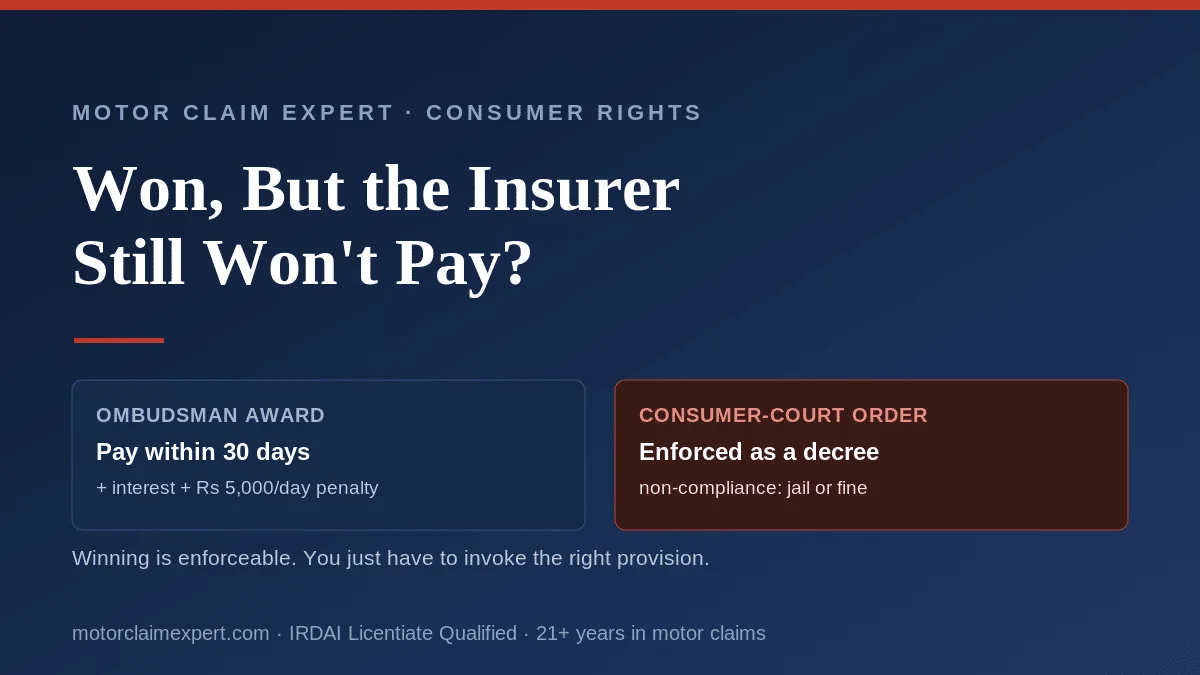
You did everything right. You disputed the rejection, climbed the ladder, and won — an Insurance Ombudsman award or a consumer-court order in your favour. And then… nothing. The insurer sits on it, and you’re left wondering whether the win was real. It is. A favourable award or order is not a suggestion the insurer can ignore; both come with statutory teeth, deadlines and penalties. This guide is the missing final rung of the dispute ladder: what to do when the insurer won’t pay even after you win.
What you may have won — and why it binds
There are two outcomes at the top of the dispute ladder, and they are enforced through completely different machinery. Knowing which one you hold tells you which lever to pull.
An Insurance Ombudsman award
If you went through the Insurance Ombudsman and won, you hold an award made under the Insurance Ombudsman Rules, 2017. It is binding on the insurer — but, importantly, not on you: if you’re unhappy with it, you can still go to a consumer court. The insurer has no such freedom.
A consumer-court order
If you took the insurer to the District, State or National Consumer Commission and won, you hold an order under the Consumer Protection Act, 2019 — enforceable with the full weight of a civil-court decree, and backed by criminal penalties for non-compliance.
Enforcing an Ombudsman award
The Insurance Ombudsman Rules, 2017 don’t just let the Ombudsman decide in your favour — they set a strict compliance regime the insurer must follow. Under Rule 17, once you accept the award in full and final settlement and send your letter of acceptance, the insurer must comply and pay within 30 days of receiving it, and must then confirm compliance back to the Ombudsman.
Insider note — the penalties most people never invoke: if the insurer misses the 30-day window, the Rules entitle you to interest from the date the claim ought to have been settled, and the insurer becomes liable for a penalty of ₹5,000 for every day of delay until it pays. Non-compliance is also reportable to IRDAI, which treats it very seriously. Cite Rule 17 by name when you follow up — insurers move faster when they see you know the exact provision.
Don’t let the acceptance step trip you: the 30-day clock starts from the insurer receiving your letter of acceptance of the award as full and final settlement. Send that acceptance promptly and keep proof of delivery — an insurer that hasn’t received a clear acceptance can genuinely stall, so remove that excuse first.
Enforcing a consumer-court order
A consumer commission’s order is not a moral victory — it is legally executable. The Consumer Protection Act, 2019 gives it real force through two provisions.
| Provision | What it lets you do |
|---|---|
| Section 71 — enforcement | The order is enforced like a civil-court decree under Order XXI CPC — the commission can order attachment and sale of the insurer’s property to realise the amount |
| Section 72 — penalty | Failing to comply is an offence punishable with imprisonment of one month to three years, or a fine of ₹25,000 to ₹1 lakh, or both |
You enforce it by filing an execution application with the same commission that passed the order. The commission has the powers of a Judicial Magistrate of the first class for these offences, and can try non-compliance summarily. In practice, the threat of attachment under Section 71 and prosecution under Section 72 is usually enough to unlock payment quickly.
Ombudsman award vs consumer order — the enforcement compared
| Ombudsman award | Consumer-court order | |
|---|---|---|
| Binds whom | Insurer only (you can still go to court) | Both parties (subject to appeal) |
| Deadline to pay | 30 days from your acceptance | As fixed in the order |
| Penalty for delay | Interest + ₹5,000/day; report to IRDAI | Attachment of property; jail or fine |
| How you enforce | Follow up citing Rule 17; escalate to IRDAI | File an execution application |
What to do when they don’t pay
You usually won’t need the nuclear option: most insurers comply once they see you know the enforcement route and are willing to use it. A firm, clause-referenced letter — Rule 17 for an award, Section 71/72 for an order — resolves the large majority of post-win delays without a single hearing. The mechanisms exist precisely so you rarely have to run them to the end.
A worked example
Winning the dispute is not the finish line — collecting is. But you are not powerless once you’ve won: an Ombudsman award carries a 30-day deadline, interest and a daily penalty, and a consumer order carries the force of a decree and the threat of prosecution. Know which you hold, invoke the exact provision, and keep your paperwork tight. For the road that got you here, see how to dispute a motor claim; to start the fight itself, the repudiation-reply template and the Bima Bharosa complaint process are your first two rungs.
Frequently Asked Questions — Enforcing an Award or Order
Is an Insurance Ombudsman award binding on the insurer?
Yes. Under the Insurance Ombudsman Rules 2017 the award is binding on the insurer, which must comply within 30 days of receiving your acceptance and confirm compliance to the Ombudsman. It is not binding on you, so you can still go to a consumer court if unhappy.
What happens if the insurer does not pay an Ombudsman award in 30 days?
You are entitled to interest from the date the claim should have been settled, and the insurer becomes liable for a penalty of Rs 5,000 for every day of delay. Non-compliance is also reportable to IRDAI, which views it seriously.
How do I enforce a consumer-court order against an insurer?
File an execution application with the same commission that passed the order. Under Section 71 of the Consumer Protection Act 2019 the order is enforced like a civil-court decree, allowing attachment and sale of the insurer’s property.
What is the penalty if an insurer ignores a consumer-court order?
Under Section 72 of the Consumer Protection Act 2019, non-compliance is an offence punishable with imprisonment of one month to three years, or a fine of Rs 25,000 to Rs 1 lakh, or both.
Do I have to accept the Ombudsman award before the insurer pays?
Yes. You must send a letter accepting the award in full and final settlement. The insurer’s 30-day compliance clock starts from its receipt of that acceptance, so send it promptly and keep proof of delivery.
Can I still go to court after winning at the Ombudsman?
Yes. The Ombudsman award binds the insurer but not you. If you are dissatisfied, you may still approach a consumer court; the insurer does not have that option.
What documents do I need to enforce an award or order?
Keep the award or order copy, your acceptance letter and its delivery proof, the original claim papers, and copies of every follow-up you send citing Rule 17 or Sections 71 and 72.
Sources & official references
- Insurance Ombudsman Rules, 2017 — Rule 17 (award binding on insurer, 30-day compliance, interest and Rs 5,000/day penalty for delay).
- Consumer Protection Act, 2019 — Section 71 (enforcement of orders as a decree) and Section 72 (penalty for non-compliance).
- IRDAI (Protection of Policyholders’ Interests) Regulations, 2024 — interest for delayed claim payments.


