
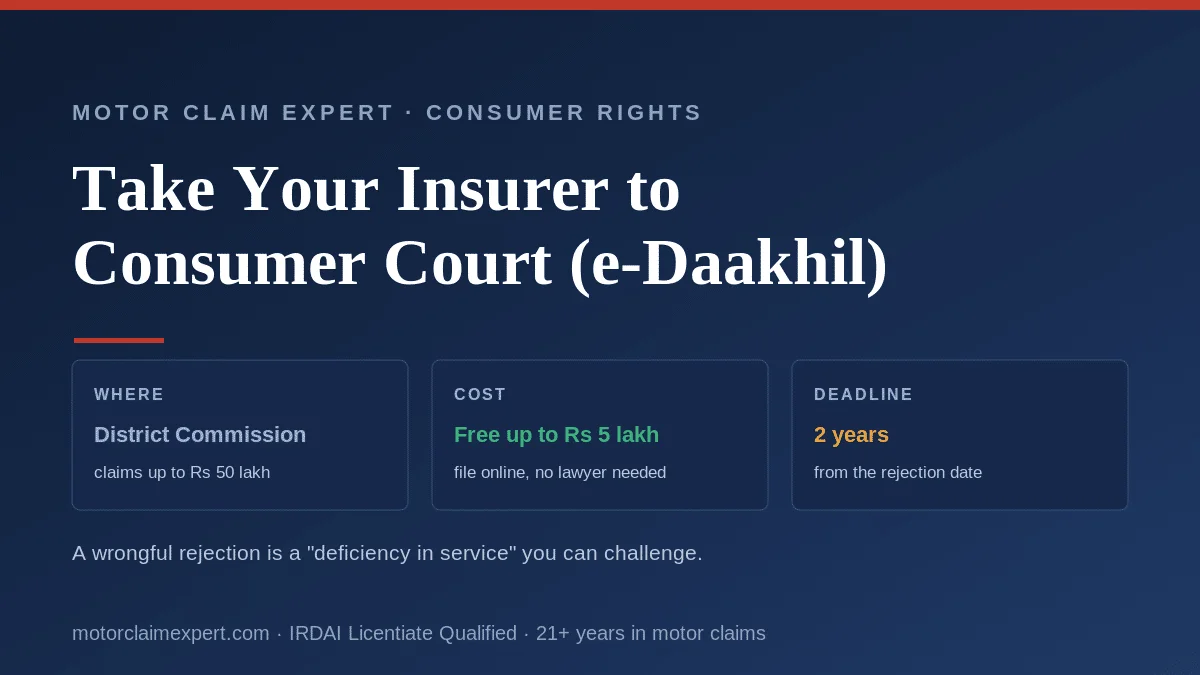
For most people, “taking the insurance company to court” sounds like an expensive, years-long ordeal reserved for those who can afford lawyers. It isn’t. The consumer commission — what people still call consumer court — was built precisely so an ordinary policyholder can challenge a wrongful rejection or a short settlement without a lawyer, for little or no fee, and now largely online. If your motor claim was unfairly denied and the insurer won’t budge, this is the forum with real teeth. This guide explains exactly how it works, where your case goes, what you can claim, and how to file it on the e‑Daakhil portal.
Where this sits in the dispute ladder
The consumer commission is the heavy end of the dispute ladder. You can go to it after exhausting the insurer’s grievance cell, or after — or instead of — the Insurance Ombudsman. Importantly, an Ombudsman award binds only the insurer, not you: if you’re unhappy with the outcome there, the consumer commission remains open. Many policyholders go straight to the commission for a clearly wrongful rejection, because its orders carry the force of a civil decree and criminal penalties for non-compliance.
The ground: “deficiency in service”
You don’t need a complicated legal theory. Buying an insurance policy makes you a consumer, and the insurer’s handling of your claim is a service. When that service falls short — a claim wrongly repudiated, an unjustified deduction, an unreasonable delay, a settlement below what the policy owes — that is a deficiency in service, which is exactly what the Consumer Protection Act lets you complain about. Your case, in essence, is: “I had a valid policy, I made a valid claim, and the insurer failed to honour it.”
Which commission hears your case
| Commission | Value of the claim |
|---|---|
| District Commission | Up to Rs 50 lakh — where almost every car-insurance dispute goes |
| State Commission | Above Rs 50 lakh and up to Rs 2 crore |
| National Commission | Above Rs 2 crore |
These limits were set by the Consumer Protection (Jurisdiction) Rules, 2021. Since a motor claim value is almost always well under Rs 50 lakh, you’ll normally file in your District Commission — typically where you live or where the insurer’s branch operates.
Expert note — this forum is deliberately consumer-friendly: unlike a regular civil court, the consumer commission was designed for you to use yourself. A lawyer is optional, not required. The fee is modest and there is no fee at all for claims up to Rs 5 lakh (a nominal fee applies in higher slabs). Filing is now done online through e‑Daakhil (edaakhil.nic.in) — the National Commission’s e-filing portal, now being brought under the newer integrated e‑Jagriti platform — so you can lodge the complaint, upload evidence, pay any fee and even attend hearings by video, without travelling to the commission.
Filing on e‑Daakhil — step by step
What you can actually claim
Ask for more than just the claim amount: a consumer complaint isn’t limited to the rupees the insurer withheld. You can seek the claim amount due, interest on it from the date it should have been paid, compensation for the mental agony and harassment the wrongful rejection caused, and your litigation costs. Commissions regularly award all four when an insurer’s refusal was unjustified. Frame your relief clearly in the complaint — you generally can’t be awarded what you didn’t ask for.
The two-year clock is the trap. A consumer complaint must be filed within two years of the cause of action — for a claim dispute, that’s essentially the date of the insurer’s rejection or repudiation. Miss it and the commission can refuse to hear you unless you can justify the delay. So don’t let a rejected claim drift: gather your papers, send your demand, and file well inside the two years. And keep every document — the rejection letter in writing is the single most important piece of your case.
Ombudsman or consumer court?
A worked example
A wrongful rejection is not the end of the road — it’s often just the point where an ordinary consumer becomes a complainant with real leverage. The consumer commission was built for exactly this: low cost, no compulsory lawyer, online filing, and orders that bind. If your claim was unfairly denied, get the rejection in writing, frame it as a deficiency in service, and file on e‑Daakhil inside the two-year window. Before you do, it helps to pin the insurer to its own policy wording — our reply-to-repudiation template shows how — and to understand where your case fits in the wider dispute ladder and among the common reasons claims are rejected.
Frequently Asked Questions — Consumer Complaint Against Your Insurer
Can I take my car insurance company to consumer court?
Yes. A wrongly rejected, delayed or under-paid claim is a deficiency in service under the Consumer Protection Act, 2019, which you can challenge in a consumer commission. You can file online on the e-Daakhil portal.
Which consumer commission do I file my insurance complaint in?
Almost all car-insurance disputes go to the District Commission, which handles claims up to Rs 50 lakh. The State Commission handles Rs 50 lakh to Rs 2 crore, and the National Commission handles above Rs 2 crore.
What is the fee to file a consumer complaint?
There is no fee for claims up to Rs 5 lakh. A nominal fee applies in higher value slabs. You can pay it online while filing on e-Daakhil.
What is the time limit to file a consumer complaint?
Two years from the cause of action, which for a claim dispute is essentially the date the insurer rejected or repudiated the claim. Filing later can be refused unless the delay is justified.
Do I need a lawyer to file on e-Daakhil?
No. The consumer commission is designed to be used by consumers directly, so a lawyer is optional. You can register, file the complaint with an affidavit and documents, pay any fee and attend hearings by video yourself.
What can I claim in a consumer complaint against an insurer?
The claim amount due, interest from the date it should have been paid, compensation for mental agony and harassment, and your litigation costs. State each of these clearly in the relief you seek.
What documents do I need to file the complaint?
Your policy copy, the claim intimation, the written rejection or repudiation letter, the survey report if any, and your correspondence with the insurer. A prior written demand notice to the insurer also strengthens the case.
Sources & references
- Consumer Protection Act, 2019 — complaint for deficiency in service; reliefs including compensation and costs; two-year limitation.
- Consumer Protection (Jurisdiction of the District, State and National Commission) Rules, 2021 — pecuniary limits (District up to Rs 50 lakh; State Rs 50 lakh–2 crore; National above Rs 2 crore).
- National Consumer Disputes Redressal Commission (NCDRC) — e-Daakhil e-filing portal (edaakhil.nic.in), now being integrated under the e-Jagriti platform; no fee up to Rs 5 lakh.


