
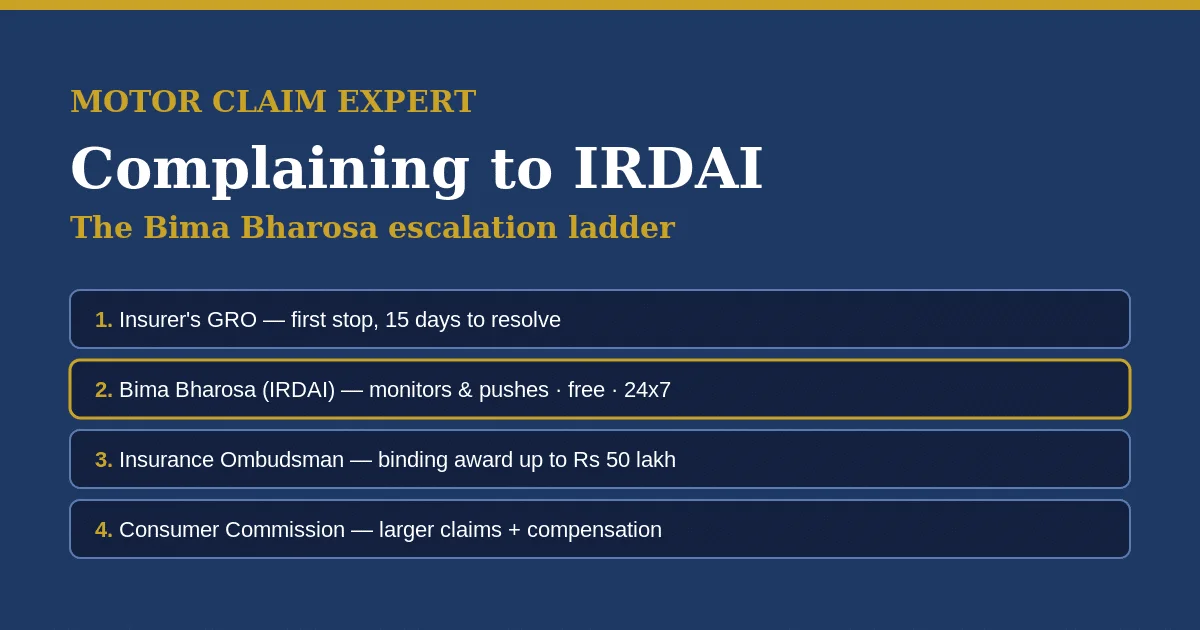
When an insurer rejects a claim unfairly or simply stops responding, the middle rung of the escalation ladder is IRDAI’s grievance portal — Bima Bharosa, the system formerly called IGMS (Integrated Grievance Management System). It is free, online and available around the clock. But it only works if you use it in the right order, and if you understand one thing about what it can and cannot do.
This guide walks through the exact process step by step: the mandatory first move, how and when to register on Bima Bharosa, how to track it, and where it sits in the wider dispute-resolution ladder.
Understand this first: facilitation, not adjudication
Bima Bharosa is a grievance-monitoring tool. When you register a complaint, IRDAI forwards it to the insurer, tracks it, and pushes for closure within a target time. What it does not do is decide the merits of your claim or award you compensation. IRDAI facilitates; it does not adjudicate. That distinction matters: Bima Bharosa is excellent for breaking a logjam and building an official, time-stamped record — but for a binding decision that orders the insurer to pay, you go to the Insurance Ombudsman or a consumer court. Use Bima Bharosa as the pressure step, not the final verdict.
Step 1: complain to the insurer’s GRO first (mandatory)
You cannot jump straight to IRDAI. Every insurer has a Grievance Redressal Officer (GRO), and your first written complaint must go to them. The moment you do, a 15-day clock starts: the insurer is expected to resolve the grievance within fifteen days. Keep proof of the date you complained — it is what unlocks the next step.
Step 2: register on Bima Bharosa
If the GRO does not resolve your complaint within 15 days, or the reply is unsatisfactory, escalate to Bima Bharosa. There are four ways in:
| Channel | Detail |
|---|---|
| Online portal | bimabharosa.irdai.gov.in — create a profile and register the complaint |
| Toll-free call | IRDAI Grievance Call Centre: 155255 or 1800 4254 732 |
| complaints@irdai.gov.in | |
| Physical letter | Policyholder’s Protection & Grievance Redressal Dept, IRDAI, Gachibowli, Hyderabad 500 032 |
The portal is free and open 24×7. On successful registration you receive a Token Number — save it. IRDAI forwards the complaint to the insurer and monitors it against its service target.
Step 3: track it, then escalate if needed
Track your complaint any time by logging in with your registered mobile number and the token number. If the complaint is not attended to within 15 days of registration on Bima Bharosa, or the insurer’s resolution is unsatisfactory, move up the ladder:
| Rung | What it does |
|---|---|
| 1. Insurer’s GRO | First stop; 15 days to resolve. |
| 2. Bima Bharosa (IRDAI) | Monitors and pushes the insurer; builds an official record. Facilitation, not a verdict. |
| 3. Insurance Ombudsman | Free, quasi-judicial, up to ₹50 lakh — a binding award. |
| 4. Consumer Commission | Under the Consumer Protection Act, 2019 — for larger claims or compensation. |
What to put in the complaint
A vague complaint gets a vague response. Include your policy number, the dates, and the precise grievance — a rejection, a delayed settlement, or an underpayment — with the documents attached and a clear statement of what you want. If a specific rule or deadline has been breached, name it: the interest owed on a delayed claim, the non-standard settlement you are entitled to, or the materiality the insurer must prove on a misrepresentation rejection. Specific complaints move faster because they are harder to fob off.
Where Bima Bharosa fits in the dispute cluster
Think of it as the enforcement layer between writing to your insurer and going to the Ombudsman. Use it when a repudiation reply has been ignored, when a claim is being delayed beyond the IRDAI timelines, when you are pressing for a non-standard settlement, or when you are contesting a misrepresentation rejection. It rarely delivers the final word, but it creates the record and the pressure that often produces a settlement — and if it does not, it is the clean bridge to the Ombudsman.
Myth versus reality
| What people assume | What is true |
|---|---|
| “IRDAI will decide my claim.” | IRDAI facilitates and monitors; it does not adjudicate or award compensation. The Ombudsman gives a binding decision. |
| “I can go straight to IRDAI.” | You must complain to the insurer’s GRO first and give it 15 days. |
| “Filing a complaint costs money.” | Bima Bharosa is free and 24×7; anyone asking for a fee is running a scam. |
| “A complaint is a complaint.” | A specific, document-backed complaint that names the breach is resolved far faster. |
The bottom line
Bima Bharosa is the regulator’s pressure valve: complain to your insurer’s GRO first, give it fifteen days, then register on the portal, save your token, and track it. Remember that IRDAI pushes and records but does not judge — so treat Bima Bharosa as the step that breaks the deadlock and, if it does not, as the bridge to the Ombudsman, where a binding award is possible. Used in the right order, with a specific complaint, it is one of the most effective free tools a policyholder has.
Frequently asked questions
Bima Bharosa is a regulator complaint, not a court. For a binding, compensation-backed order, you can also take a rejected claim to the consumer court under CPA 2019.
What is Bima Bharosa?
Bima Bharosa is IRDAI’s official online grievance portal for insurance complaints, launched in 2022 as a rebrand of IGMS (Integrated Grievance Management System). It lets a policyholder register a complaint against an insurer, which IRDAI then forwards and monitors. It is free and available 24×7 at bimabharosa.irdai.gov.in.
How do I file a complaint on Bima Bharosa?
First complain to your insurer’s Grievance Redressal Officer (GRO) and give them 15 days. If it is unresolved or unsatisfactory, register on the Bima Bharosa portal (create a profile), or use the toll-free number 155255 / 1800 4254 732, email complaints@irdai.gov.in, or a physical letter to IRDAI at Gachibowli, Hyderabad. Save the token number you receive.
Can I complain to IRDAI directly without going to my insurer first?
No. You must first complain to the insurer’s Grievance Redressal Officer and allow 15 days for resolution. Only if the insurer fails to resolve it, or the resolution is unsatisfactory, should you escalate to Bima Bharosa.
Does IRDAI decide my claim or pay compensation?
No. Bima Bharosa is a facilitation and monitoring tool — IRDAI forwards your complaint, tracks it and pushes the insurer for closure, but it does not adjudicate the merits or award compensation. For a binding decision that orders payment, you approach the Insurance Ombudsman or a consumer court.
Is there a fee to file an IRDAI complaint?
No. Bima Bharosa is completely free and open 24×7. IRDAI never asks complainants for any payment. If anyone requests a fee to ‘process’ or ‘settle’ your grievance, it is a scam, not the regulator.
What is the toll-free number for IRDAI grievances?
The IRDAI Grievance Call Centre can be reached on 155255 or 1800 4254 732. You can also email complaints@irdai.gov.in or register online at bimabharosa.irdai.gov.in.
When can I escalate to the Insurance Ombudsman?
If your complaint is not attended to within 15 days of registration on Bima Bharosa, or the insurer’s resolution is unsatisfactory, you can approach the Insurance Ombudsman under the Insurance Ombudsman Rules, 2017. The Ombudsman gives a binding award for claims up to ₹50 lakh, and is free.
How do I track my Bima Bharosa complaint?
Log in to the Bima Bharosa portal with your registered mobile number and the token number generated when you filed the complaint. The token lets you follow the status and see the insurer’s response, so keep it safe.
Sources & official references
- IRDAI portal: Bima Bharosa — the Integrated Grievance Management System (IGMS), IRDAI’s official policyholder grievance portal.
- IRDAI regulation: the IRDAI (Protection of Policyholders’ Interests…) Regulations, 2024 — grievance-redressal timelines, including escalation where a grievance is unresolved within 30 days.
- Further escalation: the Insurance Ombudsman (Insurance Ombudsman Rules, 2017, amended 2021) or a consumer court under the Consumer Protection Act, 2019.


