
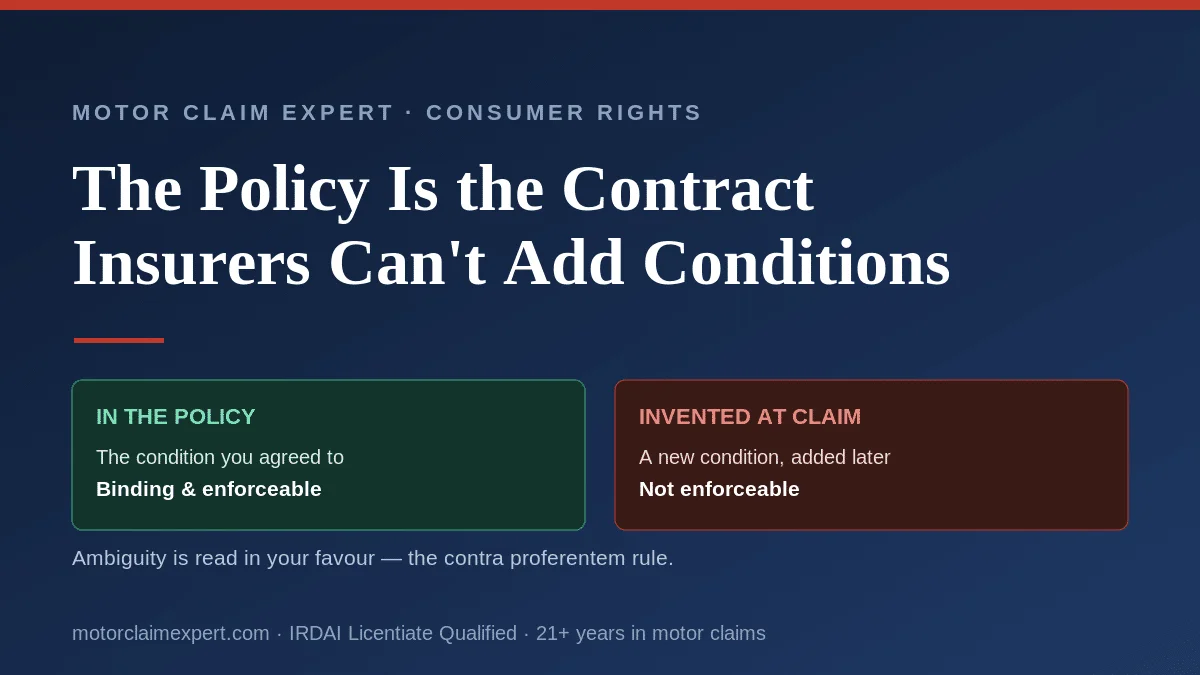
Here is one of the most useful things a policyholder can know, and one of the least understood: the policy document you were issued is the entire contract. When you make a claim, the insurer is bound by what that document actually says — no more, no less. It cannot invent a new condition at the claim stage, import a requirement from somewhere outside the policy, or quietly reinterpret a vague word against you. This isn’t a loophole or a lucky argument; it is settled insurance law in India, and it is the single most powerful principle you can hold on to when a motor claim is being obstructed.
The principle: the policy is the contract
An insurance policy is a contract, and like any contract it is fixed at the moment it is made. The prospectus, the proposal, the schedule and the policy wording together define exactly what is covered, what is excluded, and what you must do to claim. Once that contract is issued, neither side can rewrite it unilaterally. The insurer cannot, months later when you claim, bolt on a fresh requirement — “you should also have done X,” “we now need document Y,” “our internal policy says Z” — if none of that appears in the contract you were sold.
The Supreme Court has put this plainly: the terms of the policy govern the contract, and the words in it must be interpreted with reference to the policy itself, not to definitions imported from elsewhere. An insurer that drafted the wording cannot later stretch it, narrow it, or supplement it to defeat a genuine claim.
The two rules that protect you
| Rule | What it means for your claim |
|---|---|
| Bound by its own wording | The insurer can rely only on the conditions and exclusions actually written in the policy — it can’t add new ones at claim time |
| Contra proferentem | Where a clause is genuinely ambiguous, it is interpreted against the party that drafted it — the insurer — and in favour of you, the insured |
The second rule matters more than people realise. Policy wordings are drafted entirely by the insurer; you never negotiate a clause. So when a word is capable of two readings, the law does not let the drafter pick the reading that helps itself. Indian courts have applied this repeatedly, declining to let insurers import outside definitions or squeeze an ambiguous term to shrink cover.
An important limit — this is not a magic wand. The principle stops an insurer adding conditions; it does not delete the ones already in your policy. A clear, unambiguous exclusion that is written into your wording — say, no valid driving licence, or an undeclared modification — still applies. “The policy is the contract” cuts both ways: you also can’t claim for something the contract plainly doesn’t cover. The power of the rule is against invented or ambiguous grounds, not against terms you genuinely agreed to.
What “adding new conditions” looks like in a motor claim
In motor insurance the principle shows up in very concrete ways. Watch for a rejection or a deduction that rests on something you cannot locate in your own policy document:
| The move | Why it’s questionable |
|---|---|
| Demanding a document the policy never required | A claim condition not in the wording can’t be invented as a reason to refuse |
| Applying an exclusion that isn’t in your policy | Only exclusions actually printed in your contract are enforceable |
| Reinterpreting a vague term against you | Ambiguity is read in your favour, not the insurer’s |
| Adding a procedural hurdle at claim stage | A step not required by the policy can’t become a condition of payment after the fact |
| Citing an “internal guideline” not shared with you | Unpublished internal rules aren’t part of your contract |
A real example — used to illustrate, not to prove
The principle in action: in a July 2025 order, a district consumer commission in Andhra Pradesh (Kurnool) directed a general insurer to pay a deceased policyholder’s family ₹50 lakh under an accidental-death policy — plus ₹20,000 towards costs — holding that an insurer cannot introduce new conditions at the claim stage after issuing the policy. It is a helpful, recent illustration of the rule. But note: it is one forum’s order, and consumer decisions turn on their own facts. The strength of the principle doesn’t come from any single case — it comes from the settled contract law and Supreme Court reasoning that sit behind it. Treat news like this as confirmation, not as the foundation.
What this means for you when you claim
How to push back, in practice
Turn the principle into a claim you can win: get the rejection in writing and make the insurer state the exact clause it relies on. Then reply in writing, quoting your policy wording, and point out that the ground is either absent from the contract or ambiguous and therefore to be read in your favour. Keep it factual and clause-referenced. If the insurer holds firm, escalate — the grievance cell, then IRDAI’s Bima Bharosa, the Insurance Ombudsman, or the full dispute ladder — because a rejection built on a condition that isn’t in the policy tends not to survive scrutiny.
A well-drafted written reply that pins the insurer to its own wording is often all it takes. Our reply-to-repudiation template shows how to structure it.
A worked example
The lesson outlives any one headline: your policy is the contract, and the contract is what binds. When a motor claim is refused or cut, don’t argue in the abstract — go to the document, find the clause, and hold the insurer to the words it chose. If the ground isn’t there, or it’s ambiguous, the law is on your side. To see how this fits the wider picture, read what a valid rejection actually requires in our guide to why claims get rejected, and how coverage is defined in the first place in IDV and policy basics.
Frequently Asked Questions — Insurers and New Claim Conditions
Can an insurer add new conditions when I make a claim?
No. The policy issued to you is the contract, and the insurer is bound by its written terms. It cannot introduce a fresh condition at the claim stage that was not part of the policy you were sold.
What if my policy wording is unclear or ambiguous?
Genuine ambiguity is interpreted against the insurer that drafted the wording and in your favour, under the contra proferentem rule recognised by the Supreme Court of India.
Does this mean an insurer can never reject my claim?
No. Clear conditions and exclusions that are actually written in your policy still apply. The principle only stops the insurer relying on invented grounds or twisting ambiguous ones against you.
How do I know if a rejection ground is valid?
Ask the insurer to identify the exact policy clause it relies on, then check your own policy wording. If the ground is not there, or it is vague, the rejection stands on weak footing.
What should I do if a claim is rejected on a condition not in my policy?
Get the rejection in writing, reply quoting your policy wording, ask the insurer to point to the specific clause, and escalate to Bima Bharosa, the Insurance Ombudsman or a consumer forum if it holds firm.
Is an insurer’s internal guideline part of my contract?
No. Unpublished internal rules that were not part of your policy document are not binding conditions on your claim.
Where does this principle come from?
From basic contract law and Supreme Court rulings that the policy terms govern the contract, reinforced by the contra proferentem rule and IRDAI’s requirement that the policy document set out all terms, conditions and exclusions.
Sources & official references
- United India Insurance Co. Ltd. v. Harchand Rai Chandan Lal (2004) 8 SCC 644 — the terms of the policy govern the contract.
- Contra proferentem: Haris Marine Products v. ECGC Ltd. (2022) and United India Insurance Co. Ltd. v. Pushpalaya Printers (2004) 3 SCC 694 — ambiguity construed against the insurer.
- IRDAI (Protection of Policyholders’ Interests) Regulations, 2024 — the policy document must set out all terms, conditions and exclusions.
- Kurnool District Consumer Disputes Redressal Commission, Andhra Pradesh — July 2025 order (as reported), used here as a recent illustration.


