
When an insurer rejects a motor claim you believe is genuine, you are not out of options. Beyond replying to the repudiation letter and complaining to the Insurance Ombudsman, there is a stronger, court-backed route: a consumer complaint under the Consumer Protection Act, 2019 (CPA 2019). A wrongful rejection or an unfairly reduced settlement is treated in law as a “deficiency in service” — and the consumer commissions can order the insurer to pay your claim plus interest, compensation and costs. Whether a rejection is wrongful can turn on the specific ground — a drunk-driving or no-valid-licence rejection, for instance, follows its own legal tests.
This guide explains exactly how that route works in India: which commission to approach, the two-year deadline that quietly kills most cases, how to file online through e-Daakhil, and how to decide between the Ombudsman and the consumer court. It is educational, not legal advice — for a specific dispute, a consumer lawyer is worth the modest cost.
What the consumer court can actually do for a rejected claim
A consumer commission does not just “review” the insurer — it adjudicates. If it finds the rejection was a deficiency in service, it can order the insurer to:
- pay the claim amount that was wrongly denied or short-settled;
- pay interest on that amount from the date it fell due;
- pay compensation for the harassment, mental agony and deficiency; and
- pay your litigation costs.
That combination — principal, interest, compensation and costs — is why the consumer court is the right forum when a large claim is at stake or when a softer approach has failed. The foundation is the same evidence you have already gathered: your policy, the insurer’s written rejection with the exact clause cited, and the claim documents that prove the loss was covered.
Which commission do you approach? (pecuniary jurisdiction)
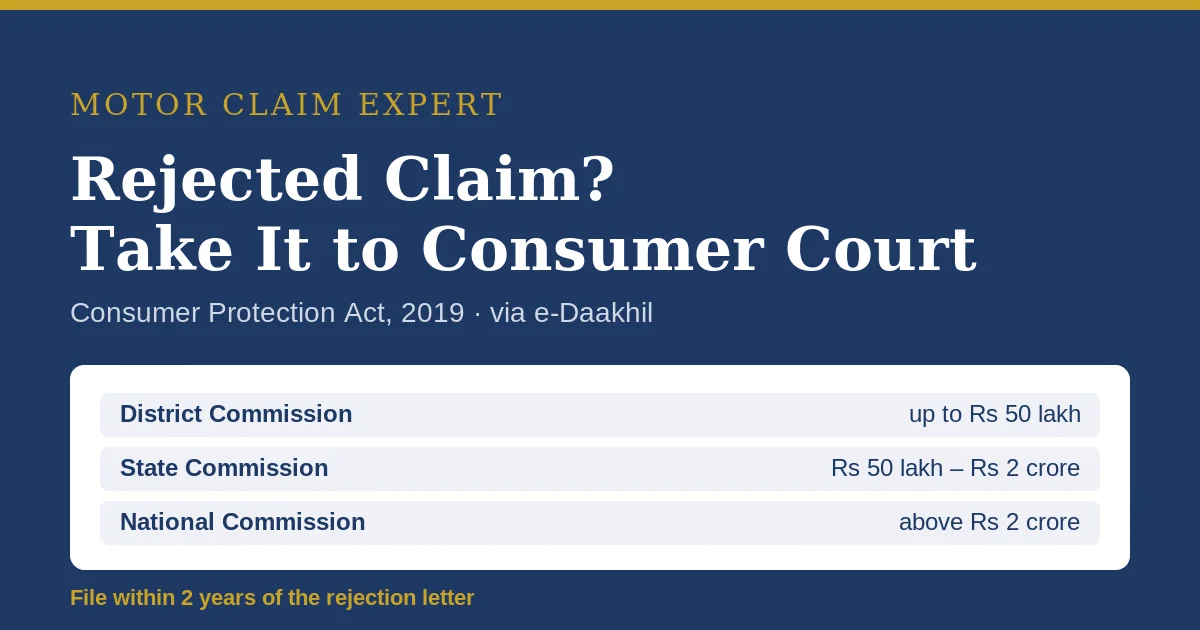
The CPA 2019 has a three-tier structure, and you file at the tier that matches the value of your dispute:
| Commission | Handles disputes of value | Level |
|---|---|---|
| District Consumer Disputes Redressal Commission | Up to ₹50 lakh | Your district — where most motor-claim cases are filed |
| State Commission | ₹50 lakh to ₹2 crore | State capital; also hears appeals from District |
| National Commission (NCDRC) | Above ₹2 crore | New Delhi; also hears appeals from State |
An important nuance: how the value is measured has been the subject of evolving interpretation — whether it is the amount you are claiming or the “value of consideration paid.” Because the great majority of car and bike claims sit comfortably under ₹50 lakh, most policyholders file at the District Commission regardless. If your dispute is large or the forum is unclear, use the jurisdiction calculator on the e-Daakhil portal or confirm with a consumer lawyer before filing, because filing in the wrong tier wastes time.
The deadline that kills most cases: a consumer complaint must be filed within two years of the cause of action — for a rejected claim, that is the date of the insurer’s repudiation letter. File after two years and the complaint can be dismissed unless you file a separate delay-condonation application with a genuine reason. Do not let the clock run while you wait on the insurer.
Ombudsman or consumer court — which should you choose?
Both are legitimate, and you generally pursue one at a time. The Insurance Ombudsman is free, faster and its award is binding on the insurer; the consumer court is more formal but can award larger compensation and reaches disputes the Ombudsman cannot.
| Factor | Insurance Ombudsman | Consumer Court (CPA 2019) |
|---|---|---|
| Cost | Free | Nominal, scaled by claim value (small claims often free) |
| Value cap | Up to ₹50 lakh | No upper cap (tiered by value) |
| Speed | Usually faster | More formal; can take longer |
| Compensation for harassment | Limited | Yes — deficiency-in-service compensation + costs |
| Binding | Binding on the insurer, not on you | Enforceable order; appealable |
A common, effective sequence: reply to the repudiation, then approach the Ombudsman or IRDAI’s Bima Bharosa portal; if that fails or the claim is large, escalate to the consumer court. You are not obliged to exhaust the Ombudsman first, but a documented paper trail of your earlier attempts strengthens your consumer case.
How to file on e-Daakhil (step by step)
Consumer complaints can now be filed online through the government’s e-Daakhil portal, without physically visiting the commission:
- Register on the e-Daakhil portal with your email and verify it.
- Start a new case, accept the disclaimer, and use the jurisdiction calculator to confirm the correct commission.
- Enter the parties — you as complainant, the insurer (and branch) as opposite party.
- Upload your complaint — a signed complaint with an affidavit, an index, and your evidence.
- Pay the nominal fee online (small claims are often exempt).
- Submit and note the case number; track hearings and file rejoinders through the portal.
Your complaint should read as a clear story: the policy was in force, the loss was covered, you submitted the documents, the insurer rejected it citing a specific clause on a specific date, and that rejection is a deficiency in service. Attach the insurer’s rejection letter and quote the exact clause it relied on — the same discipline used when you reply to a repudiation letter.
What to claim — and the evidence to attach
Ask for the full remedy, not just the claim amount: the sum wrongly denied, interest from the due date, compensation for deficiency and mental agony, and litigation costs. Support it with a tight evidence bundle:
- the policy schedule showing cover was live and the sum insured/IDV;
- the insurer’s repudiation or short-settlement letter with the clause cited;
- the claim documents — FIR/estimate/bills/surveyor report — proving the loss;
- your correspondence and any Ombudsman/IRDAI complaint reference; and
- a computation sheet showing exactly how you arrived at the amount claimed.
If your grievance is a reduced payout rather than a flat rejection — for example a non-standard settlement deduction or an under-assessment by the surveyor — the same forum and framing apply: it is still a deficiency in service.
Common mistakes that sink consumer complaints
- Missing the two-year window — by far the most common fatal error.
- Signing “full and final” first. Accepting money on a discharge voucher can weaken your right to claim more later; note any protest in writing.
- A vague complaint. “They cheated me” is not enough — plead the specific clause, the specific letter and the specific deficiency.
- No computation. The commission needs to see how your figure is built (claim + interest + compensation + costs).
- Filing in the wrong tier — check pecuniary jurisdiction before you file.
Handled well, the consumer court is the rung of the ladder that gives a genuine, wrongly-rejected claim its firmest remedy. Combined with a clean document file and a precise account of what the insurer did, it turns “claim rejected” into a case the insurer has to answer on the merits.
Frequently Asked Questions — Consumer Court for a Rejected Car Claim
Can I take my car insurance company to consumer court for rejecting my claim?
Yes. A wrongful rejection or an unfairly reduced settlement is treated as a “deficiency in service” under the Consumer Protection Act, 2019. You can file a complaint asking the consumer commission to order the insurer to pay the claim along with interest, compensation and costs.
Which consumer commission should I approach for a motor claim?
It depends on the value of your dispute: the District Commission handles disputes up to ₹50 lakh (where most car and bike claims fall), the State Commission handles ₹50 lakh to ₹2 crore, and the National Commission handles disputes above ₹2 crore. Use the e-Daakhil jurisdiction calculator if you are unsure.
What is the time limit to file a consumer complaint against an insurer?
Two years from the cause of action — for a rejected claim, that is the date of the insurer’s repudiation letter. Filing later can lead to dismissal unless you attach a delay-condonation application explaining the delay with a genuine reason.
Should I go to the Insurance Ombudsman or the consumer court?
The Ombudsman is free, usually faster, and its award is binding on the insurer for claims up to ₹50 lakh. The consumer court is more formal but can award larger compensation for harassment and has no upper value cap. Many people try the Ombudsman or IRDAI’s Bima Bharosa portal first, then escalate to the consumer court if needed.
How do I file a consumer complaint online?
Through the government’s e-Daakhil portal. You register, verify your email, create a new case, confirm jurisdiction, enter the parties, upload a signed complaint with an affidavit and evidence, pay the nominal fee online, and track the case through the portal.
How much does it cost to file in consumer court?
The fee is nominal and scaled by the value of the claim; small claims are often exempt from any fee. This is far cheaper than ordinary civil litigation, which is part of why consumer courts are the preferred route for insurance disputes.
What can I claim in the complaint?
Not just the rejected amount. Claim the sum wrongly denied, interest on it from the date it fell due, compensation for the deficiency in service and mental agony, and your litigation costs — supported by a clear computation sheet.
Do I need a lawyer to file a consumer complaint?
No, you can file and appear in person, and many consumers do. For a large or complex dispute, a consumer lawyer improves your framing and evidence and is usually worth the modest cost. This article is educational and not a substitute for advice on your specific case.
Sources & official references
- Law: Consumer Protection Act, 2019 — consumer-complaint procedure and the District (up to ₹50 lakh), State (₹50 lakh–₹2 crore) and National (above ₹2 crore) pecuniary jurisdiction.
- Official portal: e-Daakhil — the government online portal for filing consumer complaints.
- Authority: National Consumer Disputes Redressal Commission (NCDRC).


