
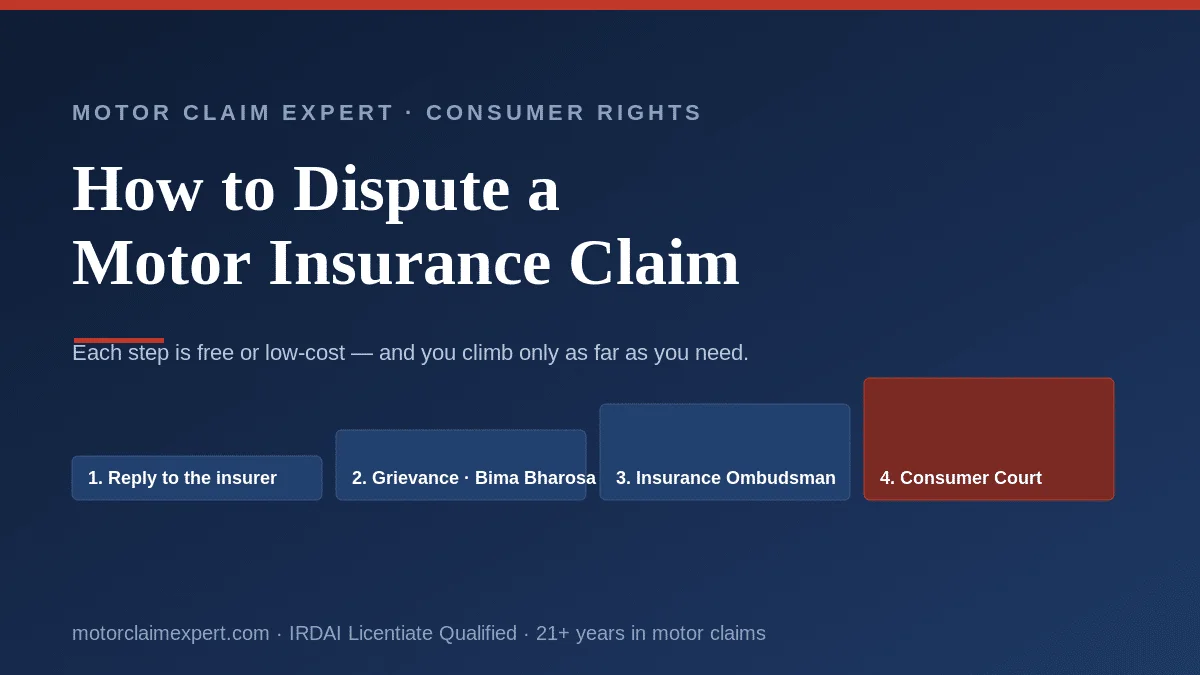
A rejected or short-paid motor claim is not the end of the road — it is the start of a process that Indian regulation deliberately stacks in the policyholder’s favour. Most owners give up at the first “no” because they don’t know the ladder exists. It does, and almost every rung is free. The trick is to climb it in the right order, because skipping a step usually sends you back down.
The escalation ladder at a glance
Before the detail, here is the whole ladder on one screen — what each step is, what it costs, and how long you have. Read it as a map: you rarely need the top rung, but you should always know it is there.
| Step | Where | Cost | Key deadline |
|---|---|---|---|
| 1. Written reply | Your insurer | Free | As soon as you get the repudiation letter |
| 2. Grievance + Bima Bharosa | Insurer grievance cell → IRDAI portal | Free | Escalate if no reply in ~15 days |
| 3. Insurance Ombudsman | Regional Ombudsman office | Free, no lawyer | Within 1 year of the insurer’s final reply |
| 4. Consumer court | District / State / National | Low fee | Within 2 years of the cause of action |
Step 1 — Reply to the repudiation, in writing
Never accept a rejection over the phone, and never argue it only by phone. Insurers act on the written record. Your reply should do three things: quote the exact clause the insurer relied on, state plainly why it does not apply to your facts, and attach the evidence (photos, FIR, estimate, policy copy). This single letter resolves more disputes than owners expect, because it forces the claim back to a human who can see the case has merit.
What to attach to your reply: a copy of the repudiation letter, the relevant policy pages, dated photographs, the FIR or panchnama if any, the repair estimate, and a short timeline of events. Send it by email and keep the delivery proof — it starts the clock for every step above.
Step 2 — The grievance cell and IRDAI Bima Bharosa
If the insurer’s claims team won’t move, escalate inside the company to its grievance redressal officer. If that fails or you get silence, lodge the complaint on IRDAI’s Bima Bharosa portal (the grievance system formerly known as IGMS). This puts your complaint on the regulator’s record and obliges the insurer to respond within a defined window — often enough on its own to unlock a stuck claim.
Insider note: a Bima Bharosa complaint does not decide your case — it pressures the insurer to review it. Treat step 2 as leverage, not judgment. Keep your evidence ready, because if it doesn’t work, the Ombudsman in step 3 will want exactly the same file.
Step 3 — The Insurance Ombudsman
This is the rung that wins most genuine motor disputes. The Insurance Ombudsman is free, needs no lawyer, and its award is binding on the insurer (not on you — you can still go to court if unhappy). It handles motor claims up to ₹50 lakh. You must approach it within one year of the insurer’s final reply, after you have given the insurer a chance to respond. For a straightforward wrongful rejection, this is usually where the story ends in the owner’s favour.
The deadline that costs people their case: the one-year Ombudsman window runs from the insurer’s final reply. Owners who spend months arguing informally, without a written final rejection, sometimes let this clock run out. Get the rejection in writing, then diarise the one-year date.
Step 4 — Consumer court
Consumer courts remain open where the Ombudsman route doesn’t fit — a claim above ₹50 lakh, a demand for damages beyond the claim amount, or dissatisfaction with the Ombudsman’s award. Under the Consumer Protection Act 2019, jurisdiction follows value: the District commission up to ₹50 lakh, the State commission from ₹50 lakh to ₹2 crore, and the National commission above ₹2 crore. It is slower and more formal, but it can award compensation and costs that the Ombudsman cannot.
The middle path — a non-standard settlement
Not every dispute is win-or-lose. Where you have breached a condition but caused the insurer no real prejudice — a modest delay in intimation, a minor documentation lapse — insurers can, and often do, offer a non-standard settlement: a partial payment (commonly around 75% of the admissible amount) instead of an outright rejection. Knowing this exists gives you a realistic fallback to propose when a full fight isn’t worth it.
How far is it worth pushing?
The honest answer is that most genuine motor disputes should never reach a courtroom. The ladder exists precisely so they don’t. Reply in writing, use the regulator’s free machinery, and reserve court for the cases that truly need it. The deep-dive guides below cover each rung — the repudiation reply, Bima Bharosa, the Ombudsman, and the specific rejection reasons — in full.
Frequently Asked Questions — Disputing a Motor Claim
What is the first step to dispute a rejected car insurance claim?
Get the rejection in writing with the exact clause and evidence, then reply point by point — the clause, your facts, your proof. A reasoned written reply resolves many disputes before any formal complaint.
Where do I complain if the insurer ignores my reply?
Escalate to the insurer’s grievance redressal officer, then to IRDAI’s Bima Bharosa (IGMS) portal, which creates an independent record and often prompts a re-examination. Both are free.
Is the Insurance Ombudsman free?
Yes. The Insurance Ombudsman is a free, independent adjudicator for individual policyholders, for disputes up to the prescribed limit, and does not require a lawyer. The insurer must comply with an award within a set time.
When should I go to consumer court?
When the rejection is clearly unjustified and the amount warrants it. A consumer court treats a wrongful rejection as a deficiency in service and can award the claim plus interest, compensation and costs.
Can I get a partial payment instead of a full fight?
Sometimes. Where a breach exists but did not cause or worsen the loss, a non-standard settlement — commonly around 75% — may be the fair outcome. Raise it early.
How do I know if my rejection will be overturned?
Ask whether the breach was fundamental and connected to the loss (likely to stand) or technical and unconnected (frequently overturned). That test, the amount at stake, and your evidence decide how far to push.
Do I need a lawyer to dispute a claim?
Not for the first three rungs — the reply, Bima Bharosa and the Ombudsman are designed for individuals without lawyers. Legal help is optional and mainly relevant at the consumer-court stage.
Sources & official references
- Regulation: the grievance and policyholder-protection framework sits within the IRDAI (Protection of Policyholders’ Interests) framework; complaints are filed via IRDAI Bima Bharosa (IGMS).
- Adjudication: the Insurance Ombudsman operates under the Insurance Ombudsman Rules, 2017 (amended 2021), handling individual complaints up to the prescribed limit.
- Law: a wrongful rejection is a deficiency in service under the Consumer Protection Act, 2019, actionable in the consumer commissions.


