
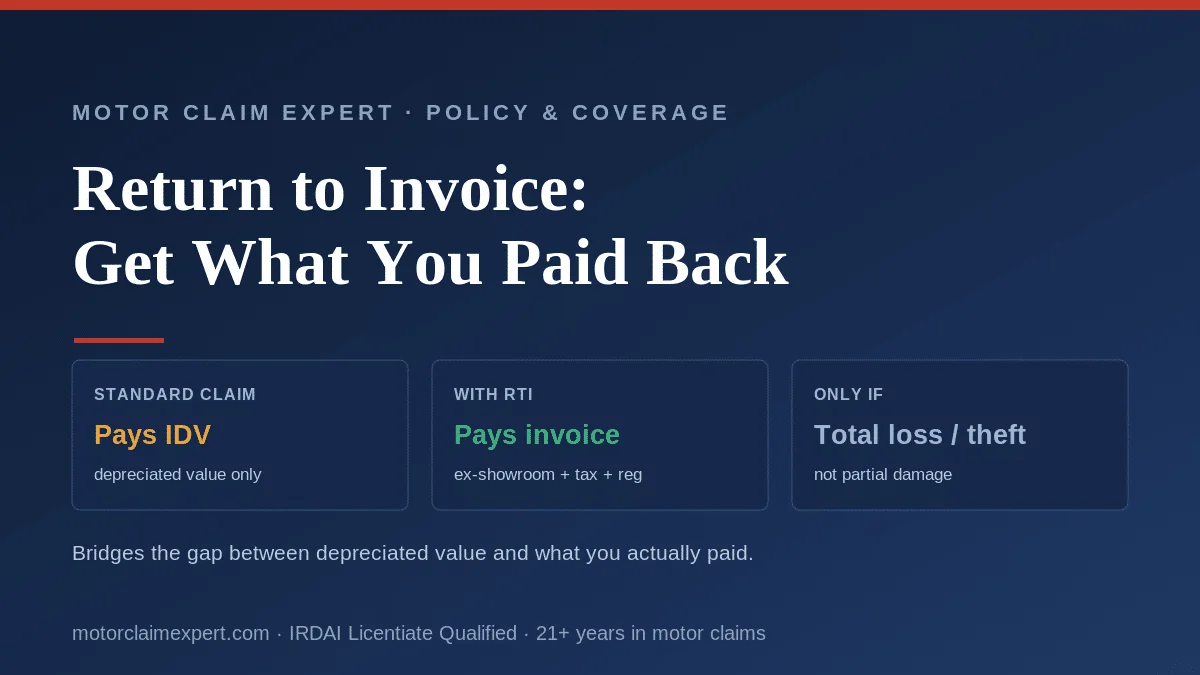
Imagine your six-month-old car is stolen, or written off in a bad crash. You paid, say, Rs 12 lakh on the road. You file the claim, relieved you had comprehensive cover — and the insurer offers you Rs 9.5 lakh. Not because anyone’s cheating you, but because a standard total-loss or theft claim pays the IDV: the car’s depreciated value, not what you spent. That gap — often two to three lakh on a nearly-new car — is exactly what the Return to Invoice add-on exists to close. This guide explains what RTI actually pays, when it does and doesn’t apply, and whether it’s worth the extra premium for your car.
The gap RTI fills: IDV vs what you paid
Every comprehensive policy settles a total loss or theft at the Insured Declared Value — the car’s current market value after depreciation. That’s fair for what the car is worth today, but it’s well below what you paid, because your on-road price included heavy one-time costs that vanish the moment you drive out: GST, registration, road tax and the dealer margin. RTI ignores the depreciated IDV and instead reimburses the original invoice value of the car, closing that gap entirely.
Expert note — why the gap is biggest in year one: a car loses value fastest early on. Depreciation for IDV purposes is steep in the first years, and on top of that, the road tax and registration you paid — often a large sum — are simply gone; a normal claim never returns them. So the difference between “what the IDV pays” and “what it costs to buy the same car again” is at its widest exactly when the car is newest. That is precisely the window RTI is designed for, and precisely why insurers only offer it on newer vehicles — once the car is older, the gap has narrowed and the add-on is no longer sold.
What a normal claim pays vs what RTI pays
| Component | Standard total-loss/theft claim | With RTI add-on |
|---|---|---|
| Car value | Depreciated IDV | Full ex-showroom invoice price |
| Registration charges | Not reimbursed | Reimbursed |
| Road tax | Not reimbursed | Reimbursed |
| Net effect | You bear the gap yourself | You’re put back to your purchase price |
The exact components vary a little by insurer — most cover ex-showroom price, registration and road tax; some also fold in the first year’s insurance cost. Always confirm the precise definition in your policy wording before you rely on it.
When RTI pays — and when it doesn’t
RTI is not a “pay me more on every claim” cover. It triggers in only two situations: your car is a total loss (damaged beyond economical repair, or a constructive total loss) or it’s stolen and not recovered. For a dented bumper, a cracked windshield or any repairable damage, RTI does nothing — those are ordinary own-damage claims settled on repair cost, not invoice value. Two more conditions matter: RTI sits on top of a comprehensive policy (it can’t exist on third-party-only cover), and it’s usually paired with — and works best alongside — a zero-depreciation add-on. Read the age limit too: once your car crosses the insurer’s cut-off (commonly 3 to 5 years), RTI can’t be renewed.
Is RTI worth it for your car?
How to buy it well: add RTI at policy purchase or renewal while your car is still within the eligible age, and pair it with zero-depreciation for the fullest protection — one guards the total-loss/theft value, the other stops depreciation cuts on repair claims. Confirm in writing exactly what the RTI covers (ex-showroom, registration, road tax, and whether first-year insurance is included) and the maximum vehicle age. It typically adds around 10% to the premium — modest against the two-to-three-lakh gap it can cover. For how RTI sits among the other add-ons, see our guide to which car insurance add-ons are worth it.
A worked example
Return to Invoice is one of the few add-ons that can pay for itself many times over in a single event — but only in the specific case it’s built for: a new-ish car that’s stolen or written off. If that’s a loss you couldn’t comfortably absorb, and your car is young enough to qualify, RTI is usually worth the modest premium; if the car is older or easily replaced, the case weakens. Match it to your car’s age and your own finances, pair it with zero-dep, and read the covered-components clause. For the value it’s protecting, start with how IDV works, and for what happens in a write-off with a loan, see total loss with a car loan.
Frequently Asked Questions — Return to Invoice (RTI)
What is the Return to Invoice (RTI) add-on?
RTI is an optional car insurance add-on that pays your car’s full invoice value — ex-showroom price plus registration and road tax — if the car is a total loss or is stolen, instead of the lower depreciated IDV a standard claim pays.
When does RTI pay out?
Only on a total loss (damaged beyond economical repair or a constructive total loss) or theft where the car is not recovered. It does not apply to partial or repairable damage.
What is the difference between IDV and Return to Invoice?
IDV is the car’s depreciated market value, which a standard total-loss or theft claim pays. RTI instead reimburses the original invoice value, closing the gap between the depreciated IDV and what you actually paid.
Does RTI cover registration and road tax?
Yes. RTI typically reimburses the ex-showroom price plus registration charges and road tax; some insurers also include the first year’s insurance cost. The exact components vary, so confirm them in the policy wording.
Is there an age limit for the RTI add-on?
Yes. RTI is generally offered only on newer cars, commonly up to 3 to 5 years depending on the insurer. Once the car crosses that age, the add-on can no longer be renewed.
How much does RTI cost?
It usually adds roughly 10% to the comprehensive premium, though it varies by insurer and car. That is modest against the two-to-three-lakh gap it can cover on a nearly new car.
Is Return to Invoice worth buying?
It is most worthwhile for new or nearly new cars, financed cars, and owners who could not easily absorb the replacement-cost gap. It matters less on older or inexpensive cars where the IDV-to-invoice gap has narrowed.
Sources & references
- IRDAI-regulated insurer motor policy wordings — Return to Invoice add-on scope (ex-showroom price, registration, road tax; total-loss and theft triggers).
- Standard comprehensive policy basis for total-loss / theft settlement at IDV (Insured Declared Value).
- Insurer RTI eligibility terms — vehicle age limits (typically up to 3–5 years) and requirement to hold comprehensive cover.


