
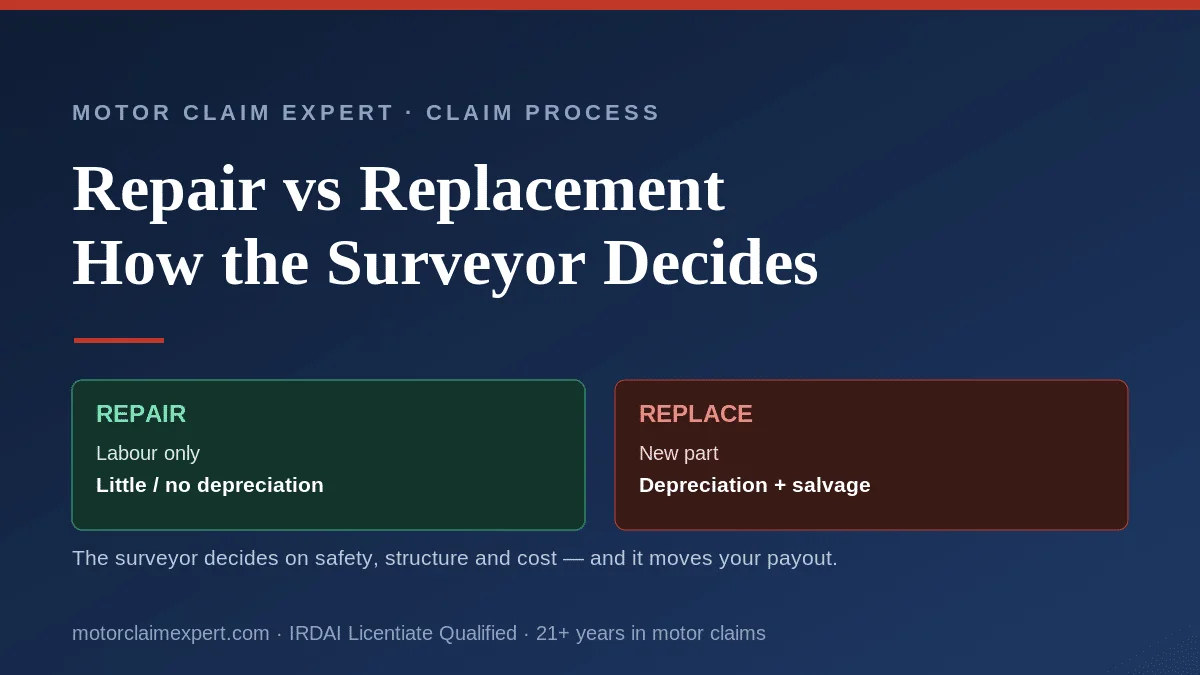
When a surveyor looks at your damaged car, the single most consequential judgement they make is deceptively small: for each damaged part, repair it or replace it? That one call, repeated across a dozen components, quietly decides how much you are paid — often more than the headline estimate does. Understanding how the decision is made, and where you can legitimately influence it, is one of the highest-value things a policyholder can learn.
Why this one decision moves your payout the most
Every replaced part carries three cost layers: the new part’s price, the depreciation the policy deducts from it, and any salvage value of the old part you keep. A repaired part usually carries only labour and materials, and — crucially — depreciation barely touches it. So the repair-versus-replace call isn’t just about how your car ends up; it’s about who absorbs the depreciation. On a plastic bumper worth ₹8,000, replacement can mean a 50% depreciation hit; a skilful repair sidesteps almost all of it. Multiply that across a claim and the difference runs into thousands.
How the surveyor actually decides
A competent surveyor isn’t guessing. They weigh a damaged part against a consistent set of criteria, and the outcome usually falls out of the answers.
| The test | Leans to repair | Leans to replace |
|---|---|---|
| Safety / structural role | Non-structural panel, trim, cosmetic dent | Airbags, crash beams, chassis members, suspension |
| Cost ratio | Repair costs well under a new part | Repair approaches or exceeds a new part |
| Extent of damage | Dent, crack or scuff that can be reshaped/refinished | Shattered, torn, or deformed beyond true |
| Manufacturer norm | Maker permits repair of that component | Maker mandates replacement (many safety parts) |
Repair-friendly vs replace-only parts
Some components are almost always candidates for repair; others must be replaced no matter how good the workshop. Knowing which is which tells you where an argument is worth having and where it isn’t.
| Usually repairable | Usually replace-only |
|---|---|
| Metal panels with dents (doors, fenders, bonnet) | Deployed airbags and seatbelt pretensioners |
| Bumpers with cracks or scuffs (often plastic-weldable) | Cracked glass and shattered lamps |
| Scratched paintwork and minor trim | Bent structural/crash members |
| Small alloy-wheel scuffs (subject to safety) | Radiators/condensers punctured; sensors damaged |
Insider note on depreciation: the reason a surveyor’s “we’ll repair this” is often good news for you is depreciation. Replaced parts are settled at their depreciated value, not new price, unless you hold a zero-depreciation add-on. A repair keeps that deduction off the table. See how the age-wise deductions work in our depreciation grid guide.
Betterment: the “new for old” deduction
When an old, worn part is replaced with a brand-new one, you end up better off than before the accident — and insurers price that in. This is “betterment,” and it is the principle behind depreciation on replaced parts: the policy restores you to your pre-loss position, not to a newer one. It is entirely legitimate; the trap is not knowing it exists and mistaking the deduction for the insurer shortchanging you.
Where owners lose money: demanding replacement of a part the surveyor was willing to repair. You get a shiny new component, but you also inherit its full depreciation and any salvage deduction — frequently a worse net outcome than the repair would have been. Replacement is the right call for safety and structural parts; for cosmetic ones, do the arithmetic first.
When to push for repair — and when replacement is right
How to make your case to the surveyor
Make the outcome you want easy to grant: ask the surveyor directly whether a borderline part can be repaired and what that does to your depreciation. Get the reasoning in writing on the estimate. If a genuinely repairable part is being written up for replacement (raising your depreciation), politely question it. If a safety part is being “repaired” to save cost, refuse — your safety and a future buyer’s trust outweigh the saving. The surveyor’s assessment is not final; it can be supported with a second workshop opinion. See how surveyors assess car damage and, if the number still comes back wrong, what to do when a surveyor reduces your claim.
A worked example
Repair versus replacement is the quiet lever inside every own-damage claim. Let safety and structure decide the parts that matter, run the depreciation arithmetic on the parts that don’t, and make your preferred outcome easy for the surveyor to justify on paper. For the whole claim from intimation to settlement, see the own-damage claim walkthrough.
Frequently Asked Questions — Repair vs Replacement
Is it better to repair or replace a car part in an insurance claim?
For cosmetic or non-structural parts, repair usually leaves more money in your pocket because it avoids depreciation. For safety-critical or structural parts, replacement is essential regardless of cost.
Why does replacing a part reduce my claim payout?
Replaced parts are settled at their depreciated value (the betterment principle), and any salvage value of the old part is deducted. A repair mainly carries labour, so it usually costs you less.
Can I insist on a new part instead of a repair?
You can request it, but on a repairable cosmetic part you inherit its full depreciation and salvage, which is often a worse net outcome. Safety and structural parts should always be replaced.
What is betterment in a motor insurance claim?
Betterment is the principle that replacing an old part with a new one leaves you better off than before the loss, so the insurer deducts depreciation to restore your pre-loss position rather than a newer one.
Which car parts must always be replaced, not repaired?
Deployed airbags and seatbelt pretensioners, cracked glass and shattered lamps, bent structural or crash members, and damaged sensors must be replaced for safety reasons.
Does zero-depreciation change the repair-vs-replace maths?
Yes. With a zero-depreciation add-on, replacement becomes far more attractive because depreciation is waived, so a new part costs you little extra over a repair.
Can I challenge the surveyor’s repair-or-replace decision?
Yes. The surveyor’s assessment is not final. You can support a different view with a second workshop opinion and escalate if a repairable part is wrongly written up for replacement, or vice versa.
Sources & official references
- Insurance Act, 1938 — Section 64UM (survey and loss assessment).
- IRDAI-approved Indian Motor policy wording — depreciation schedule, betterment and part settlement.
- IRDAI (Protection of Policyholders’ Interests) Regulations, 2024 — claim assessment framework.


