
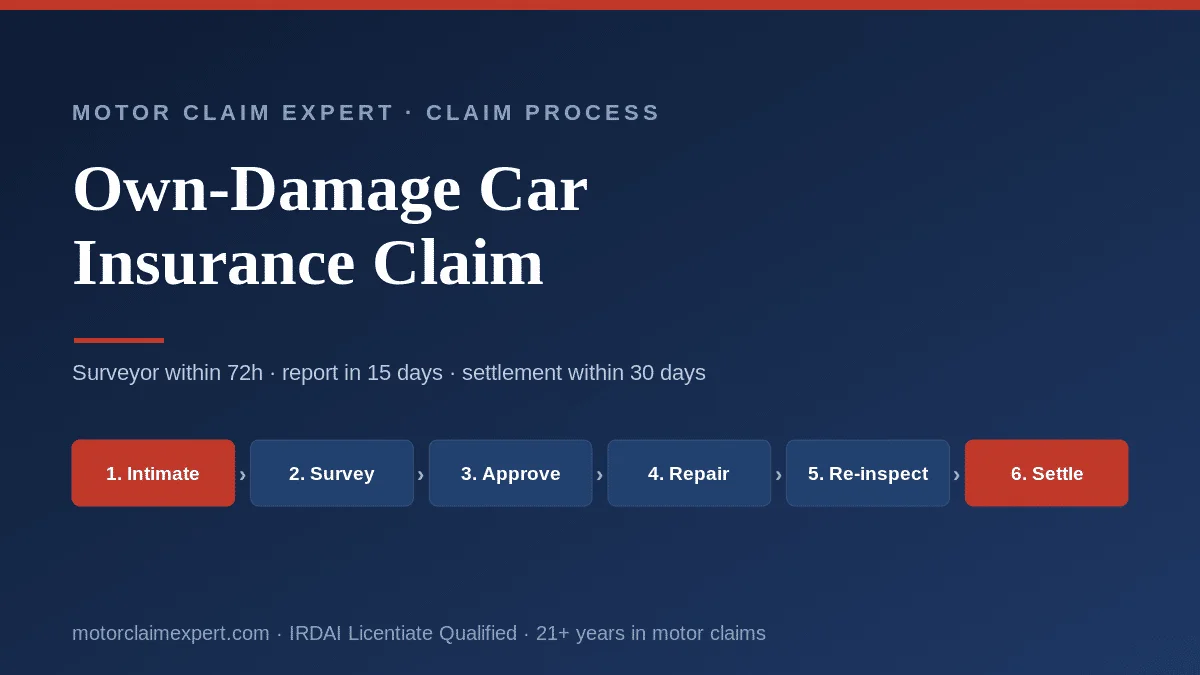
An own-damage claim is the part of your motor policy that pays to repair your car after an accident, fire, flood or theft. It is also the part with the most moving pieces — a surveyor, an estimate, an approval, a repair, a re-inspection, and a settlement — and a claim can quietly lose value at any one of them. This is the complete walkthrough: every stage in order, the regulatory clock that governs each, what the insurer checks, and the mistakes that shrink a payout. Treat it as the operational spine; the deep-dive guides linked throughout cover each step in full.
What an own-damage claim actually is
Your comprehensive motor policy has two engines. Third-party cover pays for injury or damage you cause to others and is mandatory by law. Own-damage (OD) cover pays for damage to your own vehicle — collision, fire, natural calamity, riot, theft. This guide is about the OD engine: how you turn “my car is damaged” into “the insurer has paid.” If you also need the broader picture — car versus bike, third-party claims, and the common rejection traps — start with our motor insurance claim process overview, then come back here for the OD detail.
The own-damage claim lifecycle, in one view
Every OD claim, from a scratched bumper to a written-off car, moves through the same six stages. Knowing the whole map before you start means you never miss the deadline that matters or hand the insurer a reason to cut the claim.
| Stage | What happens | The clock |
|---|---|---|
| 1. Intimate | Report the loss, get a claim number | Immediately — the same day |
| 2. Survey | Surveyor inspects and assesses damage | Appointed within 72 hours |
| 3. Approve | Estimate agreed; cashless or reimbursement chosen | Report due within 15 days |
| 4. Repair | Garage carries out approved work | Varies by damage |
| 5. Re-inspect | Insurer verifies repairs were actually done | Before release / payment |
| 6. Settle | Insurer pays garage (cashless) or you (reimbursement) | Within 30 days of report |
Stage 1 — Intimate the claim (the clock starts here)
Report the loss to your insurer the same day, before you move the car more than safety requires and long before any repair. Note the claim number — everything downstream hangs off it. For theft, a fire, or any third-party involvement, also file an FIR. Photograph the damage on the spot from several angles with the number plate visible; those images are your defence if the surveyor’s view and the garage estimate later diverge.
The mistake that ends claims before they start: delayed intimation. Insurers routinely contest claims reported days later, arguing they lost the chance to inspect the fresh loss. A genuine claim shouldn’t fail on a technical delay — courts have said as much — but you avoid the entire fight by intimating immediately. See late intimation and your rights.
Have your paperwork ready from the outset: policy copy, RC, driving licence, and — once the claim opens — the claim form. Our documents checklist and how to fill the claim form cover exactly what to submit and how.
Stage 2 — The surveyor (where the claim’s value is really set)
For any loss above ₹50,000 the insurer must appoint a licensed surveyor, and under the IRDAI Protection of Policyholders’ Interests Regulations, 2024 that appointment must happen within 72 hours of intimation. The surveyor’s job is to separate accident damage from pre-existing wear, decide what is repairable versus replaceable, and put a number on the loss. That number, more than anything else, determines what you are paid.
Insider note: the surveyor is required to submit the report within 15 days. If the surveyor drags beyond that, IRDAI’s 2024 rules entitle you to ₹500 per day of delay. And the surveyor’s report is not the final word — under the Insurance Act it can be challenged with evidence. If yours comes back low, our guide on a surveyor reducing your claim shows how to dispute it. Understand what the surveyor actually checks in how surveyors assess car damage.
Never start repairs before the survey. Work carried out before the surveyor has seen the damage — or before written approval — is the single commonest reason an OD claim is cut or refused. The surveyor cannot verify what they never saw. Wait for the go-ahead, even if the garage offers to “start now.”
Stage 3 — Estimate, approval, and the cashless-vs-reimbursement choice
The garage prepares a repair estimate; the surveyor reconciles it against what the policy will pay. Once the estimate is approved, you choose how the claim is paid. This choice is best made before repairs begin, because it changes what you pay out of pocket and where.
The full trade-off, including where reimbursement claims go wrong, is in cashless vs reimbursement.
Stage 4 — Repair, and Stage 5 — Re-inspection
With the estimate approved, the garage carries out the work. When it is done, the insurer almost always requires a re-inspection — a check that the parts billed were actually replaced and the approved work was actually performed. This is a fraud-control step, and it is where reimbursement claims most often stall: no re-inspection, no payment. Keep the vehicle available, keep the replaced parts if asked, and don’t collect the car and vanish before the insurer has re-inspected it.
Keep the claim moving: ask the garage to notify the insurer the moment repairs are complete, and confirm the re-inspection is booked. On a reimbursement claim, submit the final bill, payment proof and the satisfaction/discharge voucher promptly — the 30-day settlement clock runs on the complete file, not a half-submitted one.
The deductions: why the cheque is smaller than the bill
Three standard deductions sit between the repair bill and your settlement. None of them is a trick — they are how motor OD cover is designed — but knowing them in advance prevents the nasty surprise at the end.
| Deduction | How it works |
|---|---|
| Compulsory deductible | A fixed excess you always bear — typically ₹1,000 for cars up to 1500cc and ₹2,000 above 1500cc |
| Depreciation on parts | Plastic/rubber depreciate steeply (up to 50%); metal parts on an age grid; paint material at 50% — unless you hold zero-depreciation |
| Salvage | If you keep replaced parts or a wreck, their value is deducted |
Depreciation is usually the biggest bite. The age-wise grid is set out in our depreciation grid guide, and how a zero-depreciation add-on removes most of it is worth understanding before renewal, not after a claim.
Stage 6 — Settlement, and your rights if it drags
Once the survey report is in and your file is complete, the insurer must settle or reject within 30 days. On a cashless claim the insurer pays the garage the approved amount and you clear your deductible, depreciation and non-payables. On reimbursement, the approved sum lands in your account.
If the insurer sits on it: the 30-day clock is a right, not a courtesy. Where an insurer delays a payable claim, IRDAI rules provide for interest on the delayed amount, and you can escalate through the insurer’s grievance cell to Bima Bharosa, the Insurance Ombudsman, or the full dispute ladder. Silence is not a valid answer.
A worked example, end to end
The mistakes that quietly shrink an OD claim
Run the claim by the map above and it becomes a process, not a gamble: intimate at once, let the surveyor see the fresh damage, get written approval before a spanner turns, keep the file complete through re-inspection, and hold the insurer to the 30-day clock. If the loss is severe enough that repair costs approach the car’s value, you may be looking at a write-off instead — read total loss and the 75% rule and how your IDV is set.
Frequently Asked Questions — Own-Damage Car Insurance Claims
How do I file an own-damage car insurance claim?
Intimate the loss to your insurer immediately and note the claim number. Let the surveyor inspect the damage before any repair, get the estimate approved, choose cashless or reimbursement, complete the re-inspection, and receive settlement within 30 days of the survey report.
How long does an own-damage car insurance claim take?
Under IRDAI’s Protection of Policyholders’ Interests Regulations 2024, the surveyor is appointed within 72 hours of intimation, the survey report is due within 15 days, and the insurer must settle or reject within 30 days of that report.
Can I start repairs before the surveyor visits?
No. Repairs done before the survey or before written approval are the commonest reason an own-damage claim is cut or refused, because the surveyor cannot verify damage they never inspected.
Why is my claim payout less than the repair bill?
Three standard deductions apply: the compulsory excess (typically Rs 1,000 up to 1500cc and Rs 2,000 above), depreciation on replaced parts, and salvage if you keep the wreck or old parts. A zero-depreciation add-on removes most of the depreciation.
What is the compulsory deductible on a car own-damage claim?
It is a fixed excess you always bear on every claim, typically Rs 1,000 for cars up to 1500cc and Rs 2,000 for cars above 1500cc.
What can I do if the insurer delays my claim beyond 30 days?
Escalate through the insurer’s grievance cell to IRDAI’s Bima Bharosa portal, then the Insurance Ombudsman or consumer court. IRDAI rules provide for interest on unjustifiably delayed claim payments.
Should I choose cashless or reimbursement?
Cashless at a network garage is simplest and needs the least cash upfront, as the insurer pays the garage directly. Reimbursement gives workshop freedom but you pay the full bill first and claim it back.
Sources & official references
- IRDAI (Protection of Policyholders’ Interests) Regulations, 2024 — claim turnaround times, surveyor appointment and settlement.
- Insurance Act, 1938 — Section 64UM (survey and loss assessment).
- IRDAI-approved Indian Motor policy wording — own-damage cover, deductibles and depreciation.


