
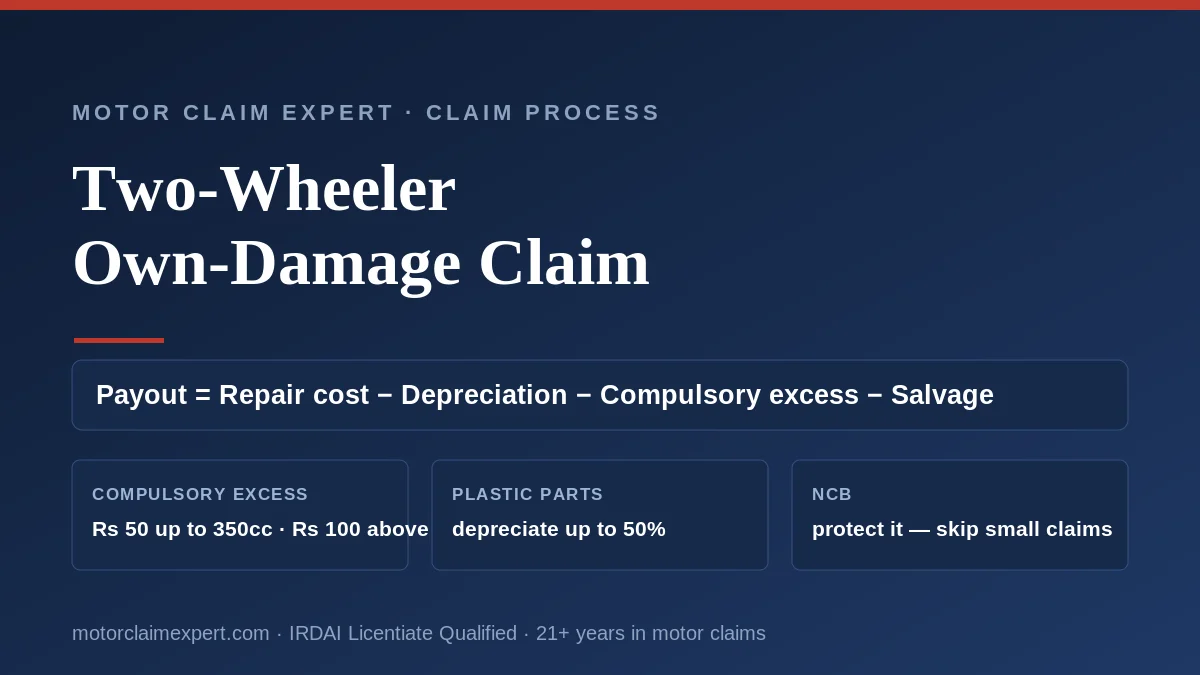
A two-wheeler own-damage claim looks simple — bike damaged, insurer pays. In practice the economics are unforgiving, because a scooter or motorcycle is a low-value asset with high-value plastic. Two forces decide whether a claim is worth making at all: a compulsory deductible you always pay, and steep depreciation on exactly the parts that break first. Understand those, and you’ll know when to claim, when to pay cash, and how to protect the money you’d otherwise leave on the table.
First decide: is the claim even worth it?
This is the question most riders skip, and it costs them. On a two-wheeler the sums are small enough that the deductible, the depreciation, and the lost No-Claim Bonus (NCB) can together exceed what the insurer actually pays you. Before you file, run the claim through a simple test.
The small-claim trap: claiming ₹3,000 for a cracked fairing can wipe out an NCB that would have saved you far more over the next two renewals — and you still pay the deductible and absorb depreciation. On a bike, a small claim is often the most expensive way to save a little money.
The claim process, step by step
Once you’ve decided a claim is worth it, the process is the same as for a car, only faster. Intimate the insurer immediately — before repairs — and note the claim number. Don’t start work until the surveyor has seen the damage or you have written approval; repairs done first are the commonest reason a bike claim is cut. For theft or third-party involvement, file an FIR. Then choose cashless at a network garage or reimbursement elsewhere, and keep every bill.
Do this before anything is repaired: photograph the damage from several angles, on the spot, with the number plate visible. Those images are your evidence if the surveyor’s assessment and the garage estimate later diverge — and on a two-wheeler, they often do.
What gets deducted on a two-wheeler claim
The gap between the repair bill and the cheque comes from three deductions. This is where most of the disappointment lives, so it pays to see it laid out before you claim:
| Deduction | How it works | Who it hits hardest |
|---|---|---|
| Compulsory excess | Fixed: ₹50 up to 350cc, ₹100 above — you pay it on every claim | Small claims (it’s a bigger share of them) |
| Depreciation on parts | Plastic/fibre/rubber depreciate fast — up to 50%; metal parts on an age grid | Fairings, panels, mirrors, indicators |
| Salvage | Value of replaced parts you keep is deducted | Larger part replacements |
This is why a two-wheeler is the vehicle on which a zero-depreciation add-on earns its keep — plastic is most of what breaks, and plastic is what depreciation punishes most.
How a surveyor assesses a two-wheeler in practice
A surveyor’s job is to separate accident damage from pre-existing wear, and to decide whether each part is repairable or must be replaced. On a bike this matters more than on a car, because a scuffed plastic panel can often be refinished rather than replaced — and a “repair” attracts far less depreciation than a “replacement.” A good rider works with this, not against it.
Insider note: if a panel can be repaired and repainted, the depreciation bite is small; if it’s replaced, you lose up to half its value to depreciation. Where a part is borderline, it’s worth asking the surveyor whether a repair is acceptable — it can leave more money in your pocket than a shiny new panel does.
Is zero depreciation worth it on a two-wheeler?
For a bike in its first few years, usually yes. Because depreciation falls hardest on the plastic parts that break most often, a zero-depreciation add-on can turn a disappointing settlement into a near-full one. The math flips as the bike ages and its value drops — past four or five years, the add-on premium may outweigh what it saves. Match the add-on to the bike’s value, not to habit.
Ride the claim, don’t let it ride you: know your deductible, respect depreciation, guard your NCB, and photograph everything before a spanner touches the bike. The guides below go deeper on the deductions, the surveyor’s assessment, and when a two-wheeler tips into total loss.
Frequently Asked Questions — Two-Wheeler Own-Damage Claims
Should I claim for minor two-wheeler damage?
Often not. Small repairs can cost less than the No-Claim Bonus you forfeit plus the depreciation and deductible. Self-fund trivial knocks to keep your bonus; claim for large damage, replaced panel sets, or engine/frame damage.
What is the compulsory deductible on a two-wheeler?
IRDAI fixes it at ₹50 for two-wheelers up to 350cc and ₹100 for those above 350cc. It applies to every own-damage claim and cannot be waived.
Why is depreciation so high on a bike claim?
Because a two-wheeler’s body is mostly plastic — fairings, panels, mudguards — and plastic parts are cut a flat 50% for depreciation regardless of age. That is why zero depreciation is valuable on a newer bike.
Do I need an FIR for a two-wheeler claim?
For theft, a third-party injury, or a major accident, yes. A minor solo scrape with no third party usually does not need one — the claim proceeds on intimation and the surveyor’s inspection.
When is a two-wheeler treated as a total loss?
When the repair estimate approaches the bike’s Insured Declared Value, the insurer settles it as a write-off at IDV rather than repairing it. Because a bike’s IDV is low, even a moderate accident can reach that point on an older model.
Is zero depreciation worth it on a two-wheeler?
For a newer bike, usually yes, because the plastic-heavy body carries a flat 50% depreciation that the add-on removes. On an older, low-value bike the benefit shrinks. Weigh the add-on’s cost against one likely panel repair.
Can I claim at any garage?
Cashless settlement is available at your insurer’s network garages; elsewhere you claim on a reimbursement basis. In both cases let the surveyor inspect the bike before repairs begin.
Sources & official references
- Tariff: the compulsory deductible for two-wheelers (₹50 up to 350cc, ₹100 above) and the parts-depreciation schedule originate in the India Motor Tariff and carry into today’s IRDAI-approved two-wheeler policy wordings.
- Policy wording: depreciation on parts, consumables exclusion, and total-loss settlement at IDV are set by your insurer’s IRDAI-approved policy wording.


