
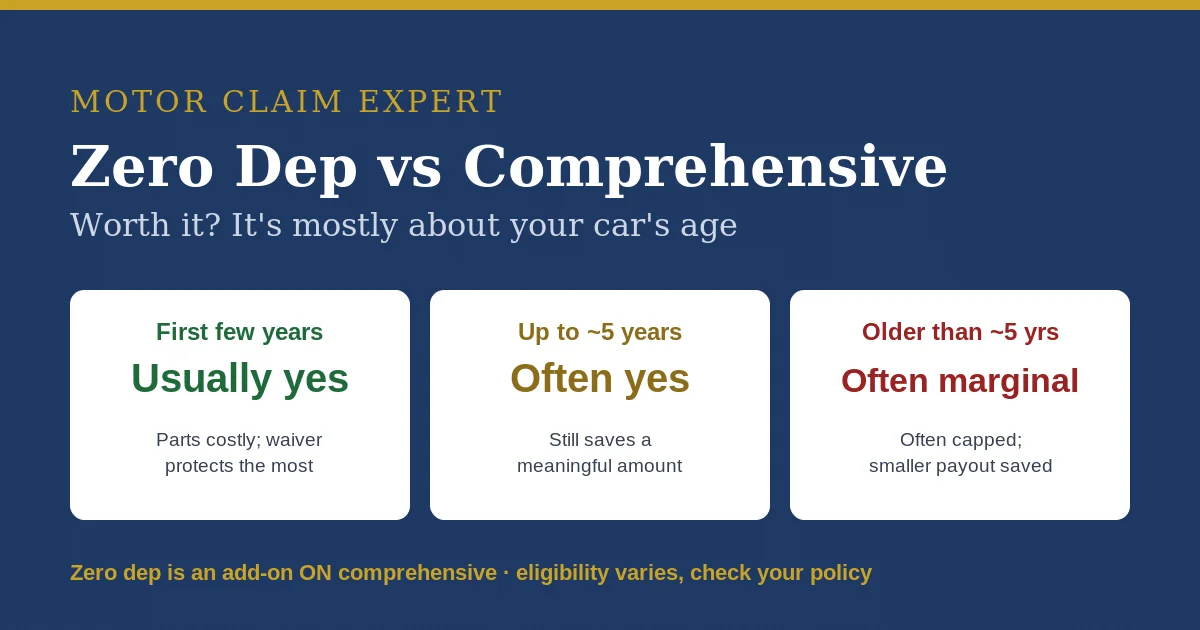
Zero depreciation is not an alternative to comprehensive cover — it is an add-on that rides on top of it. So the real question is never “zero dep or comprehensive”; it is whether the extra premium on your comprehensive policy earns its keep. The honest answer turns on two things most guides mention only one of: your car’s age, and how much of your car is plastic and painted panelling rather than bare metal. This page is the decision framework — with a worked repair example and a 60-second checklist. For the separate question of what is still deducted even after you buy zero dep, see our guide to what a zero-dep claim still deducts.
Zero dep vs comprehensive isn’t really a “versus”
Comprehensive is the base package: it pays for damage to your own car (own damage) and covers your legal liability to others (third party) — see how the three coverage levels compare. Zero depreciation is a single add-on you attach to the own-damage part of that package. You cannot buy zero dep on its own, and you cannot bolt it onto a third-party-only policy. In other words, every zero-dep policy is a comprehensive policy — plus one waiver. So the choice you are actually making is “comprehensive” versus “comprehensive + zero dep.”
What does the base already do, and where does it fall short? A comprehensive policy pays to repair your car, but when it replaces a part it applies depreciation — it pays for the aged value of the old part, not a brand-new one. That depreciation is the exact gap zero dep closes. To decide whether the add-on is worth it, you need to know how large that gap really is for your car.
What zero dep removes — and why plastic changes everything
Depreciation on replaced parts follows a standard schedule that has carried over from the India Motor Tariff into today’s policy wordings. It is not a single percentage — it depends on what the part is made of, and only some of it depends on the car’s age:
| Part type | Depreciation applied on the replacement |
|---|---|
| Glass | Nil |
| Metal parts (age-based) | 6 months–1 yr: 5% · 1–2 yrs: 10% · 2–3 yrs: 15% · 3–4 yrs: 25% · 4–5 yrs: 35% |
| Rubber, nylon, plastic parts; tyres & tubes; batteries | 50% — flat, at any age |
| Fibreglass components | 30% — flat |
| Paint (material portion) | 50% on the material cost (material treated as ~25% of a consolidated paint bill) |
Here is the point almost every “zero dep is only for new cars” article misses. The metal-parts column is indeed small when the car is young — 5% at a year old. But look at the plastic row: a flat 50% from day one, and it never falls with age. A modern car’s front and rear bumpers, many outer panels, lamp housings, grilles and trims are plastic, and their painted surfaces attract the paint depreciation on top. So even on a one-year-old car, a smashed plastic bumper loses half its part value the moment the insurer applies depreciation. The “just look at the age” heuristic captures the metal side of the story and misses the plastic side — which, on most modern hatchbacks and SUVs, is the larger side.
A worked example: what zero dep saves on a ₹40,000 repair
Take a routine front-end knock — the kind that happens in city traffic — with a repair estimate of about ₹40,000: a plastic front bumper (part ₹14,000), a metal fender/bonnet edge (part ₹10,000), a plastic headlamp assembly (₹8,000), paint material (₹4,000) and labour (₹4,000). Labour is never depreciated. Here is what you pay out of pocket, with and without zero dep, at two different car ages:
| Deduction | 1-yr car, no zero dep | 4-yr car, no zero dep | With zero dep (either age) |
|---|---|---|---|
| Plastic bumper depreciation (50%) | −₹7,000 | −₹7,000 | waived |
| Plastic headlamp depreciation (50%) | −₹4,000 | −₹4,000 | waived |
| Metal parts depreciation | −₹500 (5%) | −₹2,500 (25%) | waived |
| Paint material depreciation (50%) | −₹2,000 | −₹2,000 | waived |
| Compulsory deductible | −₹1,000 | −₹1,000 | −₹1,000 |
| You pay out of pocket | ≈ ₹14,500 | ≈ ₹16,500 | ≈ ₹1,000 |
On this single ₹40,000 repair, zero dep saves roughly ₹13,500 on a one-year-old car and ₹15,500 on a four-year-old car. Notice how little the saving grows with age: about ₹13,000 of it is plastic and paint depreciation that does not shrink over time. The compulsory ₹1,000 deductible is yours to bear either way — zero dep never waives it. If your zero-dep add-on costs, say, a 15–20% uplift on the own-damage premium (often a few thousand rupees), a single bumper-and-lamp claim more than repays a year — sometimes several years — of that extra premium.
The real decision: four factors, weighted
- Age — but read it alongside your car’s parts. Age tells you how much the metal waiver is worth (it climbs from 5% to 35% over five years). Your car’s construction tells you how much the plastic and paint waiver is worth — and that is a flat 50% regardless of age.
- How expensive your parts are. Premium or European models, LED lamp assemblies, sensor-laden bumpers and large painted panels all have more value to waive, which strengthens the case well into the mid years.
- How and where you drive. Dense city traffic, tight parking and frequent minor knocks mean more small repair claims — exactly where the depreciation waiver keeps repaying itself. A car that mostly sits in a garage has less to gain.
- The premium uplift versus your appetite to self-fund. If the uplift is small next to what one bumper-and-panel repair would cost you out of pocket, it usually pays. Weigh it against any voluntary deductible you carry (which offsets part of the benefit) and against protecting your no-claim bonus by not claiming for trivial dents.
Eligibility and the caps that catch people out
- Age window. Zero dep is generally offered up to about five years of age; some insurers now extend it to around seven years, often after a vehicle inspection. Beyond that, options narrow and the add-on may not be available at all.
- Claim-count caps. This varies by insurer. Some policies allow unlimited zero-dep claims; others cap them at around two a year. If you expect only one claim it rarely bites, but read the wording so you are not surprised.
- Still yours to pay. Zero dep does not waive the compulsory deductible (commonly ₹1,000 for cars up to 1500cc, more above), consumables such as oils and coolant (unless you buy a separate consumables add-on), or any voluntary deductible you have opted into.
Who it’s usually worth it for — and who can skip it
Usually worth it: owners of new and near-new cars; owners of plastic-panelled or premium, expensive-to-repair models (which is most modern cars); city drivers exposed to frequent minor damage; and anyone who would rather not fund part of every repair themselves.
Often skippable: owners of older cars past the eligibility window; low-value cars where the rupee value of the depreciation saved is small; low-usage cars kept mostly off the road; and owners comfortable self-funding minor dents to keep the premium down and protect their no-claim advantage by not claiming for trivial damage.
A 60-second zero-dep decision checklist
Lean towards buying it if you can tick most of these:
- Your car is newer than about five years (or your insurer still offers the add-on).
- Its bumpers, panels and lamp housings are plastic and painted — true of most modern cars.
- You drive mainly in city traffic or park on the street.
- Parts for your model are mid-to-high priced.
- The premium uplift is small next to one likely bumper-and-panel repair.
Lean towards skipping it if the car is past the eligibility window or low in value, it mostly sits in a garage and rarely takes knocks, or you would rather self-fund small dents and protect your NCB by not claiming.
What zero dep does not change either way
Whichever way you decide, keep the limits in mind so the cover is not oversold to you. Zero dep does not raise a total-loss or theft payout — those are settled at the car’s Insured Declared Value, not at “no depreciation.” It does not cover engine damage from water ingress, which needs a separate Engine Protection add-on. And it does not remove the compulsory deductible or consumables. Bought for what it actually does — removing the biggest deduction on repairs — it is a strong buy for the right car.
Frequently Asked Questions — Zero Dep vs Comprehensive
Is zero depreciation better than comprehensive insurance?
They are not alternatives. Comprehensive is the base policy; zero depreciation is an add-on you buy on top of it. So the real choice is comprehensive alone versus comprehensive with the zero-dep add-on. For a newer car the add-on is usually worth the extra premium; for an older car it often is not.
At what car age does zero dep stop being worth it?
There is no fixed cut-off, but many insurers cap zero-dep eligibility around five years, and its value falls as the car ages because the payout it protects shrinks. As a rough guide it is strongest in the first few years and increasingly marginal after that. Confirm the exact age limit with your insurer.
How much more does zero dep cost?
It raises the own-damage premium, and the exact uplift depends on the car’s make, model, age and your insurer, so there is no single figure. The practical test is whether that uplift is small compared with what you would otherwise pay out of pocket on one typical parts-and-paint repair.
Is zero dep worth it for an old car?
Often not. Past the usual eligibility window many insurers no longer offer it, and where they do, the depreciation it waives on an older, lower-value car is smaller — so the extra premium is harder to justify. It tends to make more sense to keep the premium down on an older car.
Does zero dep increase my claim payout on a total loss?
No. Total-loss and theft claims are settled at the car’s Insured Declared Value, its depreciated market value, regardless of whether you have zero dep. The add-on only reduces deductions on repair claims.
Is zero dep worth it if I rarely claim?
It depends on the size of a potential claim, not the frequency. Even a single accident repair with expensive plastic parts can cost far more in depreciation than the add-on’s premium. But if your car is older or low-value, or you are willing to self-fund minor damage, skipping it can be reasonable.
Can I add zero dep at renewal later?
Usually yes, subject to the insurer’s age eligibility at that time. Because eligibility often ends around five years, waiting can mean the option is no longer available — so if you want it, it is generally better to have it while the car is newer.
Sources & official references
- Tariff / standard schedule: the depreciation schedule for replaced parts — metal parts by age, a flat 50% on rubber/plastic parts, tyres and batteries, 30% on fibreglass and nil on glass — originates in the India Motor Tariff, 2002 and carries into today’s IRDAI-approved motor policy wordings.
- Policy wording: depreciation on parts, the compulsory deductible and the settlement of a total loss at IDV are set by your insurer’s IRDAI-approved motor policy wording.
- Product note: zero depreciation is an optional add-on; its eligibility age, claim-count caps and premium loading are set by each insurer’s IRDAI-filed product and vary between insurers.
Related guides
- Zero-Depreciation Claim: What’s Still Deducted (and Why You Get Less Than the Bill)
- Car Insurance Add-ons Worth Paying For (and Which to Skip)
- How Your Claim Amount Is Calculated: The Depreciation Grid
- Every Deduction on Your Car Insurance Repair Bill, Explained
- IDV Explained: How It’s Calculated and Why Higher Isn’t Always Better


